Single Line Reefing Setups

monkfish24

Well-Known Member
Joined
24 Apr 2003
Messages
1,597
Location
Cornwall
Visit site
I am converting my boat over to single line reefing in preperation for her to be more easily handled on my own.

Having had a browse around, it seems there are a few mentions of balance blocks inside the boom, not something I had thought about before.

Has anyone started off without the balance blocks and then moved over? Was it worth the hassle?

Picture shamelessly ripped off from vyv_cox's website.
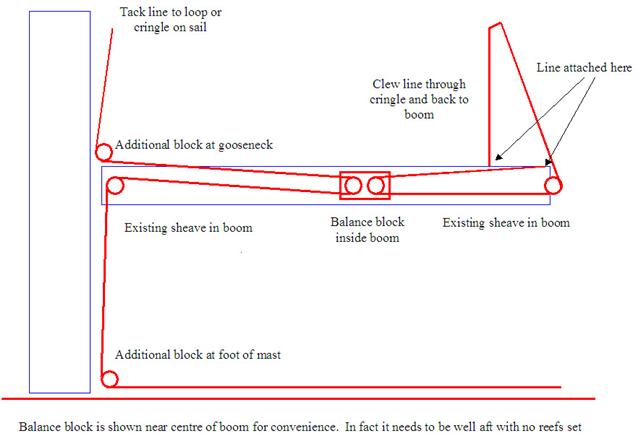
single-line.jpg
 
Last edited:
Has anyone started off without the balance blocks and then moved over? Was it worth the hassle?

A "single line" reef generally has three ends - one attached to the tack, one passed through the clew and attached to the boom, and one that you pull on. If you don't have the blocks or some similar arrangement, then you only have two ends - how were you proposing to lead the line in that case?

(Not saying it can't be done, just inviting you to consider the options in more detail.)

Pete
 
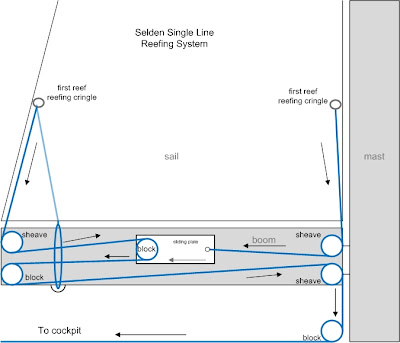
Also, I've just noticed that the drawing doesn't show the normal setup as used by the major boatbuilders. This is the conventional (Selden) system used by most:

SSRS.jpg


Pete
 
A "single line" reef generally has three ends - one attached to the tack, one passed through the clew and attached to the boom, and one that you pull on. If you don't have the blocks or some similar arrangement, then you only have two ends - how were you proposing to lead the line in that case?

(Not saying it can't be done, just inviting you to consider the options in more detail.)

Pete

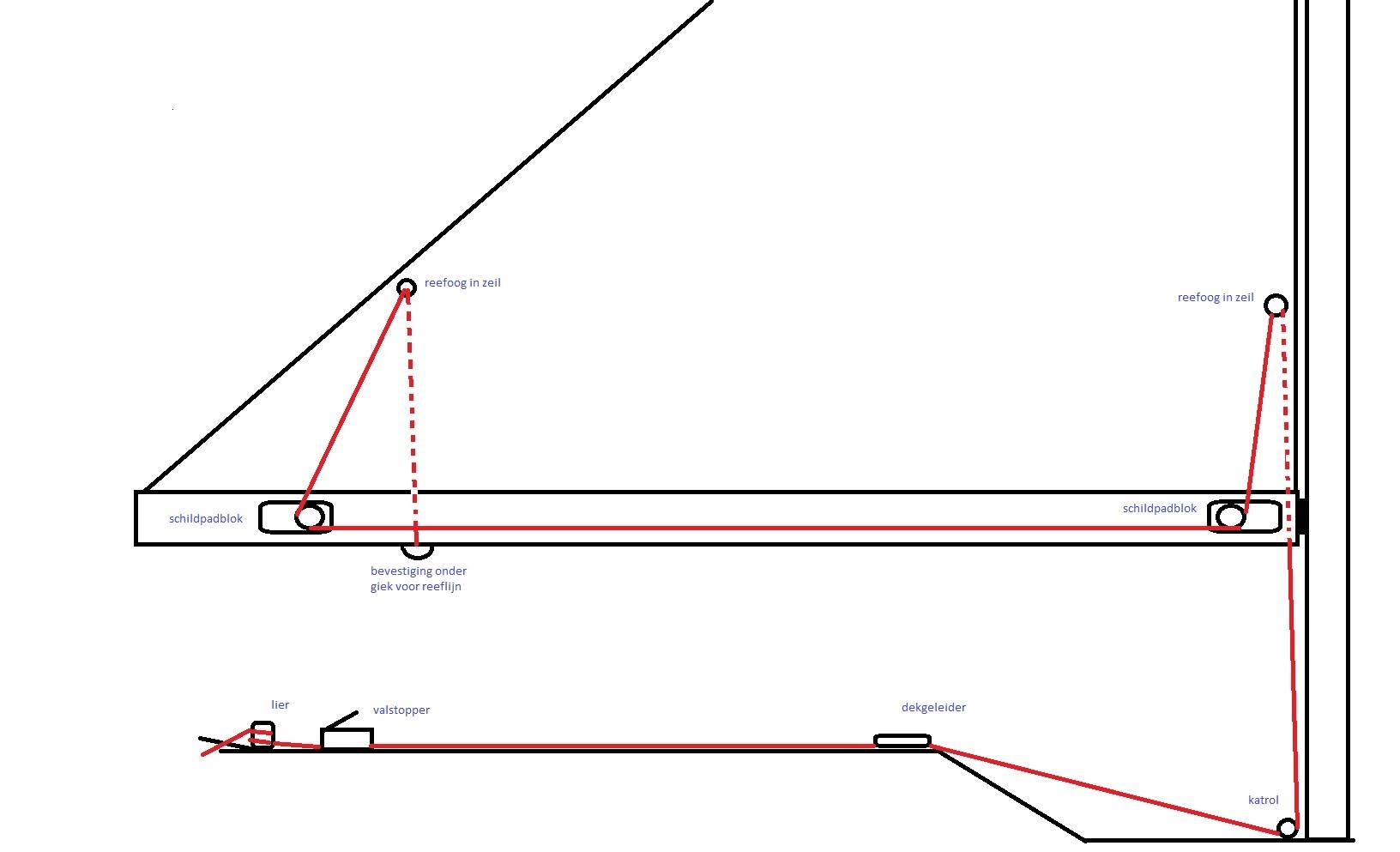
I have a single line reefing without a balance block.

One end is attached to the outer end of the boom
Up to a block at the reef clew
Down to a fixed block on the boom
Along the boom to a fixed block at the tack
Upto a block at the reef tack
Down to a block at the bottom of the mast.
Then back to the cockpit.

I cannot have a balance block inside my boom

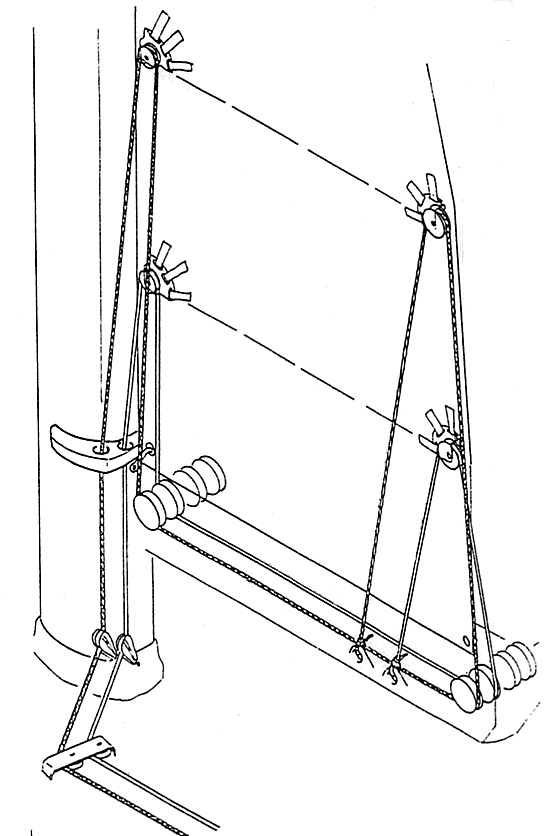
Liks this

9726764.jpg


cslr-150dpi.gif
 
Last edited by a moderator:
The way RogerShaw has explained is what I was going to set it up as. I am having friction rings fitted at the leech and luff at the moment.
 
Along the boom to a fixed block at the tack
Upto a block at the reef tack
Down to a block at the bottom of the mast.

It's interesting that your third tack block is at the bottom of the mast rather than in the vicinity of the gooseneck - presumably this gives a better lead without the three blocks jamming together when the tack is down? This is the part I'd be concerned about with a genuinely single line - once the tack is down, assuming a block somewhere around the gooseneck instead of at deck level, you're having to pull the line through three stationary blocks (or two blocks and a cringle in the sail) all wedged together in somewhat higgeldy-piggeldy fashion depending on how the sail came down, which must add quite a bit of friction to your efforts to pull the clew down. Block at deck level removes some of that potential for jamming :encouragement:

Pete
 
It's interesting that your third tack block is at the bottom of the mast rather than in the vicinity of the gooseneck - presumably this gives a better lead without the three blocks jamming together when the tack is down? This is the part I'd be concerned about with a genuinely single line - once the tack is down, assuming a block somewhere around the gooseneck instead of at deck level, you're having to pull the line through three stationary blocks (or two blocks and a cringle in the sail) all wedged together in somewhat higgeldy-piggeldy fashion depending on how the sail came down, which must add quite a bit of friction to your efforts to pull the clew down. Block at deck level removes some of that potential for jamming :encouragement:

Pete

Yes, in a word...

I've sailed a lot of miles with the same setup as Rogershaw and it works absolutely fine from a cruising point of view. If you're moving over from a conventional slab reefing system, then the biggest bit of advice is the first time you reef spend some time working out where the halyard should be for the tack to be in the right place for each reef (this is fiddly) and then mark your halyard. This makes reefing a doddle as you just drop the Halyard to the mark then wind in on the reefing pennant safe in the knowledge that it will be in the right place.
 
Yes, in a word...

I've sailed a lot of miles with the same setup as Rogershaw and it works absolutely fine from a cruising point of view. If you're moving over from a conventional slab reefing system, then the biggest bit of advice is the first time you reef spend some time working out where the halyard should be for the tack to be in the right place for each reef (this is fiddly) and then mark your halyard. This makes reefing a doddle as you just drop the Halyard to the mark then wind in on the reefing pennant safe in the knowledge that it will be in the right place.

Good idea! I like that, I can do different marks for different reefs.
 
Another tip to go with the halyard marking, if single line isn't a goer for R3, as it often isn't due to insufficient boom length for boom car systems and excessive clutter on external block systems, run a line from cockpit to gooseneck terminated with a snap shackle. Put on the appropriate cringle for the forecast when setting out, it gives you a cockpit adjustable cunningham when it's full main weather and a third reef you can take in and shake out without leaving the cockpit when it's breezy.
 
I have a similar arrangement to RogerShaw on my 24 footer. I started off with just running the lines through the cringles, but found there was too much friction. Adding some decent ball bearing blocks made all the difference. I can now put the nose to windward, tighten the topping lift, ease the halyard to the mark for the reef I want, pull in the relevant reefing line, tighten the halyard and release the topping lift in less time than it takes for the bow to blow off, which isn't long on a Snapdragon 24. All from the cockpit, so I don't scare the Admiral
 
If you have full length battens then instead of marking the halyard put some tape on the mast where the batten car stops above the reef. You could put a piece of spinnaker sail tape on the sail or a couple of the luff sliders if no batten car. You just line up the mark on the mast & the sail. This is easy to see & has the benefit that the distance from car to gooseneck is only 3 or feet. This means that there is little stretch. If you mark the halyard the distance from the clutch where you have the mark to the gooseneck might be 20+ metres & even with dynema halyard (plus a length of set sail) there will be an amount of stretch. This results in differing set each time.

When reefing, do not let all the halyard off at once. Let the clutch off but leave a couple of turns round the winch to provide friction so that you lift the boom end & pull in the reef line & drag the sail down as you go. When the 2 marks get near each other ( experience will tell you how much) lock the halyard clutch & take up tension on the reef line. Some people let off too much halyard at once & this causes them problems with the single line system.

Re the blocks forming a bunch at the gooseneck. they will not do so if you have cringles in the sail leech. You can put webbing through the cringles with rings sewed each side.( spectacles) The rings are big enough to stop them pulling through the cringles. Then you can put one block one side for one reef & one block the other side on the other spectacle for the other reef.
That way they sit each side of the sail when reefs are set.
You can adjust the length of webbing so the blocks sit nice. This is better than pullies sewn into the sail which do not flex to the angle of the reef lines so easily & create friction

Regarding the third reef. I have done an article for PBO magazine & the editor is preparing it for the next issue showing my set up. It shows my spectacles so you can see what I mean.
It can also be used for first or second reef if a lines break as it can substitute them if needs be.

Try to avoid balance blocks in the boom. If a line breaks or a block jams you cannot repair at sea & the system just creates friction. There is no mechanical advantage. It does reduce some of the line needed but one just needs to coil an extra loop at the end in the cockpit so it is an irrelevant point. I know of a couple of boats where there have been jams/ broken lines & they have not been able to reef properly. Repairs required the boom end to be removed ( pop rivets etc) & awkward repairs done at the dockside
 
Last edited:
perfect timing and nice thread

thanks to all

sorts out a couple of questions on my proposed set-up as i'm just about to do mine - especially the bit about the third block at the base of the mast and not on the boom :)
 
If you have full length battens then instead of marking the halyard put some tape on the mast where the batten car stops above the reef.

Can't agree with that.... Where the batten is will depend on how much wind etc as the luff is blown back from the mast. Marking the halyard is the simple way to ensure it's always in the same place.

You then also avoid the issue of dropping too much.
 
Can't agree with that.... Where the batten is will depend on how much wind etc as the luff is blown back from the mast. Marking the halyard is the simple way to ensure it's always in the same place.

You then also avoid the issue of dropping too much.

I think perhaps you misunderstand
The batten car on a full length batten runs in a grouve in the mast It has no bearing on where the luff is. :nonchalance:Correction below:nonchalance:
If you do not have a full length batten then mark a luff slider with a short length of spinnaker repair tape
I have been doing it for 15 years & it is easyI have suggested it to others & they have agreed.
marking the halyard will not be in the same place as i have already pointed out that the distance from clutch to reef point includes the length of halyard & a certain amount of sail & this can be quite long, so differential stretch will occur each time.
But to each his own. If you find it difficult to associate a point on the leech of the sail with a point on the mast then so be it


Update
Sorry when you said Luff I was thinking you wrote leech but the same thing still applies. The batten car is still attached to the mast
 
Last edited:
I think perhaps you misunderstand
The batten car on a full length batten runs in a grouve in the mast It has no bearing on where the luff is.

No, it does.... If the luff of the sail is not tight between the batten cars then the batten itself will be in a different place given a set halyard position depending on how tight or not the luff of the sail is.

But anyway, I'm not sure why you would complicate matters when marking the halyard at the clutch is so simple and always 100% repeatable.
 
No, it does.... If the luff of the sail is not tight between the batten cars then the batten itself will be in a different place given a set halyard position depending on how tight or not the luff of the sail is.

But anyway, I'm not sure why you would complicate matters when marking the halyard at the clutch is so simple and always 100% repeatable.

It is not BETEWEEN the batten cars. It is from the lowest relevant car to the reef
If the luff of the sail from batten car to reef ( about 3 feet ) is not tight then you have a carp reef
Same as if the halyard is not tight
It is not complicating it- It is making it easier.. that is why i suggested it.

But never mind -Like everything else You do not HAVE to do it my way. Do it how you like-
 
It is not BETEWEEN the batten cars. It is from the lowest relevant car to the reef
If the luff of the sail from batten car to reef ( about 3 feet ) is not tight then you have a carp reef
Same as if the halyard is not tight
It is not complicating it- It is making it easier.. that is why i suggested it.

But never mind -Like everything else You do not HAVE to do it my way. Do it how you like-

Ah, no my point is that if your whole luff is not straight then when you tighten up on the reefing line the first part of the tightening just takes the slack out of the luff, so it will move relative to your mark.

By far and away the simplest way to use a single line reef is to drop the halyard to a marked point at the clutch, then wind on the reefing line until luff and leach are tight. Don't have to touch the halyard again.
 
I am converting my boat over to single line reefing in preperation for her to be more easily handled on my own.

Having had a browse around, it seems there are a few mentions of balance blocks inside the boom, not something I had thought about before.

Has anyone started off without the balance blocks and then moved over? Was it worth the hassle?

single-line.jpg

This diagram is copied from my website, without acknowledgement. I developed it myself but it was then developed independently by Z-spars and registered to them. It is shown on their website. Selden were then forced to come up with their more complicated arrangement. I have used mine for nearly 30 years on two boats.
 
Ah, no my point is that if your whole luff is not straight then when you tighten up on the reefing line the first part of the tightening just takes the slack out of the luff, so it will move relative to your mark.

By far and away the simplest way to use a single line reef is to drop the halyard to a marked point at the clutch, then wind on the reefing line until luff and leach are tight. Don't have to touch the halyard again.

Letting the halyard off in one go is , quite often, the reason people cannot get on with single line reefing. The whole lot jams up. that was a problem I used to have.
What tends to happen is that the block at the mast tends to tighten first because the line is pulling down from the deck . This causes the sail to bunch at the gooseneck too soon. The reef line then tends to get caught up in the friction. If one holds the halyard back a bit one can get the clew tight first & get the sail pulled down & out at that end making a nice flat shape. Then as the halyard is eased a bit more the last bit of the sail at the gooseneck comes in & just before the final tightening the halyard is locked off just before the batten car reaches the mark on the mast. The sail is the tightened so that the car line with the mark.
One balances the operation as one goes but NEVER let the halyard go all at once. let it go bit by bit under a bit of tension so one pulls it down rather than letting it drop. The tension keeps the reef lines from getting twists & kinks.

The Hanse is fitted with single line & the forum has had the discussion.That is how I was told to do it by other Hanse owners whom I have met in my travels & i found it worked for me as well. I added the idea of the reference on the mast instead of on the halyard & a couple of owners thanked me for the improvement.

But like i said to each his own. do it how it suits you. The OP can review the ideas posted & make his own choice--- based on my suggestion:encouragement:
 
Last edited:
I don’t have that bunching problem with mine and it is a Hanse! I let the halyard off to a mark (like flaming) when still going on whatever point of sail I am on/is appropriate. The sail (fully battened) sags into the lazy jacks and the reef line pulls down evenly and neatly into the reef which is also marked. Then adjust reef line and halyard around the markings for set.

You are only going to have a pile up at the gooseneck if you are going head to wind to reef. As i’ve said here many times, good single line is about more than the line and configuration (mine is without boom blocks like rogershaw’s) and things like

Gas kicker
Teflon mast track
Oversized winches
Properly angled leads
Full battens
Ball raced blocks

Etc etc make all the difference.

Reefing used to be a total pain when we bought the boat, now it is a second thought, but it takes a complete approach to the line and everything it passes through to make single line work well. And when it does it is the easiest system available.
 
Top