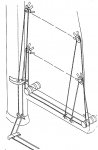
Single Line Reefing Setups

Sounds good in theory. But with two reefs and, in my case, a 3:1 purchase outhaul, there might be a risk of lines getting tangled.

I don’t understand the benefits of a balance block system anyway. You don’t save much rope, and there’s negligible mechanical advantage, if any, once losses in the blocks are taken into account. Perhaps I’m missing something.

+1. I set up my 24 footer for cockpit reefing last year. I fiddled around with balance blocks, then just ran a single line like Rogers. Seems to work, and has the added bonus of simplicity and accessibility. Important for a single hander like me! Vyv, maybe you could explain what I missed when i was playing with it?
 
Well, in my case I already have a double bank of organisers, 6 on each side, fully occupied. If I went for separate luff and leech lines I could not accommodate the extra two. And I find that balancing the main halyard with a single reefing line keeps me fully occupied without adding another reefing pennant.

I planned to fit 3 jammers on each side, plus a cam-cleat for the topping lift and a swivelling cleat for the kicker.
Starboard side jammers: main halyard; clew outhaul; single-line reef 1.
Port side jammers: single-line reef 2; reef 3 luff; reef 3 clew (no way of fitting an extra top side sheave on the boom for single-line reef 3) I might only rig reef 3, as suggested earlier, if the forecast warrants it.

I bought all the hardware, including winches, but got caught up in engine mount/bed replacement/modifications. I can do the reefing mod when Ladybird's afloat.
 
+1. I set up my 24 footer for cockpit reefing last year. I fiddled around with balance blocks, then just ran a single line like Rogers. Seems to work, and has the added bonus of simplicity and accessibility. Important for a single hander like me! Vyv, maybe you could explain what I missed when i was playing with it?

I am sure Vyv will be along to explain meanwhile here's how I see it. Reefing friction occurs between line & sail, at cringles & turning blocks. With single line reefing (no balance block) the friction created at the Tack becomes added to friction at the Clew . When a balancing block is used this addition of friction does not occur. The single reefing line from the cockpit goes directly to the Balancing Block and the resulting tension then is applied to both the tack & clew reefing lines. At first both Tack & Clew lines will tighten, then the one with the least friction will take up first (fortunately always the Tack) . At some point, the Tack reef becomes so tight that reefing is wholly directed to the Clew.
With Vyv's Balancing block system, mechanical advantage is 1:1, & less pull through of line at the cockpit. Without the Balancing Block, I estimate that pull through is double (mechanical advantage 2:1}. I consider the most important feature of Vyv's system is lessened friction particularly when pulling out the reef.
 
Another tip to go with the halyard marking, if single line isn't a goer for R3, as it often isn't due to insufficient boom length for boom car systems and excessive clutter on external block systems, run a line from cockpit to gooseneck terminated with a snap shackle. Put on the appropriate cringle for the forecast when setting out, it gives you a cockpit adjustable cunningham when it's full main weather and a third reef you can take in and shake out without leaving the cockpit when it's breezy.
This sounds ingenious, but surely when you put in your third reef you have to go forward to clip the snap shackle to the luff cringle?
 
Anyone tried replacing the balance blocks with a single low friction ring?

I very much doubt that would work. Low friction rings work well when either the loads or the angle are small. So either applications like jib leads where the angle might be 30 degrees, and certainly less than 90, or as part of a cascade kicker system where the load on each individual part is low and the tail is operated by hand.

When you have a 180 turn and you plan on winching the line a low friction ring is simply not going to cut the mustard I'm afraid.
 
I set up single line reefing for my sail which has two reefing points, a conventional reef one and a very deep reef 3 ( or 2.5). I had two reefing lines set up running alongside the boom and back to the cockpit, all turns had blocks fitted.

Resulted in a lot of friction and masses of loose line.

Do people think that having just one reefing line set up is a safe strategy for a coastal, mainly fair weather sailor. Rigged to the 1st reef in normal conditions and the second if heavy conditions are forecast?

I would fix a soft shackle to all four reefing points and clip a block with reefing line attached,prior to leaving port, to the appropriate one dependant on the weather / forecast.
 
I set up single line reefing for my sail which has two reefing points, a conventional reef one and a very deep reef 3 ( or 2.5). I had two reefing lines set up running alongside the boom and back to the cockpit, all turns had blocks fitted.

Resulted in a lot of friction and masses of loose line.

Do people think that having just one reefing line set up is a safe strategy for a coastal, mainly fair weather sailor. Rigged to the 1st reef in normal conditions and the second if heavy conditions are forecast?

I would fix a soft shackle to all four reefing points and clip a block with reefing line attached,prior to leaving port, to the appropriate one dependant on the weather / forecast.

I would respectfully suggests that you had it set up incorrectly
As for selecting which reef you might use prior to setting out-- One can hardly do that as I know that i change up & down regularly on passage along the coast. But then my single line system works properly One cannot rely on the wind being predictable. Particularly along the coast.
 
I would respectfully suggests that you had it set up incorrectly
As for selecting which reef you might use prior to setting out-- One can hardly do that as I know that i change up & down regularly on passage along the coast. But then my single line system works properly One cannot rely on the wind being predictable. Particularly along the coast.

You may be right that it was set up incorrectly. This is the way I rigged it,

5291D2BA-8740-4B30-A0E5-AD513D8C7399.jpeg

I could not use the boom slider method because the stack pack uses the slot. For each reef this necesitated 6 changes of line direction, each with a block. In total there was about 60m of new 10mm line. Result was friction raising the sail if the lines were pulled in when the sail was down or lots of loose line if they were not. I would appreciate any advice on how to improve on my set up.

My post was not clear but I was not thinking of having no option to reef if the weather was heavier forecast, just one single line and slab reefing for the second (with a trip to the mast to use the horns) if the weather was unexpectedly worse than expected. Not ideal but rare and better than continually struggling maybe?
 
Last edited:
Reefing should be really easy & i find that my single line is very much so. ( no inside boom blocks to create friction)
If it becomes a chore, one tends not to want to reef, then it can become dangerous if one reefs to late. It can become pointless, if one fails to shake out a reef, when it is not needed

Without seeing the setup one cannot make sensible comment however:-

There are several little tweaks that make the system work better. Mine works OK without blocks at the clew. The line just runs through the cringle.
The block at the luff is better if it cannot rotate, but needs freedom to go over the folded sail during the drop. As shown in the picture, sewn into the sail,it probably does not let it align with the reef lines very well near to the end of the reef. I would prefer spectacles. They would make it easier to lash the luff in emergency as well. So a webbing spectacle, with a non swiveling ball bearing block is best here

You say that the blocks are all on the outside of the boom. Do they really all line up nicely with the lines? Are they riveted in place or loose fitted, ie tied or shackled? Does the line cause them to rotate?

You mention loose lines when dropping the sail. Do the ones along the outside of the boom run inside the stack pack or outside? If outside put some lacing eyes on to help retain them.But make sure that they all run in line . Probably better to use faired plastic ones.

As for the spare line when lowering the sail; I just flick mine into the stack pack, although, if I remember( rarely), I sometimes just pull the loop hanging from the outer boom end in from the gooseneck in on its own when dropping the sail. Then tuck it into the stack pack.That should be a natural movement & not a chore, so it should not be a reason to dislike single line reefing.
When putting in reef one , you have to take up the slack ( from the cockpit) in reef two, as you go, to remove the loose loops, not after because sometimes the line can get caught. You just need one hand to pull in 3-4 feet every so often.
When finishing the reef one can just coil the lines & hang them behind the clutches against the cabin bulkhead. Not slung in a heap on the cockpit floor
 
Last edited:
Thank you one and all for a most illuminating and sensible set of posts.

My current set-up (three reefs) is a tack and clew line for each reef (six lines in all) all leading back to jammers on the cockpit roof.
The tails of these six ropes makes for a lot of string in the cockpit.

I like the look of single line reefing and from Viv's initial diagram it should be fairly easy for me to incorporate; but I foresee an increase in the possibilities for jams/friction.

With my multiple rope set-up I have a lot of flexibility and it's very easy to put any reef in - from the safety of the cockpit - without any need to go forward to the mast.
The only down side, AFAIC, to all of the above posts, and my set-up, is the loose sail along the boom which needs to be gathered and lashed.

Does anybody have a safe, neat and easy solution to gathering the "bag of sail" or is it indeed necessary/essential to gather it?
It looks un-seamanlike to leave it flapping about.

TIA
 
I can say that in almost 30 years of using my system the balance blocks have never jammed or clashed. When I first set it up I used 12 mm rope, which did lead to higher levels of friction, particularly when shaking reefs out. Changing to 10 mm Dyneema reduced this considerably. With hindsight I could probably have gone to 8 mm, adequate strength and acceptable to my existing cleats.
 
Just spent 5 days on a Bavaria 44 with single line reefing. Never again!

Dual line reefing is fine for me. All from the cockpit, adjustable and way less friction.

The old rams horn is still the simplest.

Of course, all IMHO

I’m thinking there must have been something up with the rigging. My Bavaria 50 has the Selden system shown above and it works beautifully. It takes no longer than 30 seconds single-handed to put in or let out 1st or 2nd reefs. I marked my halyard with whipping at the two correct points. I just dump the halyard to a little beyond the mark, wind in the appropriate reefing line as far as it’ll go (marked again), then point back up into the wind and pull in the final bit of halyard to get the sail looking as I want. As mentioned above, it pays to get everything set up right to ensure everything will work smoothly.

I’ve also got a very deep third reef set up with two lines, because there’s not enough room in the boom to do that with single-line.
 
I have been fiddling with my reefing this weekend. As posted earlier 2x(one for each reefing point) single line reefing was too much friction and loose line for my liking. I know that people will say that “you did it wrong” but I really did not.

Decided that 2x lines at the mast from fixed point at the mast foot to block at each reefing point and back through blocks to the cockpit plus separate lines from back of boom to block at each reefing point to 3.1 mainsheet type blocks and cleats/blocks on the boom works for me.

Still do not need to leave the cockpit to reef and much less loose line and friction.
 
Last edited:
Dutch, I'm thinking along similar ( reefing ) lines. I have thrown away all the friction-riddled unfair-led single-line workout kit that came with the boat and I'm considering how to make reefing from the cockpit simple.
I don't quite understand what you have on your boom for the lines on the leach ???
 
One common source of problems with single line reefing is cheap blocks with sleeve bearings. My system wasn't satisfactory until I replaced the blocks with decent ones with ball bearings. I also found that taking the line through the luff cringles wasn't satisfactory, even on a 24 footer. A decent block at each luff cringle made a world of difference. Now, I can head to wind and get the second reef in before the bow blows off, which isn't long in a Snapdragon!

The arguments between single and twin line will go on as long as there are reefs to put in. Simplicity and only one bit of string to pull against reduced friction and shorter bits of string, but twice as many. You pays your money and you takes your choice. Single works well on my boat, but I'd never criticise anyone who made the other choice.

To turn the lines along the boom, I use cheek blocks a bit like these, riveted into place.

HK-H233.JPG
 
Last edited:
Top