Silicone antifoul test results

Victorianna

New Member
Joined
8 Jan 2011
Messages
22
Location
Manningtree
Visit site
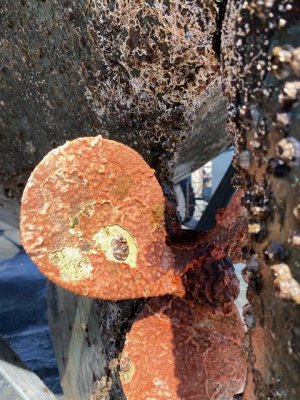
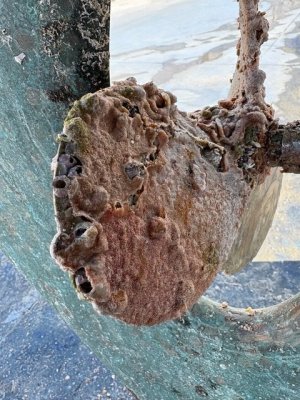
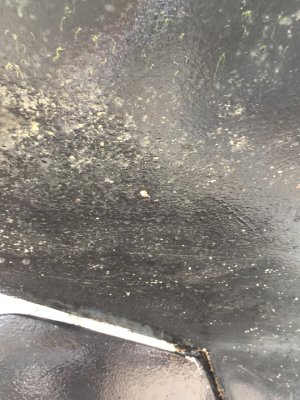
A PhD student at Essex university has been researching antifouling in Brightlingsea harbour. I'm aware that fouling and therefore best antifoul varies from place to place but the results look pretty conclusive for us east coast folks...?

Link to blog post

I've not used silicone anti foul before. Do any forumites have views on how well it sticks to old standard antifoul or whether I'd be better going back to epoxy first (reluctant for obvious reasons involving time, my knees and general happiness)
 
Follow the manufacturer instructions to the letter.

It’s not all about effectiveness.
Some marinas are now adding a surcharge for silicone anti foul when lifting and most seem to have a clause stating that any damage to the AF from the strop is your problem not theirs.

I tried SilicOne on the prop. The yardies told me it would fall off immediately after launch. They were correct.
It was interesting too that Delos tried it and made a fuss of it then never mentioned it again and changed back on the next lift out at great expense. Brian is a smart guy and knows his stuff.
 
As with all types of antifouling, reports and results vary wildly. Our prop was coated with a rubbery release-type product by a previous owner about 4 seasons ago. As of the end of last season it has some bare patches such that I might consider redoing it next winter but it has worked superbly. For the hull it is a really big commitment, more so than Coppecoat, but I’ve read that reports of yards refusing to launch are greatly exaggerated. One of the mags did a test on it on a cruising yacht and it came out really well.
 
I tried SilicOne on the prop. The yardies told me it would fall off immediately after launch. They were correct.
I helped a friend take his boat out a couple of weeks ago. He had used it on his prop on his southerly 110. He was really excited to see the prop as he had followed the instructions to the letter. It looked beautiful before he launched. Black and silky smooth.

There was no trace of it when the boat was lifted. Growth all over the prop but the black rubber had disappeared as quickly as it would if the old bill raided a bdsm emporium.

We were both a bit shocked especially as the shiny rubber finish cost him 100 quid for the prop.
 
Many large commercial vessels, container ships and cruise ships both of which are constantly on the move (such ships sitting idle are losing money) at speeds from 15 - 20 knots have tried silicone coatings many have reverted to conventional AF. When you see videos of the silicone being applied and the levels of protecting clothing you do wonder what the operators are being protected from....but maybe its just caution.

Conventional AF works, silicones cost more and sometimes (appear) to work - but read and consider Post #4 (which summarises our experience with Prop Speed and Prop Gold.

Jonathan
 
I've used Silic One on 3 boats over the last 8 years

First was on a 7 metre sports cruiser, then a 5.2 metre ally hulled rib, now on my AMT sports cuddy.

You can apply it to sound AF and the initial application is a primer, tie coat and 2 top coats

It works well and I only lifted the boat for 2 hrs annually to do oil changes and anode replacement.

It works on fast planing hulls. (20+ knots).

There's the usual build up of waterline slime which rubs off with a microfibre cloth

I was about to apply just one topcoat to freshen it up after 3.5 years but sold the boat.

It's not for everyone, but Superheat6k of this parish used it on his Corvette with great success.

Because it's very slippery I gained 1.5 knots top speed.

Current boat is out for some work and I'm going to apply one coat as it's had 2 seasons use. £40 tin should do it.

The prop kit is ineffective so don't bother.

As I said, it's not for everyone but I'm not interested in annual AF application!
 
Many large commercial vessels, container ships and cruise ships both of which are constantly on the move (such ships sitting idle are losing money) at speeds from 15 - 20 knots have tried silicone coatings many have reverted to conventional AF.

Jonathan
No disrespect meant and not in any way calling into question what you’re saying, but It would be very useful if people not talking from direct experience of the product being discussed would provide links to statements such as this. A link or two would save us all a lot of searching around.
 
No disrespect meant and not in any way calling into question what you’re saying, but It would be very useful if people not talking from direct experience of the product being discussed would provide links to statements such as this. A link or two would save us all a lot of searching around.
An absence of a link, any link, is because its a story of disappointment and repetitive articles on the same failed products does not sell magazines. Failure does not engender advertising income.

A Captain of a Cruise ship is a personal friend, I've specifically asked him about silicone coatings (I want them to work) and he has provided the experience of the fleet he works for and similar vessels, container ships. I don't think he is making it up.

I'm a certificated applier of Prop Gold aka Prop One (silicone coating for props) and used it on our props without success, I've also trialed Prop Speed with a similar and disappointing lack of success. Velox is better but not that fantastic.. If you use the search function on the Practical Sailor website they have a series of articles on AF which contain reference to silicone coatings.

You need to rely on threads like this one.

If silicone systems worked most of us would be using them. Chandlers shelves would be full of cans of silicone and surface coating suppliers would be singing their praises and securing advertising space in YM, ST, Sail etc etc. Silicone coating have been available for 40 years - the reality is they are notable by their absence from a yacht near you - after all these years. If they worked there would be adverts.

The killer for those that don't believe personal experiences from Forum like YBW is Chiara's post #4, Trying to use a conventional AF after a silicone coating is a disaster.

Jonathan
 
I have used it on my 10.3m sailing boat in Dartmouth. I'm very pleased with it. I did have the boat scraped back to the gel coat and applied it as per the spec. Lots of coats of primer. I have used it on my prop as well. Preparation is an absolute key. I had my prop shot blasted and within 2hrs applied the epoxy primer to avoid oxidation. The tie coat must be applied whilst the primer is still sticky. I'm on my second season and will be lifted soon to see how it is. John
 
An absence of a link, any link, is because...

Jonathan
You miss my point a bit. I was just saying that making a statement about something carries more weight when it can be backed up with a source. When you said “many have reverted to conventional AF” I thought “that’s interesting I’ll google it” but didn’t find a great deal on it so was hoping you might provide a link.
I’ve no skin in this game. If anything I’m rather hoping silicone antifoul doesn’t work as well as the expensive coppercoat I’ve just applied.
 
Last edited:
I have used it on my 10.3m sailing boat in Dartmouth. I'm very pleased with it. I did have the boat scraped back to the gel coat and applied it as per the spec. Lots of coats of primer. I have used it on my prop as well. Preparation is an absolute key. I had my prop shot blasted and within 2hrs applied the epoxy primer to avoid oxidation. The tie coat must be applied whilst the primer is still sticky. I'm on my second season and will be lifted soon to see how it is. John
So you don’t know how well it’s working yet then? The rest of us with failure also prepped and applied properly. My prop still bears the scars.
What I do have the results of is two years with Seajet 033 and some grease smeared on the prop. Minimal fouling, no barnacles, easy scrape of prop and shaft to clean up. We did do a few thousand miles in that time and used Scrubbis hull cleaner.
I agree with Neeves, if it worked it would be standard.
 
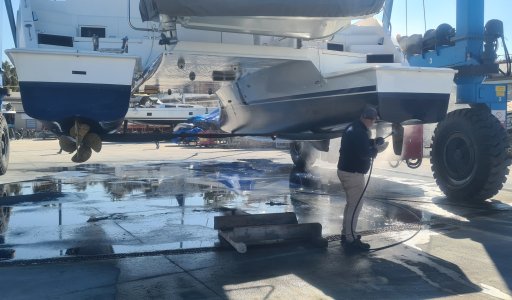
I used Propspeed on my props, rudders and shafts in early June 24 shortly after getting my new to me powercat back to home base. On my previous smaller powercat I'd been cleaning the props once a month starting around 6 months after application of antifouling. However I knew cleaning in the water on this one with its wider hulls and my increasing age would be a challenge. I lifted my boat a few weeks ago after more than 20 months and I was very impressed with the state of the props, rudders etc. There was no hard growth whatsoever. The picture below is not great, but gives an idea. He was power washing the stb side when I took it but hadn't touched the port. I'm in the Aegean Sea.
20260307_111841.jpg
 
Real-world experience of Silic-One on the hull of a 27ft sailboat here: How Hempel's Silic One silicone antifouling performed over two years on my 27ft boat - Practical Boat Owner

And Seajet BioClean here: Seajet Bioclean silicone antifoul review: Verdict after one year on the water

Despite the above successes I’m still not brave to commit to it myself, largely due to the effort required when it needs redoing.

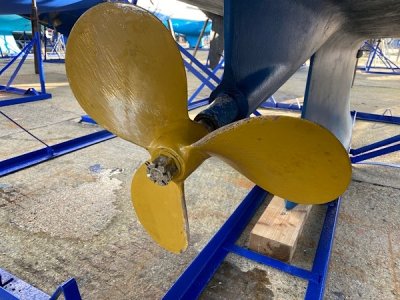
This is what our propeller looked like after 1 season (or maybe 2, not sure as pic is from previous owner) - obviously it has been cleaned after lifting:

IMG_2026-03-28-101945.jpeg

The leading edge “damage” is from where TPO had it modified post-painting to stop it from “singing”.

I have no doubt that preparation is everything. Trouble is with such an expensive product there is so much riding on that preparation.
 
The leading edge “damage” is from where TPO had it modified post-painting to stop it from “singing”.
Your PO had the wrong end of the stick! It's the trailing edge that sings - filing a flat on it, a couple of millimetres wide or perhaps even less will shut it up.

I first encountered this noise generation on Hobie 16 rudders, where the same treatment was effective. Subsequently used successfully on two props.
 
I did some more research and if you search you will find that a major, or the major incentive for commercial operators to use silicones has little to do with Antifouling, in fact antifouling seems to be way down the list. A major benefit of silicones is saving fuel, the slippery surface allows the vessel to move fast and save fuel (fuel is the biggest cost on a cruise ship). The measure, or savings seems to be conducted on a freshly prepared hull. Obviously if the hull stays clean it will also be slippery, like new AF engenders a faster hull.

As an aside how does this impact yachts that race? Having said that yachts that race, seriously, will dry sail if possible and would be honed prior to any significant race. An alternative to silicones for yachts that race would be Coppercoat - but it adds weight? As does conventional AF - (solution dry sail).

Damage is a big issue, or repairing damage, Mantion was made somewhere recently that travel hoists can damage a silicone coating. Damage would be an issue with props - but you would probably strip back and replace all the silicone. Prop Speed is common on MoBos in Sydney.

Jonathan
 
You miss my point a bit. I was just saying that making a statement about something carries more weight when it can be backed up with a source. When you said “many have reverted to conventional AF” I thought “that’s interesting I’ll google it” but didn’t find a great deal on it so was hoping you might provide a link.
I’ve no skin in this game. If anything I’m rather hoping silicone antifoul doesn’t work as well as the expensive coppercoat I’ve just applied.

It does work on fast planing hulls.

I wouldn't have applied it 3 times it it was a poor performer!

After the first 4 coat application, it's just ONE topcoat at year 3 or 4 depending on any floating log damage sustained.

Saves me a fortune in haul out fees as I just need a lift and hold to service my outboard.
 
Real-world experience of Silic-One on the hull of a 27ft sailboat here: How Hempel's Silic One silicone antifouling performed over two years on my 27ft boat - Practical Boat Owner

And Seajet BioClean here: Seajet Bioclean silicone antifoul review: Verdict after one year on the water

Despite the above successes I’m still not brave to commit to it myself, largely due to the effort required when it needs redoing.

This is what our propeller looked like after 1 season (or maybe 2, not sure as pic is from previous owner) - obviously it has been cleaned after lifting:

View attachment 208406

The leading edge “damage” is from where TPO had it modified post-painting to stop it from “singing”.

I have no doubt that preparation is everything. Trouble is with such an expensive product there is so much riding on that preparation.
I think you will find that's only the leading edge when you are going backwards :-)
 
Top