Shrinking interior of epoxy sheathed racing dinghy

weimand

New Member
Joined
18 Jul 2022
Messages
4
Location
Zürich, Switzerland / Penryn, UK
www.youtube.com
Hi alI
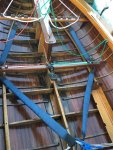
I have a 1966 Olympic one design (O-Jolle) that has undergone a refit under the previous owner in 2008 where the varnish was stripped back and the centerboard case replaced.
The hull was Epoxy sheathed on the outside. On the inside only the new centerboard case is epoxy coated and epoxy fileted to the keel. The deck and spars were varnished, none of the structure was replaced otherwise.
She was then not used very much (some of the time on salt water some on sweet) and kept in a garage most of the time.
I bought her in 2020 and have been on the Lake every other week all year round. She's stored on her trailer on the hard and covered completely with a canvas cover that is suspended over the boom, making sure that the self bailers are open and on the lowest position so all the water is able to drain.

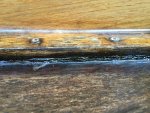
Now I noticed a lot of shrinkage yielding quite large gaps especially on the garboard planks where they join the planks and also in the rabbet where they join the centerboard case. Maybe due to the fact that we have had very dry weather here in Switzerland in recent months.

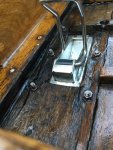
Also I've noticed two areas where the garboard plank is very soft and the Le Tonkinoise Oil that I have applied to the interior has not saturated the wood. (see attached pictures)

I should probably have payed closer attention to what was going on under the sole boards and wipe everything dry every time...

My plan now is to fill the gaps with Sikkaflex and to carefully carve out the soft bits of wood (hoping it is not all the way through to the glass) and insert a graving piece (oak?), or if it is only a thin layer fill it with epoxy filler

Do you think this is a recommended approach?

Any suggestions very welcome.

Thanks.
Andy
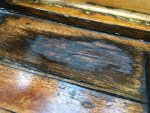
IMG_4145.jpegIMG_4146.jpegIMG_4148.jpegIMG_4149.jpeg
 
Your description makes me nervous......
Others will be able to answer your questions I hope, but I suggest getting under the boat and tapping around the areas that are soft above and discovering if they are soft below too. Good wood sounds different to mushy wood so ought to indicate if things are bad under the sheathing.
 
Welcome to the forum

Sorry to say it was not a good idea to epoxy sheath the outside as the current condition shows. Epoxying one side and not the other is a mistake - in fact epoxy off any kind on that form of lightweight construction is a mistake as the wood cannot breathe and expand and contract. Epoxy on the outside means a differential between the 2 sides of the planks hence the opening up and cracking of the epoxy, letting water in and causing the localised rot you report.

While epoxy can work on new boats because the wood is dry and stable and both inside and outside of the boat is encapsulated, usually with the addition of a glass cloth skin at least on the outside, it is only a temporary fix on an old boat. Looks good for a few years before UV degrades the epoxy and movement of the wood breaks the skin.

Little you can do now as epoxy is almost impossible to remove so best you can do is patch it. While the rot may not be too bad on larger section pieces like the hog, suspect you will find the garboard planks (3/8"?) are rotten all the way through to the sheathing.
 
Sadly I agree with Tranona. Epoxy on an old timber boat is a quick route to rot and very difficult to rectify as it traps water in the wood . Remove the coating on the outside if you can and then replace the rotten wood. Repaint and revarnish with conventional coatings which allow the wood to breathe. (I race a 1960 wooden Finn)
 
While epoxy can work on new boats because the wood is dry and stable and both inside and outside of the boat is encapsulated, usually with the addition of a glass cloth skin at least on the outside, it is only a temporary fix on an old boat. Looks good for a few years before UV degrades the epoxy and movement of the wood breaks the skin.
Actually you are WRONG. A yacht CAN be epoxied inside & out & I have done it 22 years ago to a 40 year old boat so know it works.
The inside does not get covered in GRP but treated in fluid epoxy which soaks into the surface of the wood. I cannot for the life of me recall the exact spec of it but it was rather like antifreeze in that it seeks out every little gap including the worm holes that were in the original wood at the build. When applied it is like water. The outside of my clinker Stella was covered with 300 grm woven mat after the lands were machined 6mm*6mm & filled with west & filler to bond the planks. The fastenings were gone & some could be tapped back & forth with a light hammer blow. There was rot around the fastenings. Some of the planks had sprung & after the boat was shot blasted in & out to remove paint & rot ( blew several holes in the hull) they were re fastened.
 
Over half of the XOD fleet are epoxy sheathed, no glass cloth. The process is possible on older wooden boats, if you are careful with the moisture content. You have no control of that if it’s done only on the outside. Water sitting on the inside of that impervious layer is going to have some adverse effects.
 
Actually you are WRONG. A yacht CAN be epoxied inside & out & I have done it 22 years ago to a 40 year old boat so know it works.

I did not say it could not - just that this one is not. The OP says it is oiled. Bit of a difference.

Re-read the first sentence of my reply.
 
Thank you for your thoughts.
(I hoped I wouldn't spark a general discussion on pros & cons of epoxy sheathing... Nothing I can do about now anyway as it was done before I got the boat)

I've done some probing and it seems it is not soft all the way through. After 6 or 7mm I am onto hard wood again and that only in the center of the patch. Most of the area I have hard wood after a couple of mm

Now I am wondering if I should just fill it up with epoxy filler or go a bit deeper and fit a graving piece.

Any thoughts on the cracks/open seams? Do you think it is a good Idea to fill them with Sikkaflex or would that put on to much strain if the planks start to swell again?

thanks
 
I did not say it could not - just that this one is not. The OP says it is oiled. Bit of a difference.

Re-read the first sentence of my reply.
Well I went a bit further down your prose because I accept the first part related to the dinghy
Then I read :-
"While epoxy can work on new boats because the wood is dry and stable and both inside and outside of the boat is encapsulated, usually with the addition of a glass cloth skin at least on the outside, it is only a temporary fix on an old boat. Looks good for a few years before UV degrades the epoxy and movement of the wood breaks the skin."
That was good enough for me to respond, because others might read this thread & be mislead by your comment. In my opinion it did need some clarification.
Of course you can disagree - that is part of the forum. But now both sides of the debate are there for all to read. I think that is fair, with little need to get excited .
 
You could fit a graving piece but be very careful as (unless very shallow) it will be a weak point. The proper repair would be to let in a new piece of planking covering at least 3 ribs. With regard to the open seams. If you had access to the water (ideally sea) then I would suggest you sink her for a couple of weeks to make the planks take up. Filling up the gaps now is quite likely to crack the plank or some of the ribs.
As an example. We are in the process of restoring a Truro oyster dredger (carvel planked). She’s been out of the water for about 2 years and there is a 5mm gap between some of the underwater planks. As she was water tight before (and we haven’t touched those planks) they will close up once in the water.
 
Well I went a bit further down your prose because I accept the first part related to the dinghy
Then I read :-
"While epoxy can work on new boats because the wood is dry and stable and both inside and outside of the boat is encapsulated, usually with the addition of a glass cloth skin at least on the outside, it is only a temporary fix on an old boat. Looks good for a few years before UV degrades the epoxy and movement of the wood breaks the skin."
That was good enough for me to respond, because others might read this thread & be mislead by your comment. In my opinion it did need some clarification.
Of course you can disagree - that is part of the forum. But now both sides of the debate are there for all to read. I think that is fair, with little need to get excited .
I did not mean it in that way, although you could read it differently. The sentence was about the conditions that help epoxy work on new builds, not that it cannot be done on old boats. I know you have done but the way you did it was unusual. While doing the outside is relatively easy doing the interior successfully is a lot more difficult and rarely done.
 
You could fit a graving piece but be very careful as (unless very shallow) it will be a weak point. The proper repair would be to let in a new piece of planking covering at least 3 ribs. With regard to the open seams. If you had access to the water (ideally sea) then I would suggest you sink her for a couple of weeks to make the planks take up. Filling up the gaps now is quite likely to crack the plank or some of the ribs.
As an example. We are in the process of restoring a Truro oyster dredger (carvel planked). She’s been out of the water for about 2 years and there is a 5mm gap between some of the underwater planks. As she was water tight before (and we haven’t touched those planks) they will close up once in the water.
Thank you for your support.
I think I will go for the graving piece option that I will scarf in. Replacing the plank over 3 ribs will be difficult with the glassed hull...

Yes, I was thinking of soaking her but was a bit worried doing this in fresh water, but maybe still better than paying up the seams... ?
The closest access to the sea is a 6 hour drive away from here... I will be in Penryn mid August but unfortunately won't be able to bring the boat. Which Yard are you working at?
 
You could fit a graving piece but be very careful as (unless very shallow) it will be a weak point. The proper repair would be to let in a new piece of planking covering at least 3 ribs. With regard to the open seams. If you had access to the water (ideally sea) then I would suggest you sink her for a couple of weeks to make the planks take up. Filling up the gaps now is quite likely to crack the plank or some of the ribs.
As an example. We are in the process of restoring a Truro oyster dredger (carvel planked). She’s been out of the water for about 2 years and there is a 5mm gap between some of the underwater planks. As she was water tight before (and we haven’t touched those planks) they will close up once in the water.
The fungi that cause rot often extend a long way beyond obviously soft timber, so ensuring you've removed ALL the fungal threads is difficult. If following this option, I would be inclined to treat the wood with a suitable anti-fungal agent before fitting a graving piece.
 
While doing the outside is relatively easy doing the interior successfully is a lot more difficult and rarely done.
But the way recommended by Wessex resins who sold me the resin etc & all stages were overseen by their rep at bi monthly intervals
The inside was completed in 3 stages taking about 5 hours each. So not that difficult.
That was after the hull had been shot blasted & some other woodwork repairs completed. Plus 12 broken rib repairs ( that took me a saturday afternoon on my own)
 
The fungi that cause rot often extend a long way beyond obviously soft timber, so ensuring you've removed ALL the fungal threads is difficult. If following this option, I would be inclined to treat the wood with a suitable anti-fungal agent before fitting a graving piece.
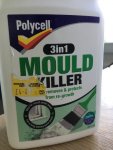
Thank you AntarcticPilot
I have this in lying around (see pic). Do you think this would be adequate?IMG_4154.JPG
 
I think that how you tackle this depends on how dry you can keep the boat. If you can really dry out the wood and then keep it dry then I would go the epoxy route. My rescued clinker lauch is more epoxy than wood, but it lives in the garage for most of the year and only spends a few days afloat.
If you can't keep it dry , then use sikaflex and breathable finishes.
However traditional wooden boats really don't like being outside, out of the water. Wet and cold when it rains and then baking hot and dry when it's sunny. Cracks and splits are inevitable and will recur.
Letting her "take up" won't help if she is then left to bake in the sun
 
Top