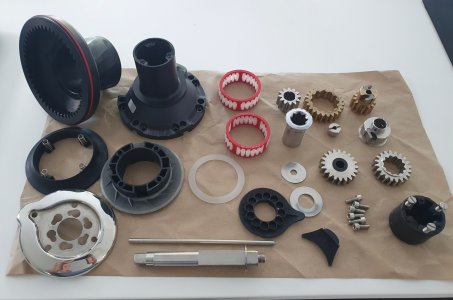
Sheet winches ... servicing ..

Refueler

Well-Known Member
Joined
13 Sep 2008
Messages
23,783
Location
Far away from hooray henrys
Visit site
Noticed one of my simple Lewmar genny sheet winches is a bit iffy on the locking pawl ... basically it turns both ways because pawl is stuck and not engaging.

Its been some years since I serviced them - so that will be a job once she's lifted.

For those contemplating similar job ... one tip that can be a life-saver :

Get an empty plastic or cardboard box ... cut out a hole in centre and sliced one side - so you can pass it round the base of the winch .. then tape it back together ... this then catches any 'balls / springs' etc that would have fallen - never to be found again !! I like to use Ice Cream plastic clear containers.
 
Noticed one of my simple Lewmar genny sheet winches is a bit iffy on the locking pawl ... basically it turns both ways because pawl is stuck and not engaging.

Its been some years since I serviced them - so that will be a job once she's lifted.

For those contemplating similar job ... one tip that can be a life-saver :

Get an empty plastic or cardboard box ... cut out a hole in centre and sliced one side - so you can pass it round the base of the winch .. then tape it back together ... this then catches any 'balls / springs' etc that would have fallen - never to be found again !! I like to use Ice Cream plastic clear containers.

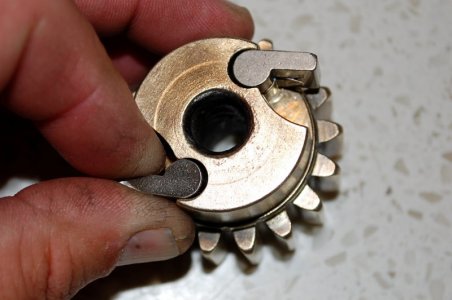
  • There are two pawls, so both have failed, meaning it has been a very long time. Oh the shame! Failing under load can beak and arm and destroy the winch internals.
  • Replace the springs and pawls. Do not just clean. I guarantee that the pawls are worn and the springs are either broken or nearly so.
  • Do all the winches.
Lots of instructions online. Most are really OCD. Thin grease on the gears, oil on the pawls.

I've never had a spring or part come loose. Just lucky I guess. However, a plastic cafeteria tray is very handy for keeping everything together. Also any job with small parts or paint/epoxy.
 
One of the reasons the pawls are not working - the boat stood for 1.5 years when keel was repaired ... then stood another 6 - 8 mths outside house ... after launch - she stayed unused for months ...

The winch does lock if you twist back and forth .. its not worn out - its just stuck with crud and lack of use.

I have all the manuals for them ... and have no problem servicing them ...

I have never used 'Lewmars' grease ! I use light cycle oil and a tiny paint brush application of grease ....
 
  • There are two pawls, so both have failed, meaning it has been a very long time. Oh the shame! Failing under load can beak and arm and destroy the winch internals.
  • Replace the springs and pawls. Do not just clean. I guarantee that the pawls are worn and the springs are either broken or nearly so.
  • Do all the winches.
Lots of instructions online. Most are really OCD. Thin grease on the gears, oil on the pawls.

I've never had a spring or part come loose. Just lucky I guess. However, a plastic cafeteria tray is very handy for keeping everything together. Also any job with small parts or paint/epoxy.
Definitely. No half measures. Take the whole lot apart and clean before oil/grease and reassembly. I used paraffin to clean
, and washed this off with meths, but other versions are possible.

The safety system to use depends on the boat. I have used a floor board resting on the lifelines, and also managed by sitting astride the winch while facing into the cockpit. You can’t have too many spare pawl springs.
 
Slight thread drift but on my Lewmar 52's there is a roller bearing that can only be accessed by removing the main casting from the Lewmar base.
I couldn't get one of the pins out that holds the gears in place. Removing the casting from the base gives access to the underside of the casting where the pin can now be drifted out.
In all my years of servicing I thought removing the central spindle and the gears would give access to all the bearings and pawls that needed greasing. Not so.
You need to access the understand of the main casting to get the last needle bearing out.
Of course as the main casting had never been removed from the Lewmar base, separating the two is a major job in itself.
With the winch off the boat I had to resort to blowtorch and/or drilling to get the 3 bolts out that secure the casting to the base.
One tip, to clean up the holes in the casting that the pins pass through a dremmel with a sanding cylinder does the job.
 
On my simple single speed sheet winches I had the exact problem of base pauls not engaging. Pull it apart and they seem fine. What was happening was that the body had worn and dropped down on the shaft to the point where the pauls were not aligned to the track of indents in the body. The fix was to make a large washer for the body to sit on at the top of the shaft. I used a piece of plastic from ice cream container. I expect it will wear out soon but so far ok.
Now I realise I replaced a pair of sheet winches long ago for not engaging pauls. I though at the time it was just wear in the body that provided some slop. Probably the same problem. Yes I do punish my jib sheet winches. (conservatively 10 or 15 thousand tacks 2 sets of winches)
ol'will
 
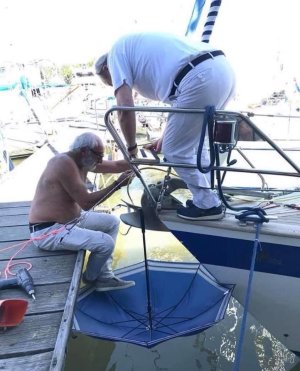
Plastic bag might be easier, but I have considered making a full on glove box for this sort of thing, particularly the sort of spring-loaded thing where you dont necessarily know exactly what was in it, and therefore wont know if you've lost anything.

Fully enclosed, as if they were toxic.

Which they sort-of are.
 
Definitely. No half measures. Take the whole lot apart and clean before oil/grease and reassembly. ...

I certainly did not mean to imply not cleaning before relubricating. What I meant was that this is a job you should be able to do easily and quickly, so as not to discourage one from doing it regularly (not a dig at the OP). Some of the discussions can make winch service seem daunting, encouraging people to postpone. I think that is wrong.

Do they need to be perfectly degreased and then degreased again with alcohol? Not hardly. You wouldn't worry any other gear box to that extent. Some can only be fully disassembled (not the Lewmar single speeds--they are dead simple) off the boat, and removing them may be quite daunting (frozen bolts or no access) to nearly impossible. Does that mean you should put off servicing them? No. They can often be cleaned quite well without complete disassembly. Take apart all that you can from above, and then clean the rest in place by getting after them with a brush and and liberal application of mineral spirits while turning. That does mean you didn't replace the inner pawls or springs; maybe get those next time, in a year or two.

There is nothing wrong with a perfect cleaning if that feels good. But it's not a watch. It's machinery, like a car. Like changing the oil, it's better to get it done than to worry over the 3 ounces of used oil that didn't drain; in a few weeks it won't matter.
 
My (1980 vintage) winches had not been serviced in quite a while (new boat to me, summer 2024) and I stripped / cleaned and reassembled them over the winter 24/25.

Some before, during and after videos here:

Lewmar winch service

A couple of pawls were worn and needed replacing, a couple of springs were either missing or broken, but by far the biggest issue was the old grease that had hardened and caused the pawls to stick.

Cleaned in a washing up bowl with diesel, dried and re-greased with 3-in-1 for the pawls and Liqui Moly Marine Winch Grease for the other bits. They have been fine all this season, will have a look inside this winter, but expect things to be fine.

Spares sourced from a Lewmar specialist parts seller on eBay iirc. (they are not available for mine ancient models directly any more)
 
I certainly did not mean to imply not cleaning before relubricating. What I meant was that this is a job you should be able to do easily and quickly, so as not to discourage one from doing it regularly (not a dig at the OP). Some of the discussions can make winch service seem daunting, encouraging people to postpone. I think that is wrong.

Do they need to be perfectly degreased and then degreased again with alcohol? Not hardly. You wouldn't worry any other gear box to that extent. Some can only be fully disassembled (not the Lewmar single speeds--they are dead simple) off the boat, and removing them may be quite daunting (frozen bolts or no access) to nearly impossible. Does that mean you should put off servicing them? No. They can often be cleaned quite well without complete disassembly. Take apart all that you can from above, and then clean the rest in place by getting after them with a brush and and liberal application of mineral spirits while turning. That does mean you didn't replace the inner pawls or springs; maybe get those next time, in a year or two.

There is nothing wrong with a perfect cleaning if that feels good. But it's not a watch. It's machinery, like a car. Like changing the oil, it's better to get it done than to worry over the 3 ounces of used oil that didn't drain; in a few weeks it won't matter.
Not every year, obviously, but you reported that it hadn’t been serviced for a long time and was malfunctioning, which to me suggests that a proper overhaul is needed. My routine would have been to dismantle every year and give a light oil and grease, and do a full clean only occasionally. Mine are 43s and 16s, but I think the principle is the same generally. It only takes a few seconds to dismantle a 2-speed winch and little longer to reassemble. I came 4th/40 in a winch-assembling race at a regatta in Germany, though it turned out that some competitors had never stripped a winch.
 
If you need the manual from Lewmar

https://www.lewmar.com/mst_attachment/attachment/click/attachment_id/191/ Page 31
Greasing
Never use grease to lubricate your pawls, as this can lead to pawls sticking in
their pockets and disabling the winch. Instead, lubricate with a light engine oil.
Use only a light smear of winch grease when lubricating ratchet tracks, gear
teeth and bearings. Otherwise excess grease will be forced out and collect in
potentially dangerous areas, such as pawl pockets.
 
... Get an empty plastic or cardboard box ... cut out a hole in centre and sliced one side - so you can pass it round the base of the winch .. then tape it back together ... this then catches any 'balls / springs' etc that would have fallen - never to be found again !! I like to use Ice Cream plastic clear containers.

If anyone has a towable generator, a similar thing is done. Use a plastic funnel that fits over the spinner line and bar, and where the funnel cone large enough to fit over the spinner blades. Split the funnel longitudinally into two halves. When the spinner needs retrieving, fit the split halves over the line at the pushpit as it spins and secure with cable ties through suitable holes. Funnel cone is pointing down towards the spinner. Let go and the funnel slides down the line, over the bar and gets caught on the spinner. The spinner stops, dead easy to retrieve the line and spinner.
 
.. its not worn out - its just stuck with crud and lack of use.

I have all the manuals for them ... and have no problem servicing them ...

I have never used 'Lewmars' grease ! I use light cycle oil and a tiny paint brush application of grease ....
If used when "stuck with crud" you will have hugely accelerated wear. You should not let them get anywhere near to that point.

Winches are beautiful mechanisms -- like fine guns. It's a sheer pleasure to take them apart, look at, and fondle the innards. Have that pleasure regularly, and share the pleasure with your crew and guests. I traditionally have a winch cleaning day every time I transit the Kiel Canal. With 3 or 4 people on board, short work is done of my 10 winches, and we have fun.

Another tip: You should not be using light oil, where grease is specified. Oil is for the pawls and springs; grease for everything else. The Lewmar grease is just the right consistency, and a tube of it lasts for many years. It's a good investment.

Don't neglect your furlers, either, particularly not the upper swivels.
 
I certainly did not mean to imply not cleaning before relubricating. What I meant was that this is a job you should be able to do easily and quickly, so as not to discourage one from doing it regularly (not a dig at the OP). Some of the discussions can make winch service seem daunting, encouraging people to postpone. I think that is wrong.

Do they need to be perfectly degreased and then degreased again with alcohol? Not hardly. You wouldn't worry any other gear box to that extent. Some can only be fully disassembled (not the Lewmar single speeds--they are dead simple) off the boat, and removing them may be quite daunting (frozen bolts or no access) to nearly impossible. Does that mean you should put off servicing them? No. They can often be cleaned quite well without complete disassembly. Take apart all that you can from above, and then clean the rest in place by getting after them with a brush and and liberal application of mineral spirits while turning. That does mean you didn't replace the inner pawls or springs; maybe get those next time, in a year or two.

There is nothing wrong with a perfect cleaning if that feels good. But it's not a watch. It's machinery, like a car. Like changing the oil, it's better to get it done than to worry over the 3 ounces of used oil that didn't drain; in a few weeks it won't matter.
I've never seen a winch that had to be taken off the boat to get fully apart. Mine range from single speed Lewmar 16's to big electric 66's, and all of them can be stripped in 60 seconds or less. The only thing which stays on the boat is the base and spindle.

I always clean mine in a plastic basin with white spirits, dry with a clean white cloth, then brush the grease on. It only takes a few minutes per winch, and it's a pleasure handling the beautiful machined bronze mechanisms. I suppose you could just add a bit of grease (oil on the pawls) and clean every other time, but why? The old grease accumulates dirt and gets stiff; best to get rid of the whole lot and start fresh.
 
Not every year, obviously, but you reported that it hadn’t been serviced for a long time and was malfunctioning, which to me suggests that a proper overhaul is needed. My routine would have been to dismantle every year and give a light oil and grease, and do a full clean only occasionally. Mine are 43s and 16s, but I think the principle is the same generally. It only takes a few seconds to dismantle a 2-speed winch and little longer to reassemble. I came 4th/40 in a winch-assembling race at a regatta in Germany, though it turned out that some competitors had never stripped a winch.
I am not the OP. My winches get service pretty regularly. The only time I have had to deal with hardened grease is on new-to-me boats.

I've seen pawls so worn they could fall out. Springs should be replaced every time and pawls every few, but since they come together in the kit ... just replace them. The more the pawl wears, the faster it wears (less contact area). Worn out pawl seats is probably the leading cause of death for winches.

A winch striping contest? Cool.

1762957740987.jpeg
 
Top