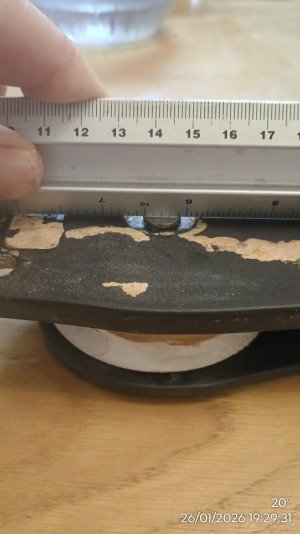
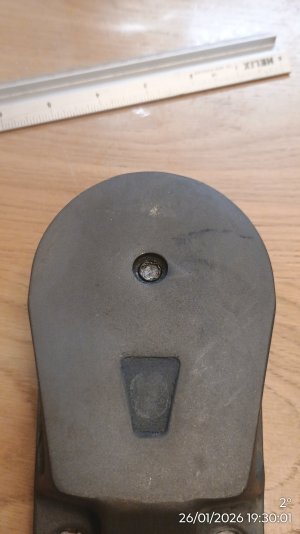
Sheave pin replacement

mogmog2

Well-Known Member
Joined
12 Feb 2011
Messages
560
Location
Littlehampton
Visit site
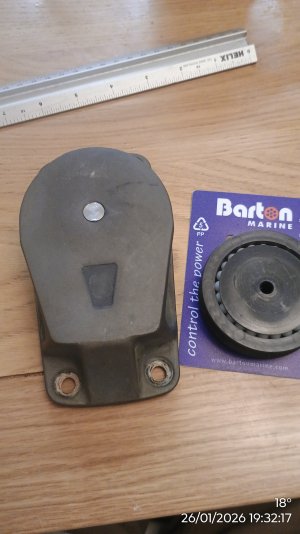
I'm refurbishing our Lewmar size 3 cheek blocks, the sheaves of which have disintegrated. I've read the various posts on here about this, but looking at a different angle as I don't want to peen the replacement pins if I can avoid it.

Whilst contemplating acceptable ways to replace the pin, which was rendered unwell in the removal process, I was looking at clevis pins as they're rather like the incumbents when I wondered how bad an idea it would be, to stick a clevis pin in from underneath, that ended flush with the cheek top? - no fastener of any sort as the pin couldn't go anywhere as the head would be trapped between the lower cheek and the teak mounting pad.
From an engineering/load bearing perspective, would a fastener contribute anything to the load bearing capacity*, beyond just retaining the pin?
Just checking before I cop out and fit a bolt...
 

Attachments

  • IMG_20260126_193217.jpg
    IMG_20260126_193217.jpg
    1.8 MB · Views: 15
  • IMG_20260126_192931.jpg
    IMG_20260126_192931.jpg
    1.3 MB · Views: 15
  • IMG_20260126_193001.jpg
    IMG_20260126_193001.jpg
    1.7 MB · Views: 14
Your plan sounds good to me provided you can get a pin and exact match of what’s there. Failing that an acorn bolt on top wouldn’t look too horrendous
 
I have replaced the sheaves in my blocks which requires the destruction of the pin (axle) I used clevis pin in some and in others I used a piece of ss tubing the right OD witha bolt and nut through the centre. Nyloc nut tightened against the tube end. It is important I think to get the cheeks pressed close to the sheave with some strength to avert the rope pressing cheeks apart and jamming between the cheek and sheave. Hence a clevis pin may not provide that squeeze together. But maybe this is not a concern.
Now because your block is flat on base plate you might need to use a counter sunk bolt head and or drill out the cheek material on outside to accommodate the pin or bolt head. No the shear strength of the pin or even smaller diameter bolt should be adequate for the loads without bending. ol'will
 
I have replaced the sheaves in my blocks which requires the destruction of the pin (axle) I used clevis pin in some and in others I used a piece of ss tubing the right OD witha bolt and nut through the centre. Nyloc nut tightened against the tube end. It is important I think to get the cheeks pressed close to the sheave with some strength to avert the rope pressing cheeks apart and jamming between the cheek and sheave. Hence a clevis pin may not provide that squeeze together. But maybe this is not a concern.
Now because your block is flat on base plate you might need to use a counter sunk bolt head and or drill out the cheek material on outside to accommodate the pin or bolt head. No the shear strength of the pin or even smaller diameter bolt should be adequate for the loads without bending. ol'will
Thanks, I'd seen your method in another post and was hoping to avoid having to get involved with shoulders and I wasn't sure I wanted to reduce the axle diameter to accommodate a sleeve (which you addressed) and also reluctant to remove material from the cheeks unless it was absolutely necessary, plus it would breach the anodising.
I knew that the pin wasn't shouldered, but looking afresh after your reply I realised that that is what the 18mm stainless bush is doing, as it's proud of the sheave by maybe 2mm. I had been swithering as whether to bore the new sheave out to take it and there looks to be plenty of meat in the central body that would accommodate it (and at £25 for the sheave I'm prepared to take a gamble).
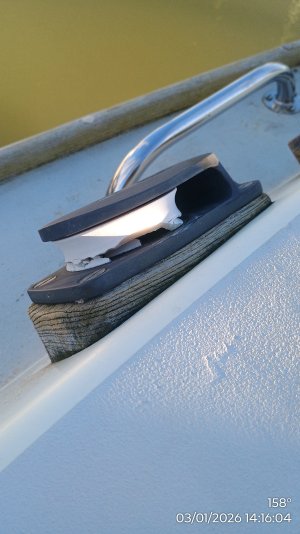
Rather than removing material from the cheek, I'd rather sink a recess in the teak mounting pad with a Forstner bit - I think I'm probably going to have to do that a bit anyway.
You've raised exactly the kind of point that was bothering me but hadn't identified (thanks for that), WRT the need for a bit of compression. I'm currently favouring a clevis and split pin, with slack taken up by washers/shims underneath in a recess in the teak.
 

Attachments

  • IMG_20260103_141604.jpg
    IMG_20260103_141604.jpg
    1.8 MB · Views: 7
Your plan sounds good to me provided you can get a pin and exact match of what’s there. Failing that an acorn bolt on top wouldn’t look too horrendous
Thanks, yes that would be my fallback. I had hoped to use a mushroom head Allen bolt but AFAICT , they don't exist, only as fully threaded screws.
Also the problem I'm having is finding a bolt with the correct length shoulder, so the thread doesn't start in the soft alloy cheek (a 55mm bolt does this), but doesn't protrude too far below (a 60mm bolt does this) -That's where the clevis pin came in...
 
What about a machine screw with a plain shank. Countersink the underside of the block a bit and also the wood block. Cut the screw so that it doesn't protrude above the top of the block All held in place by the fact the the block is screwed down.
 
Well, if there is ANY upwards load applied, there is nothing to hold the cheek down. The body is not designed to do this.

My feeling is that I would get a bolt that is close and then modify it by cutting the head down and making room for the nut in the wooden spacer. Easy.
 
Thanks, yes that would be my fallback. I had hoped to use a mushroom head Allen bolt but AFAICT , they don't exist, only as fully threaded screws.
Also the problem I'm having is finding a bolt with the correct length shoulder, so the thread doesn't start in the soft alloy cheek (a 55mm bolt does this), but doesn't protrude too far below (a 60mm bolt does this) -That's where the clevis pin came in...
Fully threaded screw with a cylindrical coupling nut cut down to the correct length and a dome headed nut to finish it off.

Amazon.co.uk
 
Top