ean_p
Well-Known Member
Oh well, just a thought! 

Its a proper engineered solution, the integrity ofthe boat would not be in questionThats looks like a good idea - but not sure I'm brave enough to entrust the watertightness of the boat to it?
McDonalds have stopped doing the straws.Radice, which is a version of the Volvo type seal but with a vent that removes the need for burping. Also a port for greasing which avoids the need to go to McDonalds to get a straw (the recommended tool for greasing the standard type. Of you have problems fitting the Radice because of the external diameter of of the stern tube then a Tides Marine is also a vented lip seal, although a different design, but has a greater choice of bore size for attachment to the tube.
Its a proper engineered solution, the integrity ofthe boat would not be in question
Quite common for the shaft to float in the stern tube. You need to centre when you lone the engine up without the seal, then disconnect the shaft put the seal on and reconnect.
If that were my boat I would remove that inner rube housing, have a bearing (length of cutless or you could have one made in a composite like Vescomite or Maritex) inserted and the outside machined to take a Radice seal. you would have to use a good flexible coupling like a Bullflex or a Centaflex as the shaft will be fixed. New shaft needed with that amount of wear IF it is where the Radice seals will run.
This exactly what I am having done with my new Beta installation in my GH. My shaft length is on the limit for having no intermediate bearing. I like this arrangement as that is what I eventually ended up with when I re-engined my old Eventide and it worked very well - I am using a Bullflex coupling, again the same as I used before.
Hope this helps.
BTW where are you located? Lake Engineering in Poole are doing the machining on mine.

No, it doesn't provide support. The carbon piece with the vent pipe is attached to the bellows which in turn is mounted on the stern tube and floating around the shaft, the stainless rotor is fixed to the shaft and bears against the carbon. I'm lucky in having room to spare for fitting.Will a PSS seal provide some form of bearing/support for the shaft - difficult to ascertain this from the data sheets
One supplier advises that no modern seals provide shaft support so its a bit confusing when trying to decide which seal
Many thanks
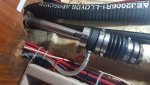
No, it doesn't provide support. The carbon piece with the vent pipe is attached to the bellows which in turn is mounted on the stern tube and floating around the shaft, the stainless rotor is fixed to the shaft and bears against the carbon. I'm lucky in having room to spare for fitting.
I got through two Radice moulded seals in the space of three years, each one eventually leaking unacceptably despite the engine alignment being as near perfect as possible. These seals eventually wore rings in the shaft, which was also new when the first Radice seal was fitted. The PSS seal as pictured leaves tha boat perfectly dry now
View attachment 138564
Does the shaft then just rely on the coupling to the gearbox for support to keep it centred in the stern tube
My shaft is just over 1m long (the stern tube is approx. 700mm long) and as far as I can tell there is no support anywhere along the length - it looks as though the packing in the old stuffing box kept the shaft centred
Yes, it does with mine, gearbox at one end and cutlass bearing at the other

It all depends on the design of the flexible coupling. Some are designed to allow the engine to move while the shaft is restrained by an aft bearing (alowing for both radial and angular misalignment) and some designed to keep the shaft centred in the coupling when there is no aft shaft bearing (only providing angular misalignment) . The Vetus Bullflex couplings have a centering ring that can be removed or left in depending on what is required. You certainly do not want the wrong combination.Does the shaft then just rely on the coupling to the gearbox for support to keep it centred in the stern tube
My shaft is just over 1m long (the stern tube is approx. 700mm long) and as far as I can tell there is no support anywhere along the length - it looks as though the packing in the old stuffing box kept the shaft centred
Not specifically, only in the sense that the bellows have a degree of rigidity. The Volvo/Radice does as the round part that attaches to the tube is effectively a cutless bearing approx 50mm long. In most cases this is all that is needed and is really no different from an conventional stuffing box on a short hose in that it supports the shaft while offering a degree of flexibility.Will a PSS seal provide some form of bearing/support for the shaft - difficult to ascertain this from the data sheets
One supplier advises that no modern seals provide shaft support so its a bit confusing when trying to decide which seal
Many thanks
