
Shackle bending

PabloPicasso

Well-Known Member
Joined
12 Feb 2010
Messages
2,916
Visit site
I need to bend a stainless pressed Shackle to fit into slots on a mainsheet car (the 40 year old previous shackle
e snapped with interesting results).

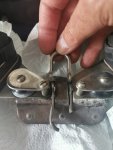
Should I just squeeze it in a vice, heat it and squeeze it, or some other method. Its not much of a squeeze needed but will have to be accurately done. IMG_20210617_173847_1.jpg
 
mmmm first I would find out why the original snapped ...

Second - I have bent a shackle a small amount in past but I do not recc'd it ... the shackle you show looks like a stainless plate shackle so will accept a small amount but as I see there we are not talking about closing the distance of the pin ends ... but the whole shackle to fit that slot ...
Heating will change the steel even after cooling .. so ??

I would be wary of this and may be a reason the original gave out ??

Sorry to not say go ahead ...
 
I suppose I would slip a piece of oak between the two faces and squeeze down on that to the correct and controlled width.

Then give the curved top face one smart tap with a hammer to maybe ease any pinch. Maybe
 
It's such a small adjustment that I would just squeeze it to size.

Richard

Look again .. its not just the ends to push together ... its the whole shackle length needs closing to match the slots.

I would be more inclined to machine the slots wider to be honest ...

Looks like a metric new shackle to replace an old imperial sized ?
 
Only reducing the pin width, but ideally along the complete length of the shakle

Perhaps machining out the slot would be easier/better?
 
Last edited:
I would just squeeze it in a vice with a piece of wood between to control it, as suggested. It looks like only a millimetre or two to get it to the original width. Don't heat it or hammer it to shape. Then try it and see how it works. he original may have broken through age and stress. Was there a shackle attached to a block by chance? if so there could be a lot of bending and twisting - replace with a short dyneema strop which I've done on my boat which made a big difference.
 
Only reducing the pin width, but ideally along the complete length of the shakle

Perhaps machining out the slot would be easier/better?
Shackles are made as we all know to specifications re strength and the metals molecular structure.
They are after manufacture under no stresses, squeezing the shackle even if it was just the ends would induce stress, to do so along its whole length would be much worse, would not recommend doing that.
As others have suggested modification to the slot presents no problems.
Also as others have pointed it some investigation into why the shackle failed would be wise.
 
mmmm first I would find out why the original snapped ...
Second - I have bent a shackle a small amount in past but I do not recc'd it ... the shackle you show looks like a stainless plate shackle so will accept a small amount but as I see there we are not talking about closing the distance of the pin ends ... but the whole shackle to fit that slot ...
Heating will change the steel even after cooling .. so ??

I would be wary of this and may be a reason the original gave out ??

Sorry to not say go ahead ...

In what way will the steel be changed and what effect will this have on its properties ?

.
 
If it were me, I would have no trepidation in making the tiny adjustment required for this shackle, but if you just squeeze the curved part in, you will find that the legs will not present squarely to the slots. I would advise that you first bend the legs out a small amount near the ends, then squeeze them together in a vice, with something solid held within the upper part of the curve, to keep the upper parts of the legs straight, while the lower parts are bent inwards the millimetre or two required.
Depending on the amount of sailing you do, start checking on its condition in about ten or fifteen years.
 
I cannot tell from your picture but I assume the 2 shackles are the same size, simply a different width.

The original shackle has clearly demonstrated it was of adequate strength (it was well, over, specified originally), its possibly been cyclically loaded and the fact that it lasted 40 years should give you comfort that the new shackle should last as long. I suspect it is unlikely you will keep the yacht for another 20 years (unless you were 10 years old when you bought the yacht) - stop fretting and go for it.

You will need to over bend the shackle to compress to the size you need, I'd do it slowly (bit by bit) as you don't know how much over bend you will need - it will spring back. I'd do it in a vice with wood in the 'slot' and wood either side of the shackle, to protect the shackle from any possible point load in the jaws. I'd have the whole shackle in the slot, not just the crown. When you squeeze the shackle just make sure it is in the vice 'square' and does not pop out (and hit you). I assume there is a shackle pin 'inside', the thread will now not be long enough - you will need to extend the thread. I would not use the old pin - it will have been stressed even though you might not see any evidence.

Whereas it would be interesting to know why the original failed the damage may have been caused, much, earlier - maybe you can recall some disaster that befell you 18 years ago - and have all the precise details?

Sorry nothing new here - I'm just reiterating good advise already posted.

I just wish other sailing kit would last as long as your failed shackle - imagine having an anchor chain, sails, halyards with a life of 40 years! I've had shackles fail, not unlike yours, supplied and specified by Ronstan and they lasted a few years.

Jonathan
 
In what way will the steel be changed and what effect will this have on its properties ?

.

By softening or hardening the metal depending on how hot he heats it and also on how he cools it. Done correctly - of course he could twist the whole thing as much as he likes .. but only if done correctly.

He's replacing a shackle that takes the full sheet load of his mainsail and often NOT in direct line of the throat - the strongest direction of a shackle.
 
I'm not quite sure why he is going to heat it - as has been mentioned the deformation needed is, very, limited (and could be completed with a Mole wrench) but you have more control with a bench vice - and if you have one (a bench vice) it really seems a bit perverse not to use it.

Jonathan
 
By softening or hardening the metal depending on how hot he heats it and also on how he cools it. Done correctly - of course he could twist the whole thing as much as he likes .. but only if done correctly.

But surely you cannot harden or soften 300 series stainless steels by heat treatment as you can with plain carbon steels because the FCC austenitic structure, only stable at high temperatures in carbon steels, is stable down to room temperatures .

.
 
Top