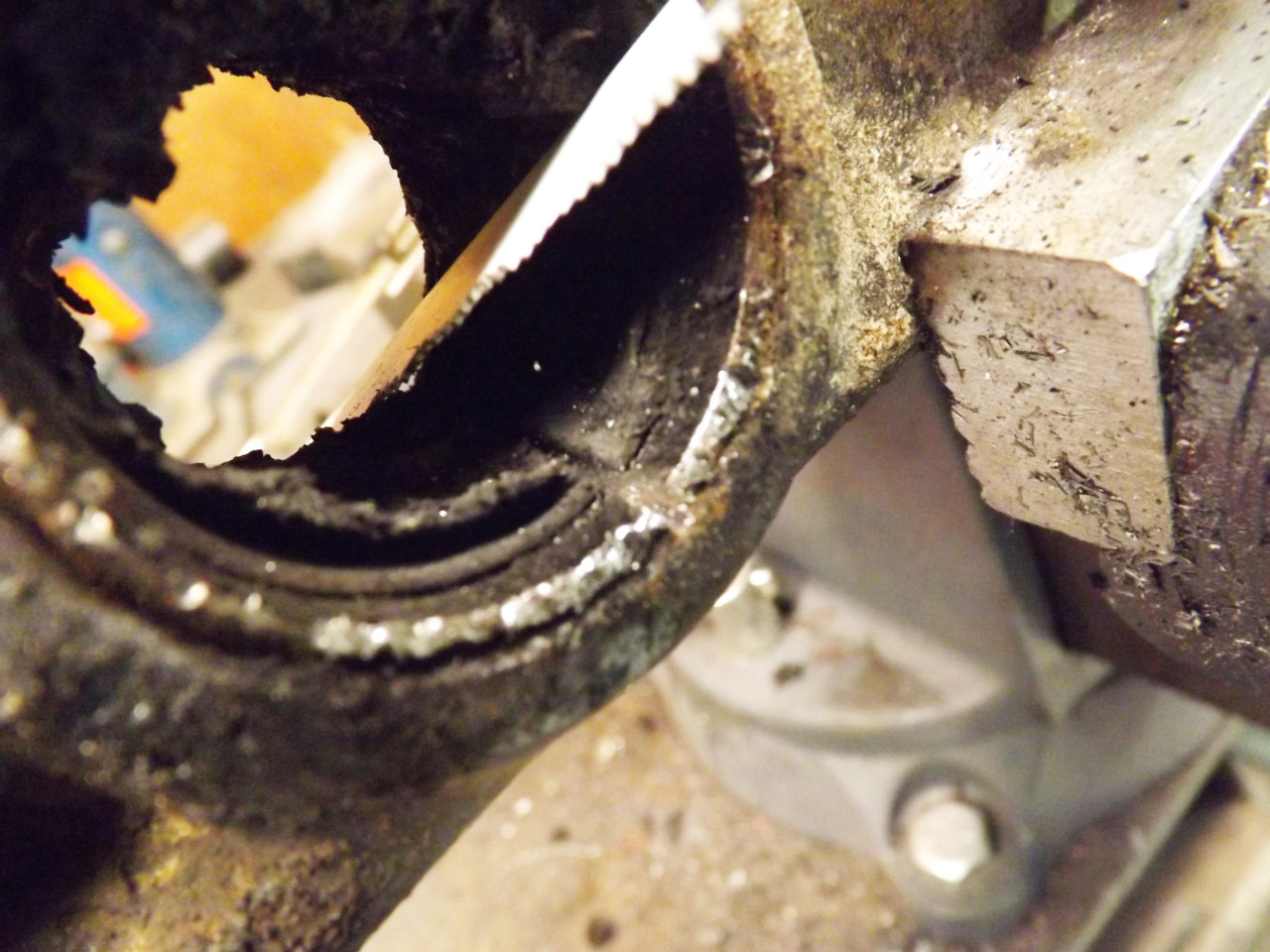
Seperating 2 aluminum components

Ian_Edwards

Well-Known Member
Joined
9 Feb 2002
Messages
2,222
Location
Aberdeen Scotland
Visit site
I'm in Australia at the moment avoiding the worst of the Aberdeen winter.
Trying to remove to mast heel casting from a 50year old mast. The mast is off a Cousair sailing dinghy, built by de Havilland, and originally used to train recruits in the Australian Navy.
The heal is held fast by Aluminum to Aluminum corrosion.
The pop rivet has holding it has been drilled out
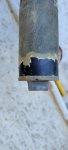
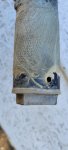
20221205_145624.jpg
20221205_145520.jpg
I've tried boiling water and a cold chisel + big hammer, but can't get it to move.
Any ideas on how to soften the corrosion which is gluing the casting into the extrusion.
Classically I'd try vinegar. But it hard to see how the vinegar can be effective, there's very little surface area for it to react with.
The mast is off the boat and in the garage, so I have access to mains power.
 
All possibilities must be tried, also alternating use of heat and penetrating rusto solvent/oil, sitting for several days adding further oil to do its trick.

Can it be drilled or milled out?

While waiting, you might ponder what to do if it never comes loose :)
Cut off, extend with bushing + new pipe and plug?
 
Last edited:
Can you drop anything weighty down from the other end of the mast. A length of thin galvanised, or aluminium, pipe for instance. Then shake the mast up & down so the weight acts like a hammer from the inside & knocks the fitting off.. But you may not have access if the other end is tapered to a small point. Plus the mast may be too heavy to hold upright. But it does look like a dinghy mast.
If you can get a weight in but not lift the mast then tie a whipping twine to the weight & just keep dropping it with the mast in the upright position
 
Thanks for the replies.
I'll try plus gas.
There's no way of getting a weight inside. All the halyard are external, and the mast head is a welded construction.
If I can't get it off then I could saw off 10mm or so off the extrusion, being careful not to cut into the casting. Loosing 10mm of the mast height is going to make any difference. The boat is only used to teach grandchildren to sail.
 
Have you tried tapping round and round the stuck region with a hammer and block of wood while supporting the opposite side on something firm? Maybe slightly distorting and expanding the mast section will loosen it.

Is the bottom sufficiently solid to drill and tap a hole for a slide hammer?
 
Try a hot air gun and then plunging the end into a bucket of diesel. Repeat.
I’d be pessimistic though. The corrosion area is large and it’s doubtful if anything will penetrate and loosen it.
 
The corrosion product reacts with acid, but unfortunately so does aluminium. I have had success separating a masthead antenna base from its bracket by dripping hydrochloric acid onto it. Just recently I have cleaned up an aluminium stanchion base that was badly encrusted with corrosion by the same means. The reaction of acid with aluminium is a lot slower than with the corrosion product, so keeping an eye on it and washing afterwards is advised.
 
Thanks for the replies.
I'll try plus gas.
There's no way of getting a weight inside. All the halyard are external, and the mast head is a welded construction.
If I can't get it off then I could saw off 10mm or so off the extrusion, being careful not to cut into the casting. Loosing 10mm of the mast height is going to make any difference. The boat is only used to teach grandchildren to sail.

If all else fails, and you end up shortening the mast by cutting it immediately above where the plug ends, might you be able to fit a wooden chock under the mast step to restore the overall height without having to shorten the standing rigging? (I'm assuming it has standing rigging)
 
It looks as thought the plug is hollow. Cut off the bottom of the plug level with the end of the mast. then use a hacksaw blade or similar saw to cut length ways into the remaining plug material in several places around the inside circumference taking care not to damage the inside of the mast. Then using a small chisel or old screwdriver , you will be able to break it out in pieces. The mast heel is a simple design and if a new one is not available it will be easy to get one turned up on a lathe and the heel part cut by hand.
 
You can buy aerosol cans of a freezing mixture ,,, used by plumbers, I believe. I used one to dismantle a bicycle to remove the saddle pillar and the handlebar stem. Best, of course, if you have two different metals with different expansion coefficients but the effect of cooling is to disrupt and crack any corrosion product. Be careful as the mixture is said to go down to -80 C.
 
After fifty years of restoring antique motorbikes I would use heat. A large jet but a soft - oxy- acetylene users will know what I mean - flame played on the bottom casting for ten minutes will have a great effect in freeing the frozen bits. I would drill and tap the base for attatching a heavy old fashioned slide hammer. My old ones weight was at least a kilo. With the mast secured againt the movement of the slide hammer, plenty of heat and then get slide hammering.

Moto Guzzi front engine bolts were zinc plated steel. With six inches inserted through an alloy sand casting and road salt they stuck like $H1t to a blanket. The above method never failed. We had to repaint the frame tubes, but Moto Guzzi's paint was crap anyway, so it was an improvement.

Good luck.
 
We use white vinegar regularly for aluminium corrosion. A few days ago we had a kitesurf bag that had been left since last season. Its an aluminium zipper on plastic teeth. The aluminium zipper had corroded due to salt water. I placed the zipper and zip section on a bowl of white vinegar. After a couple of minutes it starts fizzing. After 15 mins it had stopped. It's then unfreezed with a pull and good as new.
You could leave the mast section over night propped up in vinegar to see if it will free up
 
Had this prob with some big spinnaker poles. By far the easiest was to lop off the end off the tube, remove the corroded bits off the fitting, clean up and re-set them with some anti corrosion past.
The difference in length was so small as to be no problem, as your mast sounds.
Curious about the GRP around the mast?

Edit: You could drill some holes above the rivit one until you find the end of the fitting . That would limit how much you need to cut off the end to free the fitting.
 
Last edited:
You could drill some holes above the rivit one until you find the end of the fitting . That would limit how much you need to cut off the end to free the fitting.
Or first cut close to the end, remove the plug end then continue. If feasible, cut/split the inner part of the plug with a hacksaw-blade, then remove

Thin-Line.jpg
 
The grandchildren are 5 and 6, so a little too young to let them loose on a job like this.
I'm planning to insert an aluminum sleeve inside the mast to reinforce it.
The previous owner, who had the boat from New, had laid the boat up when he got too old to sail, he sadly passed away about 2years ago. He used a rope tied around the mast just above deck level, to secure the boat. The salt water in the rope caused corrosion in the aluminum over many years, just above deck level. I repaired it 3 years ago with a glass epoxy bandage. This has worked well up to now, lots of miles under the keel since then. However, the bandage has started to peel.
I have a 1m length of aluminum tube which is has an OD just slightly smaller than the ID of the mast.
Plan A is to split the tube axially, do a bit of panel beating on it , so it is a close fit, slide it inside the mast. Fasten it in place with pop rivets, starting on the forward centre line of the mast and working radially out ward to pull the sleve into place.
The replace the heel plug.
I'm going to try vinegar tomorrow.
Plus Gas isn't on sale in NSW. I have a Bunning's alternative, and I'll give that a go if the vinegar doesn't work.
If all that fails I'll saw a bit off the bottom of the mast, and perhaps block up the heel to compensate.
The glass around the base of the mast was put there, in hast, to reinforce the attachment point for the kicking strap when it pullout last year. That will get removed and a new attachment point will be fitted through the sleve.
 
I'm in Australia at the moment avoiding the worst of the Aberdeen winter.
Trying to remove to mast heel casting from a 50year old mast. The mast is off a Cousair sailing dinghy, built by de Havilland, and originally used to train recruits in the Australian Navy.
The heal is held fast by Aluminum to Aluminum corrosion.
The pop rivet has holding it has been drilled out

View attachment 147253
View attachment 147254
I've tried boiling water and a cold chisel + big hammer, but can't get it to move.
Any ideas on how to soften the corrosion which is gluing the casting into the extrusion.
Classically I'd try vinegar. But it hard to see how the vinegar can be effective, there's very little surface area for it to react with.
The mast is off the boat and in the garage, so I have access to mains power.
Im often asked the question how to loosen stuck or corroded parts and the answer always is, heat, fiddle, tap, distort slightly, freeing oil, vinegar, combine all and e entuallyit cones loose. There is no definitive answer but heating seems to be the most effective
 
Top