
Senior 31 hull and keel

barryassheton

Well-Known Member
Joined
18 Jul 2010
Messages
77
Location
Ryde, Isle of Wight, England
Visit site
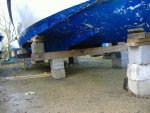
Hi, I have finally got my Senior 31 out of the water and noticed the keel was not as straight as it should be. The keel bolts are glassed in and the hull is water tight.

20140930_183603_Android.jpg

Has anyone had this issue before and know how easy it is to sort out the problem.

I also noticed there were once bilge keels attached but they are no longer there.

This is the first Senior hull I have ever worked on and any advice or even pictures of your own hulls to give me an idea of how the bottom is supposed to look would be great. Would it even be worth refitting bilge keels.

Grateful of any advice.

Thanks Baz
 
Keels

That looks a bit iffy. The Senior and RLM was available with 1 or 2 keels which bolted on, in my view twin is better with this hull esp for coastal use. The first boats were built for single keel and may not have the reinforced area inside the hull to take the force of twin keels so you may need to re-enforce this area.

The Project moulding in the pics below has moulded keels with wooden "shoes", these are larger in all ways than the standard Senior ones but show the idea. From 1969 the Project hull was moulded by Princess boats and not Senior mouldings and the hull is thicker to take the extra force.

View attachment 458752005_0103aug050002.jpg

In the pictures there is a gap between the hull and the supporting beam (railway sleeper), on the Senior there would be no gap as the keels are not as deep and both keels and the bare hull would touch the beam at the same time.

I would be very careful setting up twin keels to keep them lined up, lots and lots of measuring..

Hope this made sense...
 
That looks a bit iffy. The Senior and RLM was available with 1 or 2 keels which bolted on, in my view twin is better with this hull esp for coastal use. The first boats were built for single keel and may not have the reinforced area inside the hull to take the force of twin keels so you may need to re-enforce this area.

The Project moulding in the pics below has moulded keels with wooden "shoes", these are larger in all ways than the standard Senior ones but show the idea. From 1969 the Project hull was moulded by Princess boats and not Senior mouldings and the hull is thicker to take the extra force.

View attachment 45875View attachment 45876

In the pictures there is a gap between the hull and the supporting beam (railway sleeper), on the Senior there would be no gap as the keels are not as deep and both keels and the bare hull would touch the beam at the same time.

I would be very careful setting up twin keels to keep them lined up, lots and lots of measuring..

Hope this made sense...

We have decided not to install additional bilge keels as we do have the earlier version without the additional support however marks are visible on the hull where they have been installed at some point in the past. We are going to concentrate on repairing the keel and as it is only loose on the stern we are hoping it will be as straight forward as tightening or replacing the bolts but we wont know till we cut away the glass over the bolts.

Baz
 
We have decided not to install additional bilge keels as we do have the earlier version without the additional support however marks are visible on the hull where they have been installed at some point in the past. We are going to concentrate on repairing the keel and as it is only loose on the stern we are hoping it will be as straight forward as tightening or replacing the bolts but we wont know till we cut away the glass over the bolts.

Baz

I have heard of a boat (not one of these hulls) where the keel bolts were over-tightened after it had dried out and when the boat was launched the keel swelled and pulled the bolts into the hull creating leaks so I wouldn't advise over tightening.
Depending how badly warped the keel is you may find is less problematic to replace it?
 
Only if they were connected together!

A hull of this age will have absorbed moisture which can create an electrical path of sufficient conductivity to create problems, this could well lead to electrolisis or galvanic corrosion esp with the alloy drives that this boat has. (cathode anode?) perhaps this is why boat manufacturers of grp boats typically use timber for keels instead of steel?
 
Top