Selden mast furling trouble

MattK1969

Active Member
Joined
22 Aug 2022
Messages
48
Visit site
Morning from the Baltic

Got an old (35 years) mast furler. It's greased to within an inch of its life. Winches are all smooth running. Mast is straight.

Getting the sail in and out is a challenge. It's really really tight. In fact it's a nightmare. The thought of having to reef in a strong wind is worrying.

Is it possible that the furling thingy inside the mast can get bent? Any other ideas?

Tak!
 
You need to state what type it is. I know you are talking about an in mast system, but I over greased a Genoa furling system which just bound up the bearings over time. Strip and clean was the answer. A little grease was all that was required. It’s getting on at 35 years.
 
The sail is old. Wonder if it's a bit baggy?
Baggy sails with the stiffness gone are the kiss of death to an in-mast system .... they go in ok, but when unfurling they pick up loose folds from inside the mast and pull them out through the slot and if you don't immediately notice and stop, they jam hard in the slot and it's game over.

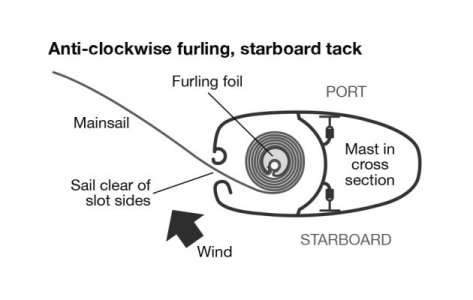
This can be mitigated if you unfurl with the sail partially filled and, if my memory serves me correct, on starboard tack. You want the exiting sail to be pushed hard against the port side of the mast slot, closing the gap completely and preventing any folds from being picked up and pulled out.

1719649806058.png
Old, worn sails don't end up neatly furled like in the above diagram, you end up with loose folds inside the mast.

Mainsail furling systems: an expert guide - Yachting Monthly
 
Baggy sails with the stiffness gone are the kiss of death to an in-mast system .... they go in ok, but when unfurling they pick up loose folds from inside the mast and pull them out through the slot and if you don't immediately notice and stop, they jam hard in the slot and it's game over.

This can be mitigated if you unfurl with the sail partially filled and, if my memory serves me correct, on starboard tack. You want the exiting sail to be pushed hard against the port side of the mast slot, closing the gap completely and preventing any folds from being picked up and pulled out.

View attachment 179182
Old, worn sails don't end up neatly furled like in the above diagram, you end up with loose folds inside the mast.

Mainsail furling systems: an expert guide - Yachting Monthly
Perfectly named "baggy wrinkle"!
 
Other than knowing old baggy sails are one of the main causes of sticky furling it is difficult to offer any real advice without knowing the system you have.
 
Baggy sails with the stiffness gone are the kiss of death to an in-mast system .... they go in ok, but when unfurling they pick up loose folds from inside the mast and pull them out through the slot and if you don't immediately notice and stop, they jam hard in the slot and it's game over.

This can be mitigated if you unfurl with the sail partially filled and, if my memory serves me correct, on starboard tack. You want the exiting sail to be pushed hard against the port side of the mast slot, closing the gap completely and preventing any folds from being picked up and pulled out.

View attachment 179182
Old, worn sails don't end up neatly furled like in the above diagram, you end up with loose folds inside the mast.

Mainsail furling systems: an expert guide - Yachting Monthly

This. Baggy sails + in-mast furling = trouble. Save yourself a lot of agony and buy a laminate mainsail, which will never get baggy until the last day of its life. Also more flexible, lighter, and thinner -- all of which improve in-mast furling function (not to mention sailing performance).

Other points: you need correct foil tension inside the mast. Read the manual.

You also need correct backstay tension, for a straight mast with no pre-bend.

Lastly, you need correct boom angle when furling or unfurling. Experimentation will show you what is required to get it in and out without problems.

You say it's well lubricated, but did you miss the top bearing? Many people assume that it's like your jib furler, that the swivel which comes down with the sail is all there is. Well, there is one more bearing at the top of the mast. Don't neglect it.
 
Is the sail easy to put in/out from the mast using the winch handle?
you need to stop any friction in the lines leading back to the cockpit and always furl/unfurl on a slight stb. tack. I've. also recently replaced my outhaul with a slightly thinner line which has helped.
 
Baggywrinkle #5 is right - everything is easier on starboard tack, with a little topping lift tension. Mine furls ok but can trap folds when unfurling if not on starboard. My sail is 35 years old but not over baggy. Mine is a Selden but no winch, only and endless line (which I can winch).

I tightened the foil which helped, and my biggest issue is friction in the ropes, not the mechanism. I often unfurl by pulling direct on the clew line and sometimes furl using the ropes direct at the mast base. I have terrible rope runs around the pilothiuse. Both are lightly loaded done like that. Excessive force (in light conditions) means something is wrong.
 
By no means an expert on in mast furling but I think it's not always starboard tack, it depends on the direction of furling ie is it clockwise or anti clockwise.
 
At 35 yearsold it will more than likely be a type RA.

http://www.uchimata.fr/wp-content/uploads/2014/10/Manual-for-furling-mast-Type-RA-GB.pdf

Mine is and I had the same problem. Having tried everything suggested I removed the bevel gear set up from the mast, not a difficult job, just a bit fiddley. When I stripped it down I found that the bottom set of balls (fig 11.1 bevel geat next to No 1) whilst having a upper cup, only ran on the flat surface of the lower gear which had worn sufficiently to create a cup but unfortunately the wear meant that the upper cup was rubbing against the bevel gear causing the friction in the system.
To remedy this I had the flat surface in the bevel gear restored by a mate with a lathe and bought a steel shim to give the balls a hard surface to run on. I replaced the balls with new ones then greased everything up and reassembled it all and the sail runs in and out like a dream now.
 
Top