Securing hull anode bolts on inside of hull

MattS

Well-Known Member
Joined
7 Sep 2020
Messages
570
Location
Kent
Visit site
Need to replace my hull anode, and will probably do the bolts whilst I’m at it for piece of mind. They both came loose when I removed it, so they both need re-fixing anyhow.

Looking at replacement bolts, they all come with a square washer for the external side of the hull, which I presume is so that you can get a good seal with some Sikaflex etc. - but they don’t seem to come with anything to spread the load on the internal side of the hull?

Example of what I mean here: MGDUFF Fixing Stud for Bolt On Anodes M10BSS

Is it not necessary to use a washer or similar on the internal side to help spread the pressure on the internal side of the hull?

What do you do to fix the bolts internally?
 
Wiser comments may well follow mine, but my thoughts are:
  • You have no great need to spread the load for an anode's fixing bolts. It should not come under any great strain, unlike a say a winch or a cleat.
  • You do however want the bolt to grip the hull very tightly, so that when you change the anode by undoing the nuts outside, or fiddle with the electrical connections inside, you do not rotate the stud passing through the hull.
So I suggest you fit the studs supplied by MG Duff, plenty of sealant, and do them up tighter - tighter than you will fix any subsequent nut, outside or inside.
 
Need to replace my hull anode, and will probably do the bolts whilst I’m at it for piece of mind. They both came loose when I removed it, so they both need re-fixing anyhow.

Looking at replacement bolts, they all come with a square washer for the external side of the hull, which I presume is so that you can get a good seal with some Sikaflex etc. - but they don’t seem to come with anything to spread the load on the internal side of the hull?

Example of what I mean here: MGDUFF Fixing Stud for Bolt On Anodes M10BSS

Is it not necessary to use a washer or similar on the internal side to help spread the pressure on the internal side of the hull?

What do you do to fix the bolts internally?
As post #2, those washers supplied are perfectly adequate on the inside of the hull. Stopping the studs from rotating when you fit the anode is a challenge as if they do rotate you may have broken the seal of the sealant. On a wooden hull you can recess the square plate into the hull, but not advisable on grp! I find the best method is, after the nuts are secured on the inside, not too tight so the sealant gets squeezed out, fit a strip of stainless steel with two holes drilled in it, over the pair or studs then fit a second pair of nuts and lock them down tight while holding the lower nut. The ss strip then locks the studs to each other preventing them from rotating.

Www.solocoastalsailing.co.uk
 
Why?

I'm interested in the choice/decision.
The galvanised ones last for at least 16 years, in my experience, and with stainless below the waterline there is always a risk of crevice corrosion. (also, I have not seen MG Duff specify what grade of stainless they use). The risk of galvanised is if the zinc of the anode completely wastes away then the studs start to corrode much quicker. In normal times this should not happen but it did to me in the first lockdown of 2020!

www.solocoastalsailing.co.uk
 
I bonded a 1in block of hardwood to the inside of the hull with epoxy and mounted the item through that. Makes a good solid job.

I have replaced the galvanized studs twice, I think, in 25 years; may use stainless next winter, now I have been reminded.

PS
Bloody hell, I won't be paying 50 quid for two bolts though :(
 
Last edited:
I bonded a 1in block of hardwood to the inside of the hull with epoxy and mounted the item through that. Makes a good solid job.

I have replaced the galvanized studs twice, I think, in 25 years; may use stainless next winter, now I have been reminded.

PS
Bloody hell, I won't be paying 50 quid for two bolts though :(

did think they were a bit pricey - hoping I can find a cheaper set with a bit of Googling!
 
As post #2, those washers supplied are perfectly adequate on the inside of the hull. Stopping the studs from rotating when you fit the anode is a challenge as if they do rotate you may have broken the seal of the sealant. On a wooden hull you can recess the square plate into the hull, but not advisable on grp! I find the best method is, after the nuts are secured on the inside, not too tight so the sealant gets squeezed out, fit a strip of stainless steel with two holes drilled in it, over the pair or studs then fit a second pair of nuts and lock them down tight while holding the lower nut. The ss strip then locks the studs to each other preventing them from rotating.

Www.solocoastalsailing.co.uk

thank you @dovekie @Plum

@Plum just so I can follow your stainless strip, am right understanding that this sits on top of the first nut inside the hull, and is held in place with a second nut? How does this strip prevent the studs from rotating?
 
Turn the ends up so it locks the flst of the nut. Use the bolt set supplied by Duff. No need to use stainless. As others say the plain bolts last for years.
 
thank you @dovekie @Plum

@Plum just so I can follow your stainless strip, am right understanding that this sits on top of the first nut inside the hull, and is held in place with a second nut? How does this strip prevent the studs from rotating?
yes, that is how I assemble it. If the nuts above the strip are tightened had down on the strip while holding the nuts below the clamping load will resist the turning of the studs when fitting or removing the anode nuts. I don't have a picture but just to be clear, the stainless strip is 1mm thick, 20mm wide with two 11mm holes 200mm apart.

www.solocoastalsailing.co.uk
 
Thank you. I'm still trying to get my head around the mixing of metals thing - is it ok to use a stainless steel strip with zinc galvanised bolts, or would I need to use stainless bolts too?
 
Thank you. I'm still trying to get my head around the mixing of metals thing - is it ok to use a stainless steel strip with zinc galvanised bolts, or would I need to use stainless bolts too?
No mention of stainless steel strip im MGDuff's fitting instructions.
If you feel want to secure the fist nut use some low strength Loctite

1617006446247.png
 
No mention of stainless steel strip im MGDuff's fitting instructions.
If you feel want to secure the fist nut use some low strength Loctite

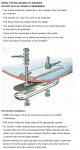
View attachment 112372

Interesting that they are showing it strengthened with a backing plate there, that was what I felt was missing so that you’re not putting the compression pressure on the hull itself (although I accept the pressure of a couple of bolts isn’t outrageous).

Which one is the fist nut @VicS?
 
Interesting that they are showing it strengthened with a backing plate there, that was what I felt was missing so that you’re not putting the compression pressure on the hull itself (although I accept the pressure of a couple of bolts isn’t outrageous).

Which one is the fist nut @VicS?
If you read the text you will see that it says, "stiffen the inside of the hull if necessary". Up to you to decide if it is necessary to support an anode but I would have thought that anything other a very lightly constructed hull will be stiff enough. If it isn't then l not want to go to sea in it.

By "first nut" l mean the one securing the stud to the hull
 
If you read the text you will see that it says, "stiffen the inside of the hull if necessary". Up to you to decide if it is necessary to support an anode but I would have thought that anything other a very lightly constructed hull will be stiff enough. If it isn't then l not want to go to sea in it.

By "first nut" l mean the one securing the stud to the hull

I did read the bit about stiffen if necessary, and wondered what one might consider to be 'necessary' - I do think the hull is stiff enough, but being relatively new to this stuff I lack the confidence to assume without asking! :)

Understood re: first nut - I thought 'fist nut' was another new nautical term for me to learn! ?
 
I did read the bit about stiffen if necessary, and wondered what one might consider to be 'necessary' - I do think the hull is stiff enough, but being relatively new to this stuff I lack the confidence to assume without asking! :)

There is no right or wrong answer to many of these things, if there was we would have no entertaining 50 page skirmishes.
In a lightweight or cored hill you might want the maximum support.

Personally, I didn't like the look of the point loading.

Putting a block behind it. with epoxy, was almost zero cost and hardly any effort. So I can't see the downsides, for me.
I like that the electrical connections have their own little plinth on the inside of the hull, I have it labelled for the wiring. I cant imagine the bolts becoming loose or leaking because the effective thickness is now 1.5in.


.
 
No mention of stainless steel strip im MGDuff's fitting instructions.
If you feel want to secure the fist nut use some low strength Loctite

View attachment 112372

Personally I don't think that design is very good , there is no way to prevent either stud from rotation when tightening the stud into the hull

I would join the 2 studs with a steel strap inside with the studs welded to the strap. Tis will prevent the stud from loosing when tightening the anode nuts.

You also need large washers on the outside to give a large sealing service so no water can get between the stud and the hull. With that stainless steel would not be subject to crevice corrosion

My anodes are attached with stainless steel (316) studs welded to my hull, using a strap on a GRP hull would give the same security of the anode.

My stainless steel studs have shown no corrosion at all wit over 10 year 24/7/365 immersion.

Locking the nuts I use stainless steel spring washers and nyloc nuts.
 
Personally I don't think that design is very good , there is no way to prevent either stud from rotation when tightening the stud into the hull

I would join the 2 studs with a steel strap inside with the studs welded to the strap. Tis will prevent the stud from loosing when tightening the anode nuts.

You also need large washers on the outside to give a large sealing service so no water can get between the stud and the hull. With that stainless steel would not be subject to crevice corrosion

My anodes are attached with stainless steel (316) studs welded to my hull, using a strap on a GRP hull would give the same security of the anode.

My stainless steel studs have shown no corrosion at all wit over 10 year 24/7/365 immersion.

Locking the nuts I use stainless steel spring washers and nyloc nuts.

Ah that's an interesting idea - would certainly remove the risk of accidentally turning the bolts and breaking the seal when swapping the anode (which is what I've ended up doing this time).
 
Top