
Second tide of the day higher. Why?

Mark-1

Well-Known Member
Joined
22 Sep 2008
Messages
5,550
Visit site
We're going towards neaps so I'd expect the HW's to become progressively lower.

In fact, at Portsmouth and various other places around the Solent the second tide of the day looks higher at the moment. (According to the tide tables.) The overall trend is still downwards.

I'm sure I've noticed this before and even talked about it, but I've long since forgotten what I concluded!

What's going on? Artifact of the tide calculation algorithm? Sun and moon lining up differently morning and evening?
 
That is related to the double tides which mean that the curves are not equal and the second high of the day is higher than the first. Much more pronounced in Poole where today the 06.48 high is 1.7m and the 19.26 is 1.9m.
 
Interaction of Sun, Moon and Earth far more complicated than first meets the eye.
The tide at Portsmouth is a kind of wave which was at Plymouth about 6 hours before.
So midnight at Plymouth, you might expect the Sun to have a different influence from Mid-day?
 
We're going towards neaps so I'd expect the HW's to become progressively lower.

In fact, at Portsmouth and various other places around the Solent the second tide of the day looks higher at the moment. (According to the tide tables.) The overall trend is still downwards.

I'm sure I've noticed this before and even talked about it, but I've long since forgotten what I concluded!

What's going on? Artifact of the tide calculation algorithm? Sun and moon lining up differently morning and evening?
Second tide frequents Scuttlebutt and always wants the last word?
 
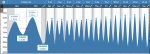
Tides on the E coast are often like that too. I'd assumed it was the interraction of the water-mass of one tide affecting the flow of the next and influenced by coastal/hydrographic features rather than direct astronomical effects. Here's Lowestoft for the next ten days. Interestingly it is the lows that seem to show the larger variation, and apparently in opposition to variation in the highs.

Just don't cut it too tight on the scrubbing-posts!

Screenshot 2021-07-02 at 11.47.35.png
 
Last edited:
It's called a Mixed Semidiurnal tide cycle according to this page:
Types and Causes of Tidal Cycles - Tides and Water Levels: NOAA's National Ocean Service Education

Quote from the page (go to the page to see the graphics):
"Diurnal tide cycle (upper left). An area has a diurnal tidal cycle if it experiences one high and one low tide every lunar day. Many areas in the Gulf of Mexico experience these types of tides.
Semidiurnal tide cycle (upper right). An area has a semidiurnal tidal cycle if it experiences two high and two low tides of approximately equal size every lunar day. Many areas on the eastern coast of North America experience these tidal cycles.
Mixed Semidiurnal tide cycle (lower middle). An area has a mixed semidiurnal tidal cycle if it experiences two high and two low tides of different size every lunar day. Many areas on the western coast of North America experience these tidal cycles."
 
Basically, tides are the sum of a variety of waves at different periods. The predominant one is the semi-diurnal one (12 hourly), but there are components daily, monthly and many other periods, all deriving from the rotation of the earth and the position of the sun and the moon, and each component is amplified or reduced by the properties of the local tidal basin. The main ones we notice are semi-diurnal, diurnal and monthly. You're in an area where the diurnal component is noticeable.
 
We're going towards neaps so I'd expect the HW's to become progressively lower.

In fact, at Portsmouth and various other places around the Solent the second tide of the day looks higher at the moment. (According to the tide tables.) The overall trend is still downwards.

I'm sure I've noticed this before and even talked about it, but I've long since forgotten what I concluded!

What's going on? Artifact of the tide calculation algorithm? Sun and moon lining up differently morning and evening?

Very similar elements to those you were given when you asked this: :)
Is half tide height always the same? (All other things being equal)
 
Yes, at the time I thought your posts were (arguably) going into more detail than was required. ...but if I'd thought about them a but more and they'd stuck in my mind I wouldn't have needed to ask this question. So I've given you a pair of retrospective 'likes' in that thread. Damn, I'm a nice guy. ?
The "higher HW with decreasing amplitude", if/when it happens, has a bit more practical implications than variations in the level of half water: should one get stuck at HW with tides going towards neaps, there is some chance of being able to have a higher later HW instead of having to wait for weeks or possibly months :)
 
The "higher HW with decreasing amplitude", if/when it happens, has a bit more practical implications than variations in the level of half water: should one get stuck at HW with tides going towards neaps, there is some chance of being able to have a higher later HW instead of having to wait for weeks or possibly months :)

Yup, that's why I noticed. I'm going on the putty and I'd prefer not to be neaped for three days. (Although I will be allowing a large margin for error and three days in one place wouldn't be a chore.)
 
Yup, that's why I noticed. I'm going on the putty and I'd prefer not to be neaped for three days. (Although I will be allowing a large margin for error and three days in one place wouldn't be a chore.)
This site can be helpful, to check whether the tide is following predictions, or being influenced by weather:
Real-time data – UK National Tide Gauge Network | National Tidal and Sea Level Facility

Some places, you can get an instant tide gauge reading from the Harbour office over VHF.
 
We beach quite frequently, to clean the hulls, and we choose days where the following high tides are always predicted to be higher than the tide on which we beach. We also beach 1 hour after high tide. We beach stern first - as its easier to re-float moving forward. We beach on highish high tides.

If we plan to spend more than 24 hours, we need more time, then we deploy the bow anchor on beaching and an anchor off each transom using the dinghy. We wipe down as the tide retreats - as we then wipe down with accessible seawater. Cleaning props we leave till we have dried out.

Our tides are not large - 2m is slightly above average.

Take a note of any moorings seaward of you - they are easy to see if you beach in daylight, less easy if you float off in the dark.

Jonathan
 
Top