
Seaworthy or not Seaworthy

My question is: when I look at a boat's specification how do I judge if this is a "relative" more seaworthy boat than the other ones?
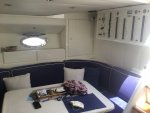
You look for subtle details .Here‘s a few in pictures.
0906A7F5-EA5E-4B8A-8A97-AEDD93BABC0D.jpeg
Storm shutters on the portholes you can swing them down to add a metal cover to protect against breakage breaches .
The switches on the electrical panel are silver coated .It’s reckoned better to protect the contacts in a marine environment.
All led so you can see running or on ie bilge pumps .
One switch for the ceiling lights turn a red only on for night vision like a military boat .Dash back lights are all red too .
0D9ABD6B-9822-4A2C-B9DD-33B0C2B4AF2A.jpeg
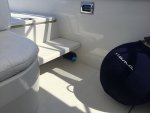
Large scuppers ( one on each side ) to drain the cockpit or equivalent. Ideally two one each side in case of a temp blockage .
C17CB711-CC98-4968-A783-561CAD5161EB.jpeg
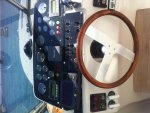
Water in fuel alarms (under the key fobs ), and emergency stop pulls in red above the keys .Dash warnings / alarms for the bilge pumps and geny overheat .Manual bilge pump switches .The MAN screen shows and displays the alarm “ inlet water pump pressure “ amongst 15 other engine parameters.Basics are dials but nice to double up with digital, or the other way round . Saves a bag overheat + impeller knacker as you see the water pressure immediately drop .

Manual cable Morse controls for the engine + gearboxes .Gearboxes can be manually operated in the ER as well .
So less chance of a electrotwackery screw up rendering zero motion .

3521E230-9D4E-421A-8DBD-7E30598703DE.jpeg
Ergonomics a foot rest and big solid wheel to hold on .A foot stand to see over the top rail if you wish .
Those five toggles are another “ seaworthy “ touch .Manually cable operated for closing the air vents in the ER .Inside it has strong spring loaded flaps which snap shut if you pull .Two tank fuel cock closers and the red is manual gas release of the inert gas .It’s got a wax bulb auto bulb as well .

Anchor is always tied off in its locker but we have a counter as well so hopefully spot a unintended deployment?
 
Last edited:
You look for subtle details .Here‘s a few in pictures.
View attachment 107396
Storm shutters on the portholes you can swing them down to add a metal cover to protect against breakage breaches .
The switches on the electrical panel are silver coated .It’s reckoned better to protect the contacts in a marine environment.
All led so you can see running or on ie bilge pumps .
One switch for the ceiling lights turn a red only on for night vision like a military boat .Dash back lights are all red too .

View attachment 107397
Large scuppers ( one on each side ) to drain the cockpit or equivalent. Ideally two one each side in case of a temp blockage .

View attachment 107398
Water in fuel alarms (under the key fobs ), and emergency stop pulls in red above the keys .Dash warnings / alarms for the bilge pumps and geny overheat .Manual bilge pump switches .The MAN screen shows and displays the alarm “ inlet water pump pressure “ amongst 15 other engine parameters.Basics are dials but nice to double up with digital, or the other way round . Saves a bag overheat + impeller knacker as you see the water pressure immediately drop .

Manual cable Morse controls for the engine + gearboxes .Gearboxes can be manually operated in the ER as well .
So less chance of a electrotwackery screw up rendering zero motion .

View attachment 107399
Ergonomics a foot rest and big solid wheel to hold on .A foot stand to see over the top rail if you wish .
Those five toggles are another “ seaworthy “ touch .Manually cable operated for closing the air vents in the ER .Inside it has strong spring loaded flaps which snap shut if you pull .Two tank fuel cock closers and the red is manual gas release of the inert gas .It’s got a wax bulb auto bulb as well .

Anchor is always tied off in its locker but we have a counter as well so hopefully spot a unintended deployment?
Unfortunately this is what the outside looks like
 
Agree that it is a vague term open to interpretation but for me it is about design and condition.

The latter relates to everything being properly maintained, operational and available (e.g. fuel)

The former covers a multitude of factors including those listed by Deleted User, the level of equipment fitted and overall design, particularly hull design e.g. planing hulls with a broad beam compared to length, shallow V and very flat sections could be said to be not as seaworthy as a narrower beamed, longer deep V hull. Similarly, some semi-displacement boats would be regarded as being more seaworthy than many competitors.

It is all relative - our Hardy is probably more seaworthy than our previous Sealine S34 but the latter was a capable boat and more than good enough for most recreational boaters.
 
Vessels should be seaworthy enough to be operated safely with comfort in the expected conditions, not fall apart, and to have a margin for the weather not behaving as expected. Some element of redundancy also helps.

If all vessels needed to be able to cope with 15metre waves, we'd be helming offshore support craft.

Positioning of switches etc. can trigger the facepalm emoji, but these things don't generally affect the above.

The one thing I am paranoid about is my steering system - twin everything else, but only one hydraulic steering system with no manual way of steering or even fixing the outdrives in one position.
 
e.g. planing hulls with a broad beam compared to length, shallow V and very flat sections could be said to be not as seaworthy as a narrower beamed, longer deep V hull.

Other combinations are possible.
A Sealine SC35 has a broad beam compared to length, but also a deep-ish-V.
It works very well for it's size if things get choppy, but it's not particularly quick or efficient.
 
Thank you very much for such an informative inputs.

This is my first time to know the term "sea kindness" and to know it is not necessary relate to "sea worthy".
I thought seaworthy is highly related to "comfortable".

Safety is always my top priority, but as a casual boater I also need "sea kindness". To some certain extent, maybe I need a little bit more "sea kindness" .....

If wind speed over 5m/s, stay in marina.
If wave height over 1.3 meter, stay in marina.
If swell period less than 5 seconds and over 1 meter, stay in marina.

My daughter complains about my boat is not as "stable" as other boats in similar size. (about 27' ~ 29')

Now I know the seaworthy is not a scientific index, it is vague.

I guess it is impossible to arrange sea trial for each boat on the list before signing the contract, even in Europe, so I thought there are some
methods to evaluate the candidates by reading the specifications.
 
For me seaworthyness depends mostly on the condition of the boats machinery.
Will it get me there and back in one piece without any trouble or the need to call for assistance.

If you choose to go out in conditions likely to overwhelm the boat its not the boats fault.
Suspect inexperience renders any catagory useless . ?

For me it's:

Does it float... and if so... how long for.

#priorities
 
That was my feeling too. The crew is everything. A boat caught out in dangerous conditions with a good experienced crew, so one man can be pumping out the engine room, another helming and another tying down everything, could survive. Whereas the same boat with just the captain will drown and probably so would the captain.
Nonetheless, if I was in very bad weather, I would rather be on one of those boats that are regarded as ‘seaworthy’, like a Nordhavn or Grand Banks.
Are women not allowed to pump out engine rooms?
 
If we want to avoid being pedantic, I suspect the definition of seaworthiness here is something along the lines of: in which boat will the less boaty types stop having fun in first (or last, I guess.)

One of my family’s companies was the regional dealer for several of the large GRP builders back in the day. Back then, I think there was a difference between brands. If things started to get a bit rough, I sure as hell would rather be out in one of the 65’ sportfishers with the Deep V hull than the gin palace brand. Of course, this was all pre-stabiliser days. But if we’re comparing like to like re: general categories of boats? (And yes, Porto, your Itama ain’t in the same category as a flybridge!) I’m not sure there’s a massive difference. I guess that’s still true to an extent. A Viking sportsfisher is going to do better when things kick up than your same sized flybridge Prinseekline or Aziretti.

Nowadays, most of the mainstream builders give the buyers what they want, and it seems what the market wants in a mainstream plastic boat is interior volume, and there’s not a whole lot of differentation in hull forms to cause radically different “seaworthiness”/seakindliness, and hey, if it turns out to be a bit less stable than we’d like, whack a bigger Seakeeper gyro in it, or add a second etc. Rather than worry about 2 degrees of deadrise or a stepped hull, the designer is putting pod drives in so they can hang them under the swim platform and have 20% more space for cabins than the equivalent hull with inboards.

Generally, I agree with Mike, more displacement, all else being equal, never hurts. But deadrise and such can make a difference once the difference between two types of hulls gets significant enough. But one thing that is very difficult to compare is how a boat feels when it pitches and rolls, especially rolls. Rolling in and of itself, unless you’re worried about the white gloved stewie having to distribute canapés from a tray, isn’t bad. The period of a boat’s roll, and other factors can often mean that the one that rolls more degrees from horizontal feels more comfortable. That’s why the Nordhavn even as it rolls, feels “better” than the planing hull in certain sea states.

Of course, who’s at the helm and crewing makes a difference. I’ve felt perfectly safe at almost 100mph coming across the Gulf Stream with my mate’s friend who was a professional offshore powerboat racer at the helm, and I’ve been terrified with a sponsor’s wife at the helm of a maxi sailing yacht in 10 knots of wind because the loads on the rig of an 85 foot racing boat were high enough that when things went wrong, people got hurt.

Peter, unless you’re looking to go up in size considerably (and we all know boat owners never ever want to buy bigger boats!) I’m not sure there will be a big difference if you’re comparing relatively similar models from a range of yards.
 
Peter, unless you’re looking to go up in size considerably (and we all know boat owners never ever want to buy bigger boats!) I’m not sure there will be a big difference if you’re comparing relatively similar models from a range of yards.
In fact, I am considering to get a bigger boat. My current is Quicksilver Weekend 855 with 7.99 meter hull length.
Is a 40' boat considerably larger and can significantly feel the "sea kindness"?

By the way, you said " ...boat owners never ever want to buy bigger boats!". Why? or this is just a joke?
 
In fact, I am considering to get a bigger boat. My current is Quicksilver Weekend 855 with 7.99 meter hull length.
Is a 40' boat considerably larger and can significantly feel the "sea kindness"?

By the way, you said " ...boat owners never ever want to buy bigger boats!". Why? or this is just a joke?

Peter, sorry, forgot the ;):p:LOL:

Just going from 8m to over 12m LOA, with the substantial increase in displacement that a 50% in length usually comes with, should make your little one much happier!

What’s the boating like in Taiwan? I assume you can’t head to Kinmen for a weekend outing. ;) Spent quite a bit of time in SE Asian waters, but more down towards Langkawi and such.
 
Peter, sorry, forgot the ;):p:LOL:

Just going from 8m to over 12m LOA, with the substantial increase in displacement that a 50% in length usually comes with, should make your little one much happier!

What’s the boating like in Taiwan? I assume you can’t head to Kinmen for a weekend outing. ;) Spent quite a bit of time in SE Asian waters, but more down towards Langkawi and such.


:ROFLMAO::ROFLMAO::ROFLMAO: I thought it was a joke, but would like to confirm....

Boating in Taiwan is still in stone age. Boaters are the "meat" and the agents/dealers are the T-Rex. The natural environment is not that
friendly either.

My marina is on the east side of Taiwan, so it is too far to go to Kinmen for a weekend trip. I go to Turtle island frequently.

Very nice to know that the 40' boat will provide much happier cruising experience than my current one.
 
Thank you very much for such an informative inputs.

This is my first time to know the term "sea kindness" and to know it is not necessary relate to "sea worthy".
I thought seaworthy is highly related to "comfortable".

Safety is always my top priority, but as a casual boater I also need "sea kindness". To some certain extent, maybe I need a little bit more "sea kindness" .....

If wind speed over 5m/s, stay in marina.
If wave height over 1.3 meter, stay in marina.
If swell period less than 5 seconds and over 1 meter, stay in marina.

My daughter complains about my boat is not as "stable" as other boats in similar size. (about 27' ~ 29')

Now I know the seaworthy is not a scientific index, it is vague.

I guess it is impossible to arrange sea trial for each boat on the list before signing the contract, even in Europe, so I thought there are some
methods to evaluate the candidates by reading the specifications.
“ Sea kindness “ you need to look at the dead-rise and the centre of gravity in relation to the centre of lift .
So a mid engined deep v shaft drive .
@ your prescription of 40 ft look at Monte Carlo , Itama 38 / 40 , Magnum 40 , Early Baia B1 .Pershing 37

Second division
Slightly smaller ( less weight ) and rear engined , Donzi -( up to 24 degree DR ) and Fountain with outboards + Boston Whaler s ,but they are not as balanced as the mid engined ones and will porpoise more or drop there sterns and land bow up coming off the top of waves at speed .Also Sunseeker Superhawks, early or newer SH 43 ? budget permitting. Huntons and Windy are other sterndrive boats .Depends how keen you want a sterndrive ? Axopar are another brand of rear engines but new players .

My boats in the next category up 40-50 , ft at 14.5 m ( 48 ft ) loa with a dead rise of 23 degrees.All itama are over twenty btw .
Fully loaded we are @ around 20 tonnes so crushes waves .

The ride comfort is a factor of the vertical accelerations , the bouncing if you like which in big waves turns into slamming .
The forces of vertical acceleration maths formula means the dead rise is squared or cubed somewhere in the equation.

So every degree makes a bigger difference that it’s worth if you like with the “sea kindness “.For a given length beam ratio .

For your daughter ( like my wife ) a stable ride was important and I took professional advice from a Riva dealer in Monaco who showed me the hull underside of a Rivarama 44 .It’s internal layout did not suit so he sent me off in search of Itama in St Tropez ..

I did test drive before buying as is the way in the Med .

There is no luck or strange co incidences here it’s all scientific .Ideally if you want to max out on ride comfort go for a mid engined shaft drive , with CAT Cummins or MAN motors with a dead rise over twenty degrees .Compromises start to creep in if you move away from this formula .
 
A good reason to get rid of the lower helm on a flybridge boat
[/QUOTE


A bit radical perhaps but ?
How about actually designing the lower helm so as to actually be able to see something useful out of the windows. ?
On one boat even the view out the front was compromised.
 
Actually a lot of boats with ‘sky lounges’ (translation, enclosed flybridge) don’t have a lower helm.
I don’t like helming from the flybridge, in fact I never do. But I have good visibility and a helm door onto the side deck.
 
Top