Sealine S24 Kad32 DPE Outdrive - Geeting Antifreeze into seawater System

Bigplumbs

Well-Known Member
Joined
7 Nov 2015
Messages
8,161
Location
UK
Visit site
I have winterised many Outboards and Now come to my Sealine S24 with KAD 32 and DPE Outdrive

The Freshwater Cooling side of the engine is fine and has plenty of Antifreeze in it. I am about to have the boat lifted for the first time (in my ownership) and want to make sure I get some Antifreeze in the leg and the Seawater side of the system. On my outboards and indeed my Mercruiser drives I would just use Muffs and a bucket full of water/Antifreeze mix.

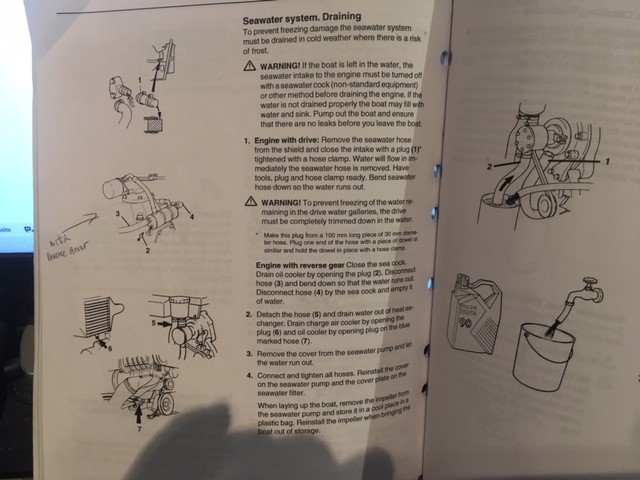
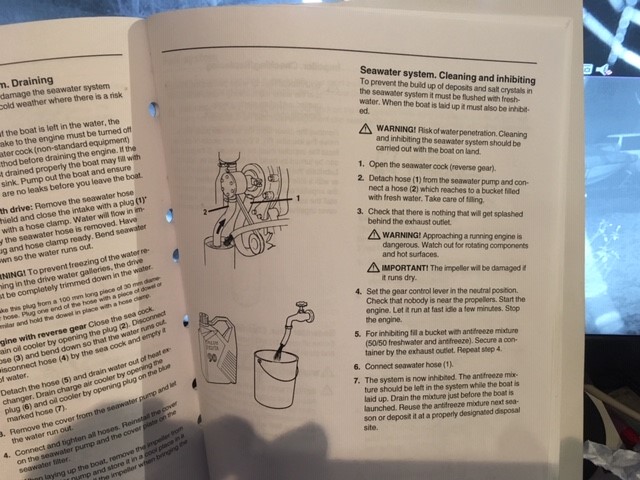
Looking at the drive the water intake is very near to the front of the leg and I am not sure Muffs will fit and provide a reliable flow of water. I have read the manual and it talks about removing the hose from the Bottom of the impellor unit and putting a second hose on this into a bucket of water. This looks quite difficult given the space I have in the engine bay and also would not get any antifreeze in the leg.

This Engine and drive is very common so I was wondering how others do it when their boat is out of the water. If anyone successfully uses muffs I would be very interested as this would be my preferred method.

Thanks

Dennis
 
I am interested in why you would do this.

Either there boat is in the water in which case it will get sea water in it whatever you do - outdrives I have had don’t have a sea water cock for the engine. If it is out of the water it will drain
 
I am interested in why you would do this.

Either there boat is in the water in which case it will get sea water in it whatever you do - outdrives I have had don’t have a sea water cock for the engine. If it is out of the water it will drain

It is to protect the raw water side of the engine cooling system and the outdrive from freezing in the winter when the boat is out of the water. It does not necessarily completely drain I have been lead to believe.
 
I am interested in why you would do this.

Either there boat is in the water in which case it will get sea water in it whatever you do - outdrives I have had don’t have a sea water cock for the engine. If it is out of the water it will drain

That method will only drain the seawater down line of the impellor. You still have seawater in the Strainer, oil cooler, heat exchanger, intercooler and exhaust manifold
 
get a bucket of antifreeze mix and a hose of equal ID to the intake hose of the raw water pump. Remove raw water pump intake hose for the hose to the bucket. Start engine until antifreeze starts coming out the exhaust. Remove impeller for the winter. Refit intake hose. Pour remaining antifreeze into basket strainer until antifreeze starts coming out drive intake vents. (Mainly to stop any ice damage occurring at the steering hydraulic fluid heat exchanger which is inline rather than any damage to the drive itself which should drain)

edit.

Note the intake hose from the transom shield to the raw water pump dips below the transom shield and runs along the bottom of the block and so water can remain in there if not drained
 
Last edited:
Disconnect the water intake pipe on the back of the outdrive, shove a short length of hose in the intake pipe and the other end in a bucket of antifreeze. Start the engine to pull it through.
 
With my KAD32 I made a “hose thing” from a section of large hose that connected to the base of the raw water pump, that then went to an adaptor and a regular sized hose that went into a bucket of antifeeeze.

Start the engine for 30 seconds, gurgle gurgle, and the raw water side is full of antifreeze.
 
Last edited:
Disconnect the water intake pipe on the back of the outdrive, shove a short length of hose in the intake pipe and the other end in a bucket of antifreeze. Start the engine to pull it through.

Is this intake location on the outside of the boat because if it is on the inside I wont be getting to that very easily
 
get a bucket of antifreeze mix and a hose of equal ID to the intake hose of the raw water pump. Remove raw water pump intake hose for the hose to the bucket. Start engine until antifreeze starts coming out the exhaust. Remove impeller for the winter. Refit intake hose. Pour remaining antifreeze into basket strainer until antifreeze starts coming out drive intake vents. (Mainly to stop any ice damage occurring at the steering hydraulic fluid heat exchanger which is inline rather than any damage to the drive itself which should drain)

edit.

Note the intake hose from the transom shield to the raw water pump dips below the transom shield and runs along the bottom of the block and so water can remain in there if not drained

Bruce

That seems to be a good method. As the boat is someway from me and after the lift out (when I wont be there) I would like to go armed with the correct dia of pipe. Does anyone know what this dia is on a KAD32P

Regards

Dennis
 
Is this intake location on the outside of the boat because if it is on the inside I wont be getting to that very easily

I do it from the inside direct to the raw water pump intake. The bucket doest have to be at engine level. You can have it in the cockpit.
 
With my KAD32 I made a “hose thing” from a section of large hose that connected to the base of the raw water pump, that then went to an adaptor and a regular sized hose that went into a bucket of antifeeeze.

Start the engine for 30 seconds, gurgle gurgle, and the raw water side is full of antifreeze.

Where did you stand the Bucket of water because I have very little space in the engine bay of the Sealine S24. Or did you use a long hose and stand it on say the swim platform

Dennis
 
Bruce you may have missed one of my questions as the thread moved on somewhat.

So that I can make up a pipe prior to going to the boat (It is some way from me) do you know what the dia of the inlet pipe at the water pump would be ?. Searching the net cant seem to find this out

Thanks
 
Read your manual.

Drain down pipe from oil cooler cable tied to coolant drain under super charger.
Drain plug in bottom of intercooler .
Release lower hose on heat exchanger end cap.
Job done .
 
Read your manual.

Drain down pipe from oil cooler cable tied to coolant drain under super charger.
Drain plug in bottom of intercooler .
Release lower hose on heat exchanger end cap.
Job done .

Firstly you assume that everyone will have a manual and know the names of the parts you mention. I have one and it did not say that. You seem to have described either the method to drain your coolant from the fresh water side or indeed draining down the model with reverse gear which is how I am reading it.

The pages I attach below would seem to be the one that confuses many. I don't see how your method will add the antifreeze or indeed answer the question I asked.

So on the manual front I think could do a lot better might be a fair description and on the volvo front why not have a system that uses muffs like so many others

Did you read my question

page-1.jpg


Page-2.jpg
 
Last edited:
Rather than all that taking off pipes, draining down and pissing water all over the engine. I think I will go with the method Bruce described.

All I need to know is the internal diameter of the pipe that connects to the inlet side of the water pump.... Is it 19 mm inside dia
 
God help anyone who has a KAD 32 in a boat or rib they trailer and who wants to quickly flush it out after each use.

Seems like the muffs option is not an option on a volvo
 
If the boats on a trailer just place a suitable container full of the liquid of your choice under the leg covering the inlet grills .
Start up and let it tick over for a bit until ( if different colour - ie green AF ? ) it’s all circulated through.
If poss a big enough container to submerge the exhaust in the interest of neighbourly behaviour.
No need to touch a jubilee clip .
This is what I see at dry stack operations.
 
VP is correct. You can drain all raw water. Air doesnt freeze. Cant beat that.
It is still my method as far as dumping everything after flushing. In the past Ive been reluctant to drain CAC though for good reason ( the drain screw is Damocles sword) as it was corroded badly, well I have no options now it broke off today. That and I always worry there are some fluids in the system regardless. In my mind flushing stops any salt deposits forming after draining so may as well do it with antifreeze in it. The manual for mine doesnt mention flushing at all. Just where to drain from.
 
Top