Seacock sealant squeezing

webcraft

Well-Known Member
Joined
8 Jul 2001
Messages
40,410
Location
Cyberspace
www.bluemoment.com
.
Fitting a through-hull today after over-enthusiastic tightening of the new seacock broke the mastic on the old one.

Will be sealing it with Sikaflex 291. A friend has recommended tightening it most of the way then leaving for 24 hours before a final tightening. I do this for deck fittings, but I have not read about this anywhere else when it comes to fitting through-hulls. My view is that unless the bottom side of the through-hull is held absolutely rigidly for the final tightening (difficult) there is a risk of the fitting turning and breaking the young seal.

So - your view? To tighten all the way immediately, or pause, reflect and retighten after 24 hours?

(Please, no 291/292 wrangles or other sealant issues, just the wait or don't wait scenario)


- W
 
.
Fitting a through-hull today after over-enthusiastic tightening of the new seacock broke the mastic on the old one.

Will be sealing it with Sikaflex 291. A friend has recommended tightening it most of the way then leaving for 24 hours before a final tightening. I do this for deck fittings, but I have not read about this anywhere else when it comes to fitting through-hulls. My view is that unless the bottom side of the through-hull is held absolutely rigidly for the final tightening (difficult) there is a risk of the fitting turning and breaking the young seal.

So - your view? To tighten all the way immediately, or pause, reflect and retighten after 24 hours?

(Please, no 291/292 wrangles or other sealant issues, just the wait or don't wait scenario)


- W

Don't do it for the reasons you have worked out for yourself.

I would not even do it for bolted down deck fittings
 
Don't do it for the reasons you have worked out for yourself.

I would not even do it for bolted down deck fittings

So tighten all the way immediately, not worrying too much about sealant squeezing out? There is, after all, a recess under the external mushroom to hold sealant, and I will be allowing a generous splurge to cover and encapsulate the sealing nut.

As Vic says, I had worked it out - but the friend with the advice is an engineer, so there is a tendency to be wary about ignoring him.

- W
 
An utterly degraded expression, sadly, which conveys little meaning. That's not necessarily to say your friend isn't the real McCoy...

Exactly, the OP really needs a friend who is a polymer scientist. Why not just do what Sika recommend?
 
A friend has recommended tightening it most of the way then leaving for 24 hours before a final tightening. I do this for deck fittings, but I have not read about this anywhere else when it comes to fitting through-hulls.

A mate who is a boat builder and has degree in yacht construction makes the same recommendation. Sika shrinks slightly as it cures. Obvious risk is that you allow the fitting to twist.

I got a local machine shop to make me a 'step wrench' with an M24 head. It is much easier when you have the right tools for the job. I'm quite chuffed with it.

If you have something similar and someone outside with a big M24 spanner holding it you'd be hard pushed to to break the sealant. I do the mental agility bit myself and warn them from their perspective which way the turn will be that they have to resist.

PS My particular step wrench has no steps and is just made for a particular size of seacock (3/4"). I'll need another one made when I do a bigger seacock next year.
 
I wouldn't use Sika 291, it's an adhesive as well as sealant and only a sealant is required. The fitting is held in place by the back but. All you need is a seawater proof sealant. Butyl rubber tape would do, less messy, cheaper and doesn't go off in the tube.
 
I wouldn't use Sika 291, it's an adhesive as well as sealant and only a sealant is required. The fitting is held in place by the back but. All you need is a seawater proof sealant. Butyl rubber tape would do, less messy, cheaper and doesn't go off in the tube.

The bond strength of 291 isn't particularly high. (292 is the one for that). It's routinely used for the job the OP has in hand. That said, I'm a big fan of butyl for many applications. Mine's never gone off in the tube, not least because it doesn't come in a tube ;). But you're right, it doesn't harden, anyway.
 
There are several errors in my previous post.
1. Back nut not back but.
2. Should have said it's Sika that goes off in the tube not butyl

Due to predictive text and typing on small keyboard
 
I wouldn't use Sika 291, it's an adhesive as well as sealant and only a sealant is required. The fitting is held in place by the back but. All you need is a seawater proof sealant. Butyl rubber tape would do, less messy, cheaper and doesn't go off in the tube.

Absolutely right. A skin fitting is a service item - yes of course not a annual service item but it will need replacing and Sika 291, as said, is an adhesive. When the fitting needs replacement it can only be released by mechanical means! That means grinding. I wouldn't use Butyl under the water personally. I'd use polysulphide - in fact I have for over 35 years.
 
My own practice, whether others choose to make note of or not is up to them, is, after judicious application of sika 291, to pull up gently, wipe away the squeezed out excess, leaving a small clearance, ~ 1-2 mm as best can be estimated, for a few days whilst the sika cures, then whilst holding the fitting to prevent its turning, tighten the fitting securing nut home after the cure.

This allows the sika to form a gasket providing an element of flexibility in the joint. I have been doing this for many years and have never had a through hull leak. I like others would prefer to use polysulphide, but the excellent Boatlife brand is no longer available, and my chandlery only seem to stock sika.

BTW after you have partly used a tube of sika, keeping the open tube, suitably wrapped, in the freezer keeps the stuff fresh for months.
 
I've often wondered how sailers got on before 'liquid gaskets' like Sika were available. Presumably they used rubber gaskets which have the advantage that they can be dismantled without difficulty. Has anyone used a rubber gasket for sealing a through hull fitting or indeed a keel to hull joint?
 
I've often wondered how sailers got on before 'liquid gaskets' like Sika were available. Presumably they used rubber gaskets which have the advantage that they can be dismantled without difficulty. Has anyone used a rubber gasket for sealing a through hull fitting or indeed a keel to hull joint?

"Before" such things were available probably takes you back to life before Noah. Putty, tar, pitch, oakum...
Rubber is something of an arriviste.
 
I've often wondered how sailers got on before 'liquid gaskets' like Sika were available. Presumably they used rubber gaskets which have the advantage that they can be dismantled without difficulty. Has anyone used a rubber gasket for sealing a through hull fitting or indeed a keel to hull joint?

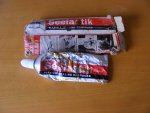
We used a sealant called Seelastik. A linseed oil (???) based product probably best described as "putty in a tube". My through hulls were put in using it in 1977/8. They have not been touched since. It lasts for decades in the tube without going hard too

DSCF1710.jpg
 
Last edited:
Exactly, the OP really needs a friend who is a polymer scientist. Why not just do what Sika recommend?

If Sikaflex is your chosen goo then there are a couple of useful guides to its use.

The brief user guide http://www.kjhowells.com/hres/sikaflex_a_users_guide_1_.pdf

and the more comprehensive Marine Handbook http://www.kjhowells.com/hres/sikaflex_marine_handbook_1_.pdf

There are also technical data sheets available on line for each product which Richard will be able to explain to you.
 
sorry to hijack this this thread, but would Arbokol be ok to use on rudder gudgeon bolts?

Yes, particularly if you want to be able to remove them at some point. The thing with sealants is that most will seal, but you have a choice of setting and non setting and just sealant or adhesive. I have used polysulphides for 40 years for all underwater including keel to hull, seacocks, cutless housings, rudder fittings and never had any problems with not sealing and always been able to take apart if needed.
 
Top