Seacock Advice

Mmreally? I had gained the strong impression that while DZR brass has been used for that sort of length of time, the use of bog-standard brass, with a design life in marine environments of five years or so, was a much more recent development.
Yes, really. DZR is primarily a UK product. The 5 year life requirement came in with the RCD in 1998, so builders have been using brass for at least 15 years, and in Europe for many years before that. Mine are already 2.5 times older than the required life! since 1998 Jeanneau alone have built at a guess over 30000 boats with an average of probably 6 seacocks a boat ie 180000+ fittings. How many failures have there been?

Personally I would not use ordinary brass for replacements because better products are freely available. However at a macro level you cannot ignore the fact that brass has been used, and is still used successfully in large numbers of boats over many years.
 
Yes, really. DZR is primarily a UK product. The 5 year life requirement came in with the RCD in 1998, so builders have been using brass for at least 15 years...

That doesn't follow. Perhaps I have been mislead by press reports, but the impression I got was that builders have only recently started working down to the five year life requirement, having previously used much better materials.

How do you think your insurers would react if you had a leak and it turned out that you know your seacocks to be 2.5 times over their design life? Incidentally, it's the skin fittings and tails I'd worry about, since they are much thinner in important areas than valves.
 
There is a lot of confusion about what materials have been used, when and by whom as you will discover if you read the published material. This is because until recently it was very difficult to determine what the exact composition of the material was. Vyv Cox of this parish has written extensively on the difficulties in identifying materials. The consensus is, however that most European builders use fittings made in Italy which are not DZR or bronze. It is probably fair to say that when boats were built in the UK (ie in volume terms 20+ years ago) fittings were bronze or DZR, mainly because that is what was available, not necessarily a conscious decision to use higher grade material.

As to concerns about insurance, my insurer does not make it an explicit condition of insurance that I change any fitting at any particular time - even the Volvo saildrive diaphragm nor the rigging. The only requirement is that the boat is maintained in a seaworthy condition. As you will see from the various threads on insurers' T&Cs this is a contentious area, as is defining what is appropriate inspection and maintenance. However, the level of claims resulting from failure of such components seems to be very low, so insurers do not feel it necessary to define specific requirements. You will even find a detailed discussion with one insurer who currently (like most others) excludes insurance of damage resulting from corrosion (whatever the material) but in reality would not normally use this as an exclusion if there was evidence of satisfactory maintenance and inspection. It is proposing to rewrite its clause but guess that it will fall short of an unambiguous statement of what it considers acceptable maintenance.

You come back to the point I was making earlier, although there is concern at a micro level about the quality of the material used, that concern does not seem to translate into a major issue at a macro level. If there were mass failures, you can be pretty sure that insurers would be the first to show concern, given that they would be expected to pick up the bill.
 
You come back to the point I was making earlier, although there is concern at a micro level about the quality of the material used, that concern does not seem to translate into a major issue at a macro level. If there were mass failures, you can be pretty sure that insurers would be the first to show concern, given that they would be expected to pick up the bill.

It would be interesting to know what proportion of brass fittings have been replaced, either as a precaution or as a result of observed deterioration.
 
It would be interesting to know what proportion of brass fittings have been replaced, either as a precaution or as a result of observed deterioration.

I will be doing mine in march and will take photos and report for others to smile at!!

You have not responded to what boat I should have bought instead of a Jeanneau so that I would not be a mug!!
 
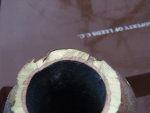
My brass seacock/skin fitting had definately deteriorated and "gone pink" when I replaced it in 2012 (boat new 2006)
SkinFittingSection1.jpg
 
You have not responded to what boat I should have bought instead of a Jeanneau so that I would not be a mug!!

If you let me know which bit of "I'm not referring to the boats as rubbish; I'm referring to the seacocks as rubbish." is causing you problems, I'll happily explain further.

Can't see why you could possibly want to replace them. They're RCD certified and should last for ever.
 
Still a fair bit of good metal there - but what a textbook example of the creeping pinkness!

Pete
Another cut-through seacock from a 2005 launched boat replaced in 2012 - http://www.yachtsnet.co.uk/P1030461.jpg - slightly better than Halo's but definitely a few traces of dezincification. They would probably have been fine for a few more years, but the trouble is you don't know. The only real problem was the hose tails, one of which was like this - http://www.yachtsnet.co.uk/P1030462.jpg and clearly a different brass to the seacocks and skin fittings.
 
It would be interesting to know what proportion of brass fittings have been replaced, either as a precaution or as a result of observed deterioration.
Doubt that you would ever be able to get any reliable data, so one can only look at individuals' experiences, either first hand reports or more likely from sources such as surveyors who see far more cases than individuals.

As you can see from the small sample on this thread, brass seacocks do seem to last well over the minimum 5 years expected to meet the RCD (not a design life though as I rather flippantly suggested earlier). Signs of dezincification are observed by some, but not to the extent of indicating failure - remember valve bodies are big chunks of metal and are not under any physical stress in normal use. More extensive dezincification is found on fittings, mainly hose tails which are small sections and also more vulnerable to damage from external sources. The main reasons for replacement of valves are not related to dezincification, but to corrosion or breakage of the handle and spindle or failure of the bearing surface for the ball, leading to either seizure, leakage, or both. This is common to all ball valves irrespective of the material of the body (bronze, DZR, brass or plastic). This was the reason for replacing the toilet outlet on my Bavaria after 9 years - and no signs of dezincification on either the valve body or the tail.

So, although the chances of dezincification are obviously higher with brass bodied valves, it does not necessarily mean the risk of failure leading to sinking is significantly greater than with other materials. The message for me is that the small additional risk can be virtually removed by using the higher grade material and the additional cost for an individual is small in relation to the overall costs of running a boat. On the other hand a builder like Jeanneau will perhaps see that small (unquantifiable) risk worth taking to make substantial monetary savings in the cost of building its boats. Brass valves and fittings bought in volume are typically 50% cheaper than DZR, so a manufacturer would be foolish not to consider them.
 
On a separate thread where I complained about the rust on my BMW motorcycle it was recommended that I use ACF50 aerosol spray. For seacocks I usually poke up a thin paintbrush with marine grease on the outside
while someone works the valves from the inside.

Does anyone thgink ACF 50 would be better or worse?
 
On a separate thread where I complained about the rust on my BMW motorcycle it was recommended that I use ACF50 aerosol spray. For seacocks I usually poke up a thin paintbrush with marine grease on the outside
while someone works the valves from the inside.

Does anyone thgink ACF 50 would be better or worse?
not under water, i assume you have ball valves, silicone grease might be better
 
The message for me is that the small additional risk can be virtually removed by using the higher grade material and the additional cost for an individual is small in relation to the overall costs of running a boat. On the other hand a builder like Jeanneau will perhaps see that small (unquantifiable) risk worth taking to make substantial monetary savings in the cost of building its boats. Brass valves and fittings bought in volume are typically 50% cheaper than DZR, so a manufacturer would be foolish not to consider them.

It would be very interesting to know what proportion of buyers would include better skin fitting materials as an at-cost option (£50? £100?) when buying a new boat.
 
It would be very interesting to know what proportion of buyers would include better skin fitting materials as an at-cost option (£50? £100?) when buying a new boat.

Long way behind having patterned Corian (only an extra £250, madam) for the galley worktop rather than the standard solid colour!

You ought to be a fly on the wall for a few days at a boat show to get an idea of what potential - and actual - buyers consider important. Think you will find a different discourse than on here. I remember when I was buying my new Bavaria the head of the dealership remarking that I asked questions nobody else did!
 
Top