N.A.M.E
New Member
Hi every ,
How can I calculate the volume of the sea chest of boat 30m ?
what inputs should I have ?
How can I calculate the volume of the sea chest of boat 30m ?
what inputs should I have ?

Enclosed compartment in a ship's hull that houses seawater intakes for various systems,Welcome
Might be helpful to explain what you mean by "sea chest" in this context.
Can you explain ?Displacement.

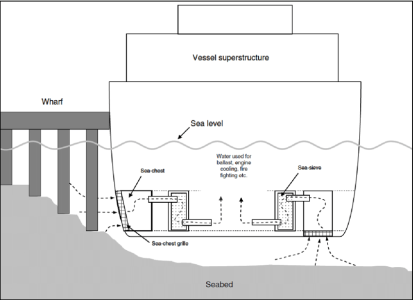


Now you have got that off your chest perhaps you could answer the OP's question - if you actually know the answer & do not have to confuse us with b..x. How do you calculate the volume? & what dimensional inputs do you apply. He did not say anything about additional pipes, pressure above, or below the norm & flow etc. Just "volume"You need to calculate the maximum flow rate that will be drawn from the sea chest by all services i.e. engine cooling, water maker, maybe air con cooling, air compressor cooling, fire pumps, oil coolers. You then need to establish the minimum inlet pressure, NPSH, for the services that are sucking water. Once you know that, you need to calculate the pressure drop that the inlet grill and filter elements, baffles, if any, will cause due to the maximum volume flow rate as a velocity for the size of the opening. If the pressure drop across the sea chest is high, then the NPSH may be exceeded and pumps stall. Iterate until the size of sea chest is arrived at for the required flow rate. To be honest, a sea chest is sized for still water inside and pressure drop will be very low if grillage area and sea chest is relatively large. Size is likely determined by pipe diameters and stiffening around the hole in the hull rather than pressure loss. If there is more than one inlet pipe in the sea chest, then you need to ensure that the suction at one pipe doesn't impact the flow into the other pipe, and that usually means more space. It must not exceed the frame spacing of the vessel, if so, then add in more sea chests that fit between frames.
A vessel of c. 30m is unlikely to have many true sea chests, which are usually found in commercial shipping as in Awol's helpful diagram. It therefore seems wise to assume that NAME's mother tongue is not English (though he is undoubtedly competent), and possibly that his question relates to larger vessels being built overseas without support from a formally qualified naval architect familiar with the calculations that OP seeks . The most likely (single) "sea chest" that springs to mind in context of the OP's question as needing "inputs" is that of the whole hull, and 'displacement' or 'displacement tonnage' is probably the commonest metric used in creating stability programs and hydrostatic curves.Can you explain ?

I thought about that too, but the number doesn’t make sense.I would have thought measure the chest; length by height by width would give a rough volume though a lot of large diameter pipes would add some volume as well.
I calculated the flow rate of the auxiliary system and tried to determine the cross-sectional area,( A=Q/v) but I don't have a definite value for the appropriate velocity.Also check class rules. A 30m boat in some jurisdictions may be required to comply with a certifying body, who will stipulate design requirements for sea chests e.g. American Bureau of Shipping (ABS), Lloyds, Det Norske Veritas DNV et cetera.
noIs that the old seachest I lay on while was thinking how I could bugger off and have a snooze?

That's true, and I apologize if my words were unclear, but my experience is still limited. And I believe the size of the sea chest won't have a significant impact on the displacement compared to the overall volume of the tanks right ? , But thanks for pointing that out, I might give it a try.A vessel of c. 30m is unlikely to have many true sea chests, which are usually found in commercial shipping as in Awol's helpful diagram. It therefore seems wise to assume that NAME's mother tongue is not English (though he is undoubtedly competent), and possibly that his question relates to larger vessels being built overseas without support from a formally qualified naval architect familiar with the calculations that OP seeks . The most likely (single) "sea chest" that springs to mind in context of the OP's question as needing "inputs" is that of the whole hull, and 'displacement' or 'displacement tonnage' is probably the commonest metric used in creating stability programs and hydrostatic curves.
Perhaps the OP could add more information ?

