Scarfing a rubbing strake ?

conks01

Well-Known Member
Joined
3 May 2012
Messages
241
Visit site
Hi,

I've attached a layout of my Westerly Pageant 23 as per pic below.

I've decided to go with a new Iroko rubbing strake.

Given the length (7.1m) the Iroko length(s) are 4.2m so Ill need to scarf etc.

Given the pressure/bend points re the curvature of the boat where is the best place to implement the scarf joint? For example at mid-point / beam?

To glue the scarf together is it best to use epoxy. Some sites appear to recommend metal tube supports also (not sure how this works nor what these actually are?

Thanks.
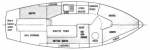
Pageant.PNG
 
I used epoxy. Given the strength of the glue, I don't think you need to worry about where the scarphs occur along your boat. The length of your available timber gives one joint amidships and that sounds OK to me. Having done this job myself some years ago, I would suggest that you do a step scarph, if you feel up to it, because the glue line is a bit obvious otherwise. I didn't! You would need to set up some sort of a long bench or series of stands to support the pieces while the scarph joints set. And indeed, it would be a good idea to cramp the sections so that your scarph joint doesn't slide apart. Slippery stuff, wet epoxy! Perhaps that is the reference to 'metal tube supports'.
 
Hi,

I've attached a layout of my Westerly Pageant 23 as per pic below.

I've decided to go with a new Iroko rubbing strake.

Given the length (7.1m) the Iroko length(s) are 4.2m so Ill need to scarf etc.

Given the pressure/bend points re the curvature of the boat where is the best place to implement the scarf joint? For example at mid-point / beam?

To glue the scarf together is it best to use epoxy. Some sites appear to recommend metal tube supports also (not sure how this works nor what these actually are?

Thanks.

View attachment 70790

My Iroko gunwhales and rubbing strips are scarfed but they were done by a boatbuilder 25 years ago so don't know what glue he used. There are no metal tube supports, just stainless screws. I know this as i had to remove one a few years ago to rebed on mastic to cure a few leaks through the screw holes. The scarfs are at the point of least curvature within the scope that your timber lengths allow. Make sure the scarfs go the right way, the forward length of timber should have the thin end of the scarf on the outside. Assuming you are using Iroko plugs over the screwheads, do not glue in the plugs, just dip them in varnish or whatever wood treatment you are using and hammer them in. As Iroko is so stable, they will not fall out and if you ever need to reove the rubbing strip again you will regret using glue.

Www.solocoastalsailing.co.uk
 
Thanks.

For the scarf cut itself what would you use. Would it be a circular saw of jigsaw with a fine blade etc.?
 
Thanks.

For the scarf cut itself what would you use. Would it be a circular saw of jigsaw with a fine blade etc.?

I prefer hand tools where possible so would use a Japanese saw but whatever saw used i would still make the final trimming with a smoothing plane by putting the two pieces on top of each other and planing both surfaces at once to ensure both angles are identical.

Www.solocoastalsailing.co.uk
 
Thanks.

For the scarf cut itself what would you use. Would it be a circular saw of jigsaw with a fine blade etc.?

I am currently fitting iroko rubbing bands to a 45 ft ferro boat and each side will have 2 layers of 20mm thick iroko. There will be may ve 6 scarfs each side on the first layer and 4 on the second layer.

I made up a jig to do the scarfing with a router to get the ambles correct every time.

I have scarfed using a electric plain but you need more skill. I have also scarfed plywood with a plain or angle grinder/sander. This is easier due to the plies of the wood makes getting an even scarf.

Glues I have used is polyurethane wood glue, Epoxy and sikaflex 11FC. I an currently using sikaflex 11FC for both the scarf and the sealant to the hull. First layer is bolted and sealed on one piece at a time cutting the scarf then fitting each piece.

The second layer will be fixed only with sikaflex 11 FC and will be clamped on until fully cured.

This is the second time I an doing this job as the epoxy cracked and let water in the joint which then parted and the wood iroko parted.
 
I've attached a layout of my Westerly Pageant 23 as per pic below.

I've decided to go with a new Iroko rubbing strake.

Given the length (7.1m) the Iroko length(s) are 4.2m so Ill need to scarf etc.

Given the pressure/bend points re the curvature of the boat where is the best place to implement the scarf joint? For example at mid-point / beam?

I had a 21' Jouster, which had the original scarfs (in teak) near the widest part - which, like the Pageant, is also the tightest curve. Both side sprang open. It seems to be very common on the smaller Westerlies. Based on that, I'd be inclined to go for two scarfs (scarves?), at the flattest sections. Have you investigated getting anything longer than 4.2m? Some timber is available in longer sections, generally by special order. I bought some from Aitken and Howard in Dumbarton a couple of weeks ago, and they'll supply up to 9m lengths.
 
I had a 21' Jouster, which had the original scarfs (in teak) near the widest part - which, like the Pageant, is also the tightest curve. Both side sprang open. It seems to be very common on the smaller Westerlies. Based on that, I'd be inclined to go for two scarfs (scarves?), at the flattest sections. Have you investigated getting anything longer than 4.2m? Some timber is available in longer sections, generally by special order. I bought some from Aitken and Howard in Dumbarton a couple of weeks ago, and they'll supply up to 9m lengths.

Thanks for the heads up. 9m sounds ideal albeit would it bend/curve I. E avoid the need for a scarf?
 
Use the wedge shaped bits you cut off as packing for the clamping so that you are squeezing at right angles to the glue line. I actually stuck them to the wood with hot melt glue as I knew I'd be cleaning up and planing afterward anyway.
 
Easiest way to cut an accurate scarf is to use a router and a jig. This is simple to build and makes use of cheap drawer slides for smooth movement.

https://www.youtube.com/watch?v=s4QWXFqtsTQ&t=21s

As for the glue, I much prefer to use a resorcinol type than thickened epoxy. It is totally waterproof (it is used in the production of marine ply) and, unlike epoxy, it is not affected by UV. Perhaps this is not a problem at your location but down here, in Malta, the UV can be really vicious.
 
Thanks for the heads up. 9m sounds ideal albeit would it bend/curve I. E avoid the need for a scarf?

I am probably not the right person to ask, because I plan to try my first ever experiments with steaming wood on Monday, but I am pretty sure the answer will be "Yes, particularly if you steam it". In your position I would definitely be looking for a long length of wood supplier before faffing about with joints. Whereabouts are you?
 
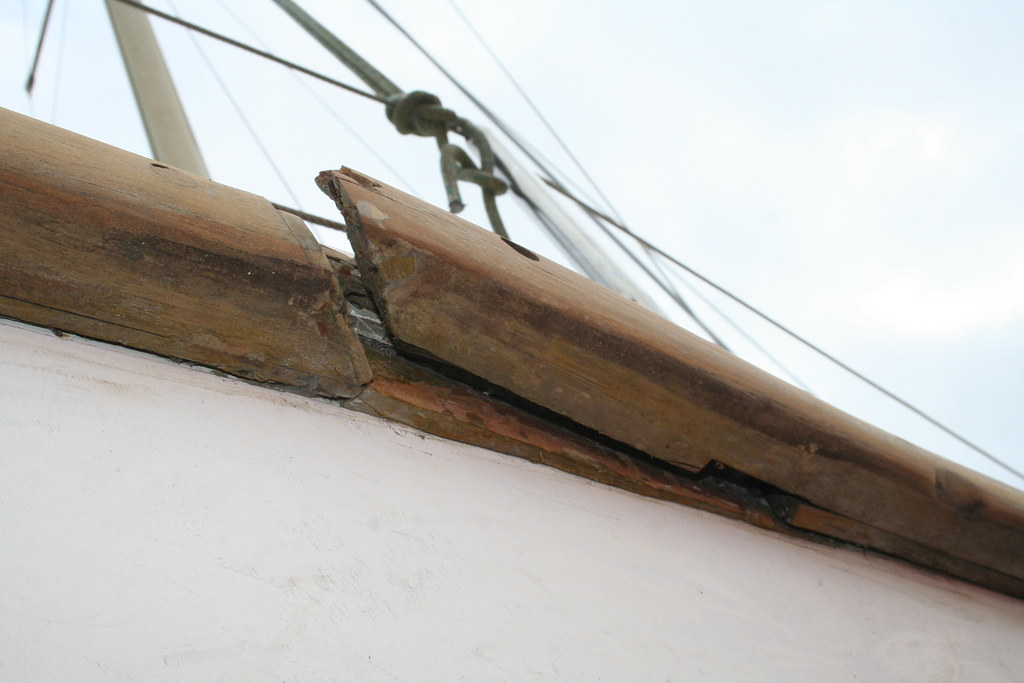
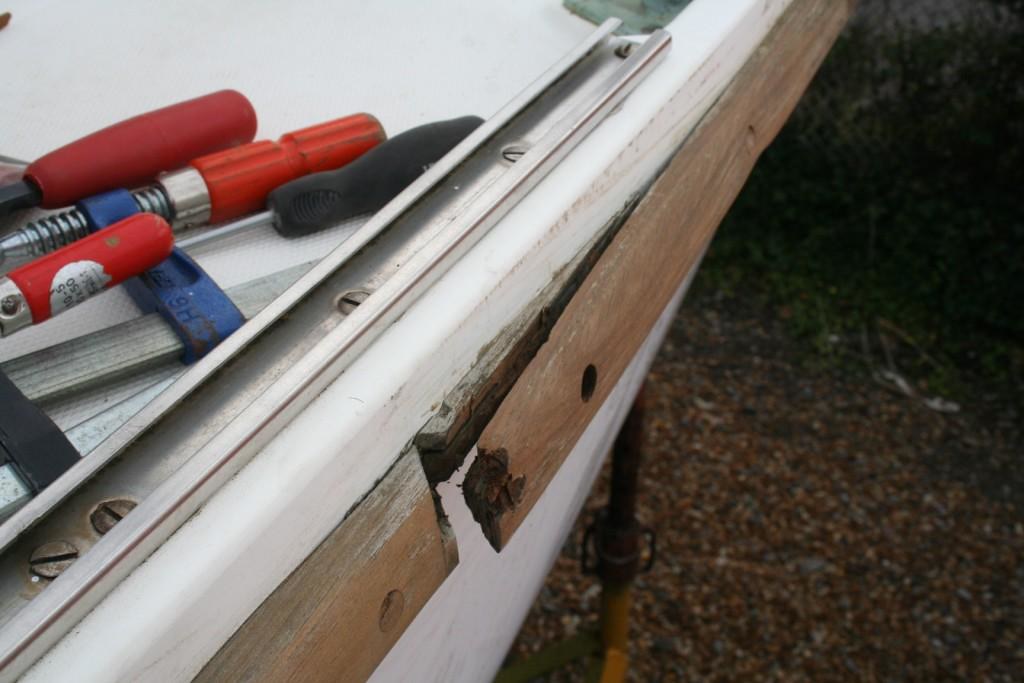
I really, really wouldn't worry too much about positioning of the joints if using epoxy and proper additives...microballoons (to give it a brown tinge) and microfibres/colloidal silica as thickeners. This is what the rubbing strake looked like on my Sabre when I got her...pinged wide open at the widest point of the boat:

5126426690_7d9997e670_b.jpg


5125821313_78283a851a_b.jpg


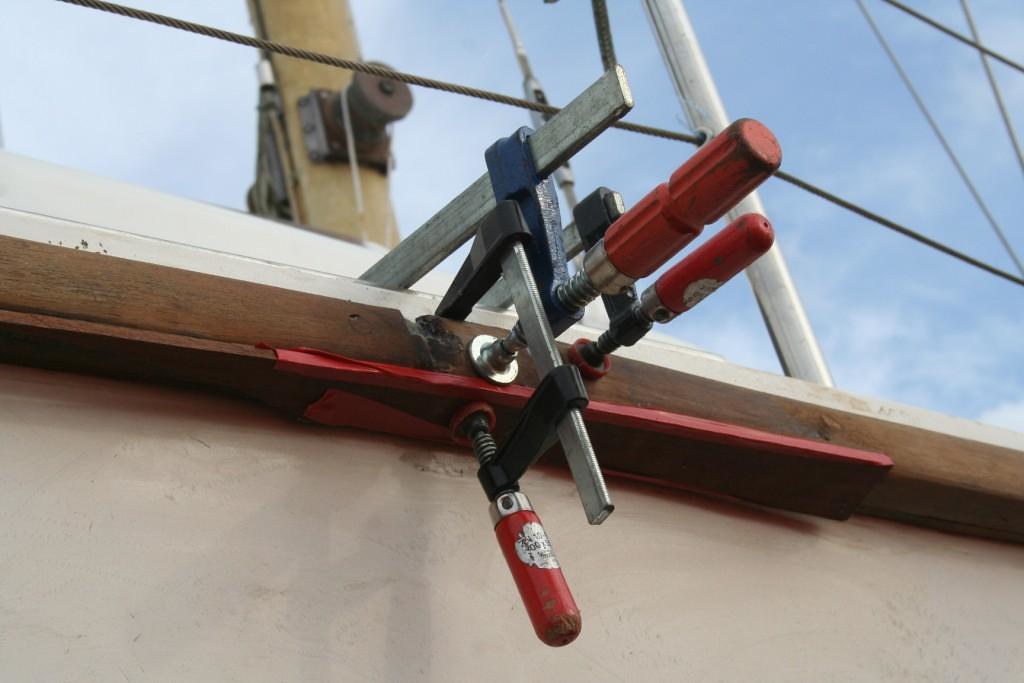
Using nothing more than epoxy, clamps, and the fillers mentioned above I did this...(obviously fairing the gaps in afterwards). The piece of wood covered in tape is just there as a guide (tape applied so it did not end up stuck to the strake!)

5126426758_2ce3415e8e_b.jpg


...and it's fine to this very day, nearly 10 years later, despite plenty of knocks and bangs.
 
Last edited:
Shame it hadn't been properly made in the first place. More of a diagonal joint than a scarf. A scarf joint is minimum 8:1. And it looks like it was joined as the rail was fitted. Your repair has been good work to achieve 10 years wear and tear. The OP should scarf the rail first and once the joint has hardened then fit the rail. Have done a few of those.
 
... In your position I would definitely be looking for a long length of wood supplier before faffing about with joints. ...
You are going to want to spile this to the sheer to do anything like a decent job (you don't want it bending up and down as well as sideways). A single length when spiled is liable to require a plank so wide as to be prohibitively expensive. Scarph is essential to save material, and 8:1 not a silly wee 45 degree cut, which is really just a butt joint.

I don't buy the argument on UV failure of epoxy in this instance as all that is exposed is the edge of the glue line. Epoxy as a coating suffers UV failure even in Scotland! Having said that, Maltese sun may reach parts that no other sun reaches. There is some evidence that ate least some resorcinol glues are not waterproof - but probably only on a 25 year time scale.
 
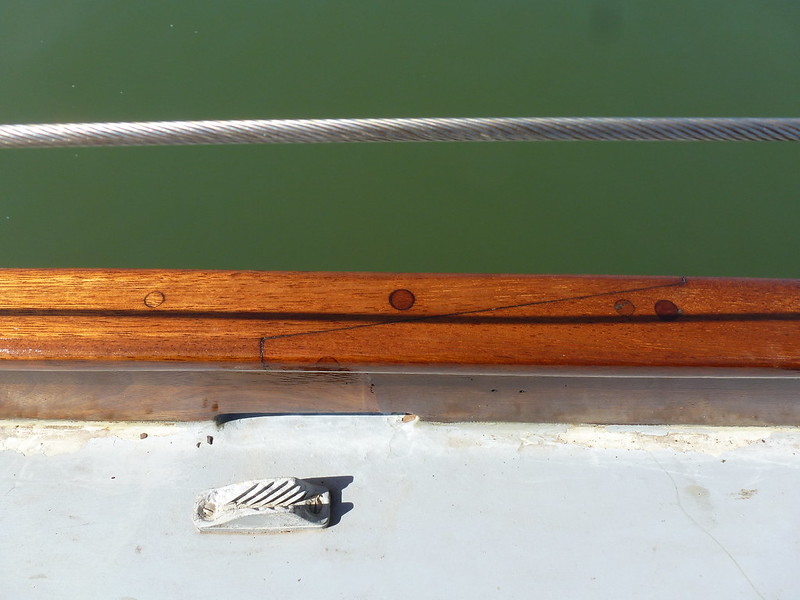
An interesting issue but I would suggest that it won't be necessary to spile. TG is quite a few scarfs around. The rubbing rail is the 'Laurent Giles' knuckle which is 5" x 1 1/8", then fitted in two lengths (32') with one scarf. The sheer and shape can be coped without any spiling or steaming. Indeed I replaced the gun'wales both side (having taken off the knuckles). That need three iroko planks either side 14' x 1". Again that did not need steaming but to cope with the angle of the bottom edge needed shaping - and needed a lot of support. The gunwales were scarfed twice to make 32' on length. Fitted at the bow the end of the plank at the back was supported up and they were fitted round the shape stage by stage. Unfortunately all painted I can't show an image. But the image of the rail illustrates that the wood will 'accommodate' the sheer and shape:

P1040153 by Roger Gaspar, on Flickr

P1040156 by Roger Gaspar, on Flickr

Obvious for the scarf for the rail is 'on top' rather than 'on side' for the rubbing strake but it illustrates it works. It's been there a while! The rails had been removed to replace the gun'wales and then put back. The scarf joints survived. (PS the deck paint job under progress!)
 
An interesting issue but I would suggest that it won't be necessary to spile. TG is quite a few scarfs around. The rubbing rail is the 'Laurent Giles' knuckle which is 5" x 1 1/8", then fitted in two lengths (32') with one scarf. The sheer and shape can be coped without any spiling or steaming. Indeed I replaced the gun'wales both side (having taken off the knuckles). That need three iroko planks either side 14' x 1". Again that did not need steaming but to cope with the angle of the bottom edge needed shaping - and needed a lot of support. The gunwales were scarfed twice to make 32' on length. Fitted at the bow the end of the plank at the back was supported up and they were fitted round the shape stage by stage. Unfortunately all painted I can't show an image. But the image of the rail illustrates that the wood will 'accommodate' the sheer and shape:

P1040153 by Roger Gaspar, on Flickr

P1040156 by Roger Gaspar, on Flickr

Obvious for the scarf for the rail is 'on top' rather than 'on side' for the rubbing strake but it illustrates it works. It's been there a while! The rails had been removed to replace the gun'wales and then put back. The scarf joints survived. (PS the deck paint job under progress!)

That's how I did mine although the "stop ends" were a bit more pronounced. They seem much less likely to snag and split apart than traditional thin wedges.
 
I really, really wouldn't worry too much about positioning of the joints if using epoxy and proper additives...microballoons (to give it a brown tinge) and microfibres/colloidal silica as thickeners. This is what the rubbing strake looked like on my Sabre when I got her...pinged wide open at the widest point of the boat:

5126426690_7d9997e670_b.jpg


5125821313_78283a851a_b.jpg


Using nothing more than epoxy, clamps, and the fillers mentioned above I did this...(obviously fairing the gaps in afterwards). The piece of wood covered in tape is just there as a guide (tape applied so it did not end up stuck to the strake!)

5126426758_2ce3415e8e_b.jpg


...and it's fine to this very day, nearly 10 years later, despite plenty of knocks and bangs.

Thanks .... that's very encouraging!

Did you do much to clean up the mating surfaces before gluing?
 
You are going to want to spile this to the sheer to do anything like a decent job (you don't want it bending up and down as well as sideways). A single length when spiled is liable to require a plank so wide as to be prohibitively expensive. Scarph is essential to save material, and 8:1 not a silly wee 45 degree cut, which is really just a butt joint.

I presume that "spile" means "profile in a vertical direction", does it? I don't think the OP need worry about that - those Westerlies were design to have a simple strip used in the way he plans. Anyway, how is a kink halfway along going to help?
 
Top