Sanity check on engine geometry

Nearly right ,that only applies say in a V8 ( which MapishM has here so its reasonable to use that ) with a flat plane crank ** .
Jeeze. The firing order and phasing of firing is wholly irrelevant to the question. You are not understanding the question - the answer to the question is the same whether you have a one cylinder engine or a 16 cylinder, and whatever the phasing and order of the firing.
 
Last edited:
Bingo.
All agreed J, except...

In fact, I don't get the 180 or 540. Why shouldn't 180 be enough no matter what?

Yup, agreed, but only with the proviso that if you only want to make sure than any open valve is closed (relaxed) then 180 degrees will do it. But you said "and vv", and I said I was answering you with precision. If you want the "vv" part of the question then I stick to my guns and say it is 180 or 540. If a cylinder is at BDC about to do the compression stroke, both valves are shut and 180 degrees wont change that. Nor will 360. You need 361 rotation in order for the first of the valves (exh) to begin to open and 540 to have both valves in the opposite state to 0deg, which is what you asked. So, with your question as asked, the answer is 180 or 540 and you cannot know which. Or you can say 540 to make sure that each valve is at the opposite of what it was at 0 degrees. (You can of course argue that if you start at BDC before the compression stroke, both valves shut, it is impossible to be opposite with both valves because that requires both to be open, but the "mathematical" answer is 540 in that case)

Obviously this ignores valve overlap and VVT and all of that.

I'm with BJB -this is waste of time. The reason for doing this must (I guess) be to stop the valve spring from "memorising" its compressed position when a vlave is open, but remember the spring is also compressed plenty when the valve is shut.

And as I say, don't rotate the wrong way if there is any positive displacement swash plate pump attached as PTO to the engine.
 
Last edited:
Jeeze. The firing order and phasing of firing is wholly irrelevant to the question. You are not understanding the question - the answer to the question is the same whether you have a one cylinder engine or a 16 cylinder, and whatever the phasing and order of the firing.

Hey relax , I was just picking you up on the 180, 540 thing that you included .
That only applies to a flat planed crank , which MapishM too enquirers about .^^^
Hence “ nearly right “.

Adding that into this big diesel , discussion , inferring or even mentioning the 180,540 thing just confuses others .
As said that sort of stuff is reserved for high performance petrol engines .
Apart from Ferrari ,TVR I think Porsche have dabbled in the top end stuff GT3 ,but I know Ferrari canned it from the 430 onwards 2005 ,not sure where Porsche are with it ?

Just re in forcing my point and yours that there is no position really and more over you can,t find it whereby one thinks one relax a valve spring in two moves ,ie all open say inlet or all closed say exhaust s ,
Because of the firing orders , ecept in a flat planner which apart from the examples above ,this ( V8 ) is not .
 
Hey relax , I was just picking you up on the 180, 540 thing that you included .
That only applies to a flat planed crank , which MapishM too enquirers about .^^^
Hence “ nearly right “.

Adding that into this big diesel , discussion , inferring or even mentioning the 180,540 thing just confuses others .
As said that sort of stuff is reserved for high performance petrol engines .
Apart from Ferrari ,TVR I think Porsche have dabbled in the top end stuff GT3 ,but I know Ferrari canned it from the 430 onwards 2005 ,not sure where Porsche are with it ?

Just re in forcing my point and yours that there is no position really and more over you can,t find it whereby one thinks one relax a valve spring in two moves ,ie all open say inlet or all closed say exhaust s ,
Because of the firing orders , ecept in a flat planner which apart from the examples above ,this ( V8 ) is not .
This has nothing to do with flat planed cranks. The phasing and and firing order is irrelevant to mapism's question.
 
Porto, I don't think to have a reputation for refusing to getting involved in technically tricky debates, but at first glance I've been unable to even reach the end of your last posts.
I think that overcomplicated doesn't even begin describing your train of thoughts, but I'll re-read all that more carefully tonight, just in case.
Time being, I'll just confirm that the manual spinning was smooth as silk - more about that later! :encouragement:
 
Porto, I don't think to have a reputation for refusing to getting involved in technically tricky debates, but at first glance I've been unable to even reach the end of your last posts.
I think that overcomplicated doesn't even begin describing your train of thoughts, but I'll re-read all that more carefully tonight, just in case.
Time being, I'll just confirm that the manual spinning was smooth as silk - more about that later! :encouragement:

Thx. I did say KIS , “ none brain smokey “ very early on .
I reckon yours are firing in pairs ( one in each bank ) and as said best fit would be 180 degree turn I can see why your spannerman says that , that’s all ,not saying do it or it will be enough due to valve overlap , and I have challenged the whole concept doing it in a 2000 rpm er layered up for 7 months - in the interest of extending valve spring life or minimising repairs .??
You have not actually said WHY ( valve spring wise ) you want to do it ?


Intrigued on the manual turning , do tell ps as I,am contemplating doing the tappets (valve lash as the yanks call it ).
Put off barring it over ,for me only 1 piston “ coming on “ compression wise at a time ,but like yours 2 L ish pots and same bore .My hesitancy stems from having to remove the plugs on a Testorossa 5 L flat 12 to turn it , even then it was a struggle,
Socket on the crank pully method - just seemingly erroneously extrapolating that experience up to 13 L diesel or 18 L in your case .
Another barometer is hand cranking , starting small diesels having to use the decompression lever , without that even a single cylinder 400 cc it’s vertually impossible, never mind the stuff we have ,hence my challenge re barring .

Btw I have seen the bolt - - on the crank pully and read the manual that switches between barring the pully and using the MAN ratchet depending on what job is been proposed .
Great to be able to turn it manually ,easily thought :encouragement:
I,am next on it Dec 19 th so will pop a socket on one .
 
Well, I don't think that in a very slow manual rotation any meaningful compression can be created...

Am I missing something here - how can you NOT create normal compression by turning an engine over? You said the injectors haven't been removed.
 
...Btw, I don't buy the whole "rest the springs" theory and think it's bolx, but that's not what you asked. As I've said before, beware taking advice of that nature from a mechanic.

A different reason which I do sort-of believe is that an open inlet valve can allow damp outside air into the engine, causing corrosion of that cylinder. More likely to be a problem on a Fordson Major that's stood in a field for 40 years.

Have you blanked the air inlets as part of the winterising?

Regarding turning the engine over - mark a visible part of a pulley (Tippex), flick it over on the starter, check it comes to rest in a different position, if not try again. Now tell me you've removed the batteries for the winter!
 
Another thing - if you get bored over Christmas, get a protractor and start drawing your own valve timing diagrams. Hours of fun and you'll eventually get the answer to your question.
 
A different reason which I do sort-of believe is that an open inlet valve can allow damp outside air into the engine, causing corrosion of that cylinder. More likely to be a problem on a Fordson Major that's stood in a field for 40 years.

Have you blanked the air inlets as part of the winterising?
Yep, but that problem is fixed by blanking, as you say, not by turning the engine with a spanner. BTW, on a boat, I'd be more interested in blocking the exh side as it is close to seawater.
 
Am I missing something here - how can you NOT create normal compression by turning an engine over? You said the injectors haven't been removed.

Even if valve seats and piston rings make perfect seals then you would still not get normal operating compression. While an engine is running compressing the air will heat it, increasing the pressure. If done slowly then that heat will dissipate via conduction through the cylinder head and block.
 
Even if valve seats and piston rings make perfect seals then you would still not get normal operating compression. While an engine is running compressing the air will heat it, increasing the pressure. If done slowly then that heat will dissipate via conduction through the cylinder head and block.

OK, slightly less compression, but the OP did suggest turning it with finger and thumb!
 
Ok, a few more details as promised.

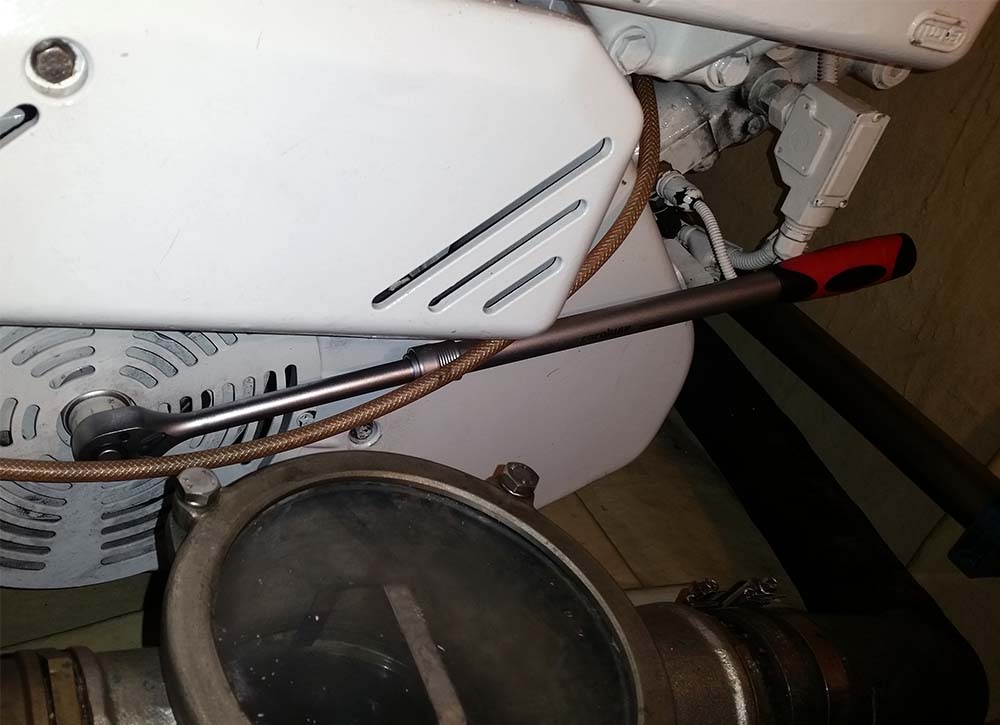
First of all, a pic showing all it takes on MAN engines to spin them manually: a ratcheting socket wrench (32mm), possibly a bit long. Mine can be extended up to 60cm or so, as shown in the pic.
Apropos, I'll admit it: I was unable to rotate the engine by hand. I must be getting old! :rolleyes: :p
Sometimes I'm amazed when I write something that in my mind is clearly a joke, and someone take my world for it...
Maybe I should stick to serious comments, to avoid spoiling my own credibility! :D
1GFpUbjJ_o.jpg


I rotated each engine with that, by 180 plus about 15 degrees.
It obviously took several movements - easy peasy with the ratchet - but in all of them the rotation was equally smooth and amazingly effortless.
In fact, I spent more time to put some adhesive tape on the socket and mark it to check the degrees (it's somewhat visible also in the pic) than for actually spinning the blocks... :)
I mean, of course I had to use some strength on the lever, but less than I was expecting - it's a 15 liters blocks, after all.
Based on this experience, I believe it would have been easy to do the same also on the 12 cylinders version of the same block - of which there are some here in the asylum.
Mind, I'm not saying this to suggest that everybody should do it, let alone convince anyone that it can make a relevant difference in longevity or whatever - it's just in case anyone would wish to try.

FWIW, I never did this when I kept my old boat in the N Adriatic (where she was also sheltered for 6 to 8 months), and she survived very well without this treatment, so I don't think it's a big deal - and neither the engineer who suggested me to do it pretended that this is a must (as opposed to circulating and leaving antifreeze in raw water circuit), just a good habit.
But I don't mind following a suggestion even if its relevance is uncertain, when a) there is at least some logic behind it, b) I can't see any drawbacks in it, and c) it only takes a few minutes to put it in practice... :encouragement:
 
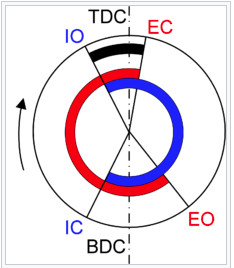
If the engine has fixed valve timing, there will be valve overlaps where both inlet and exhaust valves are open.
But I don't think it's possible to rotate the engine in such a way that all the open valves close and vv, because the overlap periods aren't usually the same at the end of the exhaust or intake phases, plus in a multi cylinder engine there isn't one figure that would be correct for all the valves to flip.

I'd start from TDC then give it a 360 in the normal direction of rotation every month and hope for the best.

bZGcWP.png


.
 
Last edited:
But to get to a state where all those that are closed are open and vv is impossible, I think, because the overlaps are usually not symmetrical at the TDC / BDC ends.
I would agree that you can't identify a rotation which grants that all the closed valves will be open, but I don't think this has a lot to see with overlaps.
The problem is that when one valve is closed, it can take anywhere between 1 and 540 degrees to reach its opening point (I'm assuming 180° opening phase for simplicity).
Otoh, when one valve is open, you are sure that it only take 180° before it will close (again, forgetting overlap).
Therefore, if a valve is still close but right at the beginning of its opening cycle, one degree is enough to open it.
Otoh, if a valve is closed because it just completed its opening cycle, it takes 540° to open it again.
BUT, some other closed valves could be anywhere in between...

In other words, by turning the engines 180° (+overlap) what you are sure to achieve is that any valve open before beginning to turn the engine will be closed afterward.
But I don't think there's a way to be sure of the opposite - which has never been the goal of this exercise, anyway.
Though I must apologise for a bit of confusion, because I did write "and vv" at the end of point (1) in my OP, which should actually be deleted - my mistake! :encouragement:
 
Last edited:
Aha, bingo, we are in same page. If you delete the "and vv" then yes 180 degrees is the answer. But if we answer the question you asked, with the "and vv", then it's 540. #22 above. You got there! Any virtual cigars on offer P?
 
Aha, bingo, we are in same page. If you delete the "and vv" then yes 180 degrees is the answer. But if we answer the question you asked, with the "and vv", then it's 540. You got there! Any virtual cigars on offer P?
Well, glad to offer also a real cigar. Or even better (for me, anyway), a glass of good wine! :encouragement:
Just keep some spare time for joining us during the delivery trip, somewhere in Croatia - or Apulia/Sicily/Sardinia, as you prefer.
But I'm afraid I don't agree that the 540° rotation grants the "vv": I mean, if a closed valve is say 270° past the end of its opening cycle, by turning the crankshaft 540°, you will open that valve (after the first 270°), but then you will close it again (after another 180°), well before completing the remaining 90°.
Or am I missing something?
 
Well, glad to offer also a real cigar. Or even better (for me, anyway), a glass of good wine! :encouragement:
Just keep some spare time for joining us during the delivery trip, somewhere in Croatia - or Apulia/Sicily/Sardinia, as you prefer.
But I'm afraid I don't agree that the 540° rotation grants the "vv": I mean, if a closed valve is say 270° past the end of its opening cycle, by turning the crankshaft 540°, you will open that valve (after the first 270°), but then you will close it again (after another 180°), well before completing the remaining 90°.
Or am I missing something?
No, you're right. Each valve is open for 180 then closed for 540, and that repeats. To be sure that any open valve shuts, then turn 180. If you want to be sure a shut valve opens you have to turn the engine so that the valve "lands" in the 180 segment out of the 720. It is impossible to state a figure for how much to turn the engine unless you know your starting point, which you don't.

Think of a football in a goal. You don't know exactly where in the goal. How far do you have to move it to be sure it's not in the goal? Answer about 8 metres. Now think of a football on the pitch. You don't know where. How far do you have to move it to be sure it's in the goal? You can't know.

In a 4T engine the valve open 180deg is the goal and the valve shut 540deg is the pitch.

Basically mapism, your "and vv" ruined the question ??

(As before, ignoring overlaps, vvt, etc)
 
Basically mapism, your "and vv" ruined the question
I'm not sure... Did it?
Taking my question #1 as it was, 180 (plus something, but let's forget that) was the correct answer for the main question, and "undetermined" for the "and vv".
Still both perfectly logical and correct answers...
...Though of course that wasn't my intention, since what I had in mind was open->close, not vv! :)

PS: coming to think of it, another interesting question would be is there's any crankshaft position in which ALL valves are closed.
Of course, this DOES depend on the number of cylinders (obviously such position exists, in a single cyl engine, but that becomes more difficult to guess as the number of cyl grows). And of course, knowing the initial position would be a must.
I'm just wondering if in a V8 there's any position inside the whole 720° cycle where all valves are shut.
Gut feeling tells me it's unlikely, but this time I really have no idea - any thoughts welcome!
 
Last edited:
I'm not sure... Did it?
Taking my question #1 as it was, 180 (plus something, but let's forget that) was the correct answer for the main question, and "undetermined" for the "and vv".
Still both perfectly logical and correct answers...
...Though of course that wasn't my intention, since what I had in mind was open->close, not vv! :)

PS: coming to think of it, another interesting question would be is there's any crankshaft position in which ALL valves are closed.
Of course, this DOES depend on the number of cylinders (obviously such position exists, in a single cyl engine, but that becomes more difficult to guess as the number of cyl grows). And of course, knowing the initial position would be a must.
I'm just wondering if in a V8 there's any position inside the whole 720° cycle where all valves are shut.
Gut feeling tells me it's unlikely, but this time I really have no idea - any thoughts welcome!

Well done on barring ,I’ll give it a go - suprised ,they say every days a school day here .If I can ,I’ll be doing the tappets .

Regarding the final para ^^^ , if you read all my posts carefully I wrote them with a V8 in mind ,firing order , crank angles etc ,Thinking of the whole thing. Not just the one cylinder ,as that’s irrelevant?
Without the rocker boxes off , or unable to feel them “ coming on “ with the bar , or unable to see the timing marks you have no idea what state the springs are in .
As said all you are doing is reshuffling the valve L .All 16 / Engine
As said any perceived , “ set “ or un stiffening by not turning it during its 7 months lay up will not be noticeable in 2000 rpm er .
Loss of valve spring performance in only noticeable at high rpm,s in my book 2000 ,Ok max 2300 is still not high enough to notice any valve spring losses .They just never get near bouncing arround 2000 rpm .

At first I suspected in the interest of power that they would fire in pairs ,one in each bank together ,like two 4 , s bolted together , but now you report relative ease of barring ,I am thinking they may be set up to fire individually , each bank taking it in turns ,in the interests of smoothness.
There will be no position on the cross planed crank whereby all the valve s are closed
Now perhaps you can see why referred to the firing order ^^^^ , I,ve been in V8 mode all through this thread not single cylinder .

Btw , my interest in this stems from keeping a few cars ,
One of which has a W16 , with 4 valves / cylinder to boot -.., variable cams .......now then think about the position of those 64 valves .
 
Last edited:
Top