There is a lot to be said for your approach as it helps develop the judgement and skills that will avoid difficulties and disaster. I think that having proper rescue equipment is desirable, even if its never used. And while I use traditional methods to sail and navigate the use of a plotter or Navionics when exploring new or little used anchorages is a real help. And as said in poor visibility or at night.
thats the thing with still having a method of GPS location on board and charts. It just wouldn't be instantly to hand or automatically plottedEven if you don't want a plotter cluttering up the place, Navionics or one of the other apps on your phone would be a useful safety precaution. A bit like a liferaft, you've no intention of using it, but if you need it, you'll be damned glad you have it. Unforecast fog is far from unknown, and it would be a shame to emulate Sir Cloudsley.
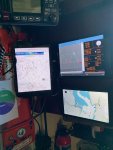
no no no ?I have a traditional boat but I’ve kitted it out like the 777s I used to fly. Like the aircraft there is no steering compass just a standby one like the E2B in all aircraft. I like my glass cockpit ?
Upstairs and downstairs ?View attachment 147500View attachment 147501
Very true, and caution even in apparently charted areas is wise. We have encountered unmarked rocks in well charted UK areas. And sailing offshore is straightforward though perhaps knowing where you are is also wise!(New) and little used anchorages, in some parts of the world (Australia) have never been surveyed and are simply 'white' portions of the chart with the word 'Unsurveyed' printed in black across the white.
The real world is a bit like the curates egg.
Sailing from Sydney to Hobart - get out to the 100 fathom line (as that's roughly where the East Australia Current will give you a decent lift) count the lighthouses and turn right at the appropriate number (which I forget) - its roughly a 550nm passage.
It seems to work as most yachts get there.
Jonathan![]()
How did you pass the time instead?First Mate and my cruise to Londonderry was made far simpler by the plotter. We could have achieved it without, but it would have been far more stressful, plenty of bearings taken, chartwork, estimating how far off we were, identifying the correct channel markers and cardinal marks.
I made it single handed to Sweden and back without a plotter, plus a few other North Sea crossings as well as the easy coastal pilotage as you say. As have probably all the older contributors here done similar. My fear is making it too easy and getting addicted to it. I think the happy medium is basic GPS on board as a back up and times when other position fixing isn't an option. Just wondering on the negligence thing but no one is coming with any examples that make me worry that its a riskIf the OP intends serious passage making a plotter and AIS will be of great benifit. If cruising in known waters he is familiar with, not so much.
Do you think Drake or Columbus would have turned one down had they been available?
You only have to read your link to see how unlikely it is that not using navigational aids would ever pass any of the tests. Don't know the details of course but in your example of the dinghy death I very much doubt failing to wear a lifejacket would have any relevance. I suspect if there was a case it would first be to establish a duty of care (not difficult) then establish a breach - that is an act or omission by the skipper which caused the loss. These are really tough tests, as indeed they should be as the offence is serious with life imprisonment as the maximum sentence.Negligent manslaughter. I'm not living in fear of this unlikely event but it could still be an outside possibility so I'm curious. Gross Negligence Manslaughter | The Crown Prosecution Service
There was someone recently, experienced boating person decided not to wear a lifejacket while on someone elses tender (IIRC) and drowned. Skipper of dinghy I think was legally pursued. Boat skippers even if a couple of mates in a dinghy are legally held to account.
If plotters are seen as basic safety equipment might I be considered negligent for not using one. Its at a point where AIS is seemingly considered basic safety gear now.
I'm unironically posting that the tour leader in the SUP deaths should be put in prison on the other thread. Should we be responsible to avail ourselves of every now available safety device...? Its not really comparable to what she did but I can't help wondering if i'm putting myself at risk even if I do everything else right if something goes wrong.
Yes I think you're right. At most I imagine it might appear in a report as a recommendation of what might have helped. Hard to imagine a situation where it could be the entire reason for failure but where I was doing normal sufficient navigation with other methods. If i wasn't doing that navigation then that would be the point of blame.You only have to read your link to see how unlikely it is that not using navigational aids would ever pass any of the tests. Don't know the details of course but in your example of the dinghy death I very much doubt failing to wear a lifejacket would have any relevance. I suspect if there was a case it would first be to establish a duty of care (not difficult) then establish a breach - that is an act or omission by the skipper which caused the loss. These are really tough tests, as indeed they should be as the offence is serious with life imprisonment as the maximum sentence.
Most of the cases that go down this route in relation to boating involve activities where the duty of care is high - that is professional or commercial relationships and the breach clear - as in the Haverfordwest case. While duty of care is present in most everyday social encounters such as having a crew on board your private yacht, establishing a breach is much more difficult because there is not a professional relationship. Even if there was (for example a professional skipper), lack of navigational aids would not be considered a breach unless it was a coded boat where such equipment was a legal requirement (which I don't think it is). even then you would have to show that the lack was a cause and directly resulted in the death.
You can dream up all sorts of scenarios (that is what we do when we set exam questions) and subject them to the tests using case law (as in the link)and once you do that with your scenario you quickly realise that your fears are unfounded.
... I’d say there may be advantages for the kids in having a plotter from my experience: they seem to actually get a better spacial awareness of where we’ve been... You can have a rolling road etc which some people prefer to steer to...
Again it depends which waters people plan to sail in. NOAA I believe is stopping publishing paper charts sooner than UKHO, and UKHO produce the primary paper charts for many countries outside the UK (and it looks like they will stop well before 2026j.UKHO are stopping printing in 4 yrs but others will continue. I think it’s wrong to even say paper charts will be unavailable for some never mind many waters.
So my question is if there is any precedence for someone doing something as it was done for hundred of years but when something goes wrong being prosecuted for negligence for not availing themselves of the latest tech? Having passengers its a bit of a worry but just wondering really.
With my first couple of boats I was sailing with paper charts, compass, and log, plus the latest electronic aids of echosounder and hand held RDF. Around the north of Scotland we often got thick fog with strong easterly winds. When I started teaching RYA shore based courses, and later practical courses, the techniques of blind navigation was an important part of the course.did sailors of old just heave to for fear of hitting the bottom or was it that usually mist comes with no wind and so they had little choice?
on that we are agreed! Paper charts will likely be available in one format or another for the life of anyone alive today - that might be Imray or others picking up where Admiralty drop out or it might be some sort of custom printing service but it’s not how any of our children’s peers will learn to navigate nor is the easiest / simplest method to do it. It would be like teaching my engineering student son how to use a slide rule. Possible, perhaps an interesting curiosity, but not something that makes him actually want to get involved.But my point was using paper “to teach the kids” may not help real world navigation for them.
I love a hypothetical “what would you say to the coroner” argument. Do coroners actually cross examine witnesses? We don’t have them in Scotland, but I expect they would never be having the conversation you suggest, and if they tried you need better legal representation. If someone wanted to cross examine me on why I hadn’t used a chart plotter I would only need to show them the screen that appears when you turn it on. You have read that screen? The one that says it shouldn’t be used for navigation, right?What would be one's response to this remark from the coroner:-"
Their adverts generally sell them as "Chart Plotters". Why would they do that if not meant for that purpose? --So one can use them as such of course ? . The AIS does not carry that notice, on my boat at least.I love a hypothetical “what would you say to the coroner” argument. Do coroners actually cross examine witnesses? We don’t have them in Scotland, but I expect they would never be having the conversation you suggest, and if they tried you need better legal representation. If someone wanted to cross examine me on why I hadn’t used a chart plotter I would only need to show them the screen that appears when you turn it on. You have read that screen? The one that says it shouldn’t be used for navigation, right?
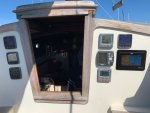
Do you ever throw anything away? ??I have a traditional boat but I’ve kitted it out like the 777s I used to fly. Like the aircraft there is no steering compass just a standby one like the E2B in all aircraft. I like my glass cockpit ?
Upstairs and downstairs ?View attachment 147500View attachment 147501
well yes thats exactly the situation I was imagining myself in. And makes me think better to not have something i don't want to use rather than turn it off.I think one should look at it a little differently. Accidents are , fortunately, pretty rare. But they DO happen Even though they always happen to the other bloke. Someone has to be the "other" bloke.
So let's take the scenario where one has a perfectly good working chart plotter & , say, a similarly set up AIS transponder.
But due to one's desire to use old fashioned methods - perfectly understandable to most on this forum- they are turned off.
Then god forbid, one happens to be the "other" bloke.
What would be one's response to this remark from the coroner:-
Well sir, I see that you had a perfectly good chart plotter on board as well as a perfectly good working AIS. Is that correct?"
"Yes"
"It seems to me that the incident could have been avoided if these instruments had been deployed. Do you not agree?"
" Well err "
"So can you explain to the court why they were TURNED OFF in a busy shipping lane & why you FAILED to use them to full effect?"
"Errmmm"
So with that very hypothetical scenario ( well someone has to win the lottery) now tell us why you would not turn them on & keep an eye on them whilst sailing ?
In fact why one would not make use of modern technology, if at all within their means & applicable to the craft & its use, in question.
I suppose a similar argument could apply to any safety item or even procedure, on a boat, be it life jacket, harness line etc etc. But for the sake of the thread it is about navigation technology & its legal requirement, as asked by the OP.
haha ok I've not seen that. My car satnav sometimes freezes in a position for a while. Would be a shame to rely on it entirely for positioninga chart plotter I would only need to show them the screen that appears when you turn it on. You have read that screen? The one that says it shouldn’t be used for navigation, right?