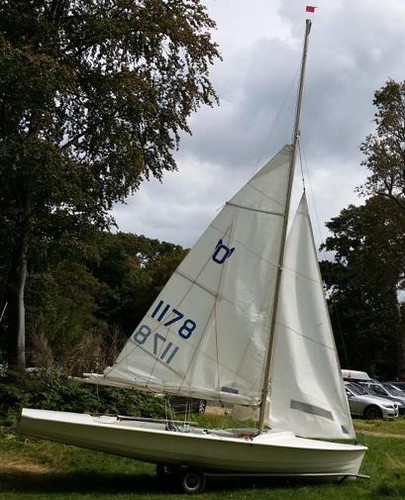
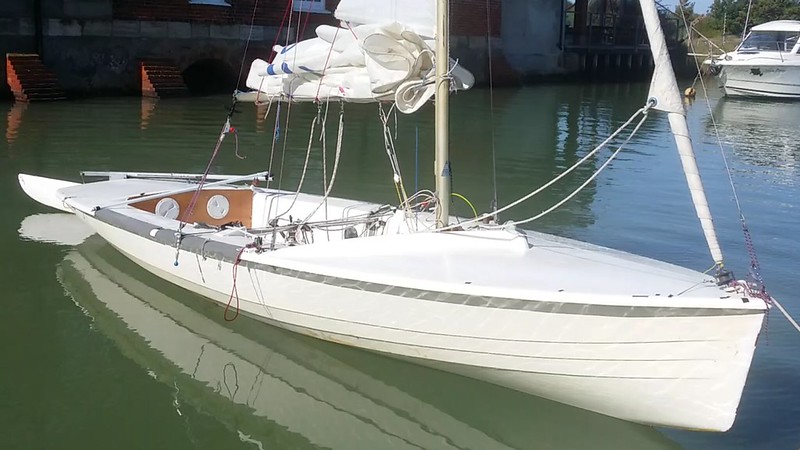
Sailcloth weight for open water Wayfarer

MADRIGAL

Well-Known Member
Joined
12 Jan 2019
Messages
382
Visit site
What weight of Dacron cloth do people like for sails on boats such as Wayfarers, Ospreys, and Drascombes cruising in the Channel, the Irish Sea, North Sea, etc?

 
Probably the same as a standard Wayfarer cruising/racing sail, which might be between 4 and 5 oz. On dinghy sized sails these cloths are strong enough for any windspeed you can have sail set in, as long as the sail and stitching is sound.
 
Probably the same as a standard Wayfarer cruising/racing sail, which might be between 4 and 5 oz. On dinghy sized sails these cloths are strong enough for any windspeed you can have sail set in, as long as the sail and stitching is sound.
Agreed. It is probably time for a new mainsail.
 
As I recall the last time we had a new mainsail for our Wayfarer it was 6oz Contender. Currently Hyde sails advertise Wayfarer main in 6oz and Trident UK in 5oz.
The main Wayfarer sailmakers will be able to advise further.
My experience of the more budget sails is the leech quickly stretching, discuss your requirements with the sailmaker rather than just taking their standard budget/cruising offering.
You might also try the UK Wayfarer Association Forum - the sub is quite modest, or Facebook Wayfarer dinghy group.
 
If you are going offshore ( rather than inland waters) then one might be more interested in reefing reinforcement. Plus a good quality cloth with less stretch rather than just a cheap heavy cloth. A light cloth is better for performance as weight aloft affects heeling .But a sail that does not retain its shape is just as bad.
It has to be said that the mast is just as important. No good getting light sails & having a heavy wooden, or poor quality aluminium mast. I doubt Wayfarers allow carbon, but there are different mast makers & like other classes, the mast makes a big difference in the way it responds to gusts etc.
 
If you are going offshore ( rather than inland waters) then one might be more interested in reefing reinforcement. Plus a good quality cloth with less stretch rather than just a cheap heavy cloth. A light cloth is better for performance as weight aloft affects heeling .But a sail that does not retain its shape is just as bad.
It has to be said that the mast is just as important. No good getting light sails & having a heavy wooden, or poor quality aluminium mast. I doubt Wayfarers allow carbon, but there are different mast makers & like other classes, the mast makes a big difference in the way it responds to gusts etc.
Reefing reinforcement is a good idea, as I am looking at a sail for offshore work, and frequently find myself single-handing under reefed main alone. Few people take dinghies offshore in my area, and the local sailmaker thinks I'm mad. He may be right, but not because of the sailing I do.
 
February 7th

Thank you Madrigal...I typed 'sailcloth' in the search box, and not only did I find a recent thread, but it's about dinghies, and specifically Ian Proctor dinghies! ?

I'm sorry I missed this thread...I've been too busy sewing track sliders on to my main, so I can hoist and drop more easily. When I visited the boat to try it, I discovered the top two metres of the Osprey's mast track is fractionally too narrow to let the 3mm-thick sliders glide...so, back home to shave them down to 2mm, and now I'm waiting for a dry weekend to try again.

My question is, how critical is it that the sailcloth patches I add to reinforce slab-reef corners, be made from the same weight of cloth as the sail itself? Below is my Achilles 24's leech, horizontal. Days of work for me, but very satisfying. Holy cow, some of those stitches are irregular, I wonder what I was thinking about.

48949050617_caf0f1f70d_z.jpg


When I was sewing those patches and cringles in, two years back, I was advised to match the weight of the yacht's small but sturdy cruising mainsail, in the patches...

...so I picked up a couple of square metres of whatever that was...6 oz? Slightly heavier than the Osprey's, but not much in it.

I've sold the Achilles but I still have the sailcloth. Can I use it for the Osprey's reef reinforcements, without regretting it?

Thanks, all...
 
February 7th

Thank you Madrigal...I typed 'sailcloth' in the search box, and not only did I find a recent thread, but it's about dinghies, and specifically Ian Proctor dinghies! ?

I'm sorry I missed this thread...I've been too busy sewing track sliders on to my main, so I can hoist and drop more easily. When I visited the boat to try it, I discovered the top two metres of the Osprey's mast track is fractionally too narrow to let the 3mm-thick sliders glide...so, back home to shave them down to 2mm, and now I'm waiting for a dry weekend to try again.

My question is, how critical is it that the sailcloth patches I add to reinforce slab-reef corners, be made from the same weight of cloth as the sail itself? Below is my Achilles 24's leech, horizontal. Days of work for me, but very satisfying. Holy cow, some of those stitches are irregular, I wonder what I was thinking about.

48949050617_caf0f1f70d_z.jpg


When I was sewing those patches and cringles in, two years back, I was advised to match the weight of the yacht's small but sturdy cruising mainsail, in the patches...

...so I picked up a couple of square metres of whatever that was...6 oz? Slightly heavier than the Osprey's, but not much in it.

I've sold the Achilles but I still have the sailcloth. Can I use it for the Osprey's reef reinforcements, without regretting it?

Thanks, all...
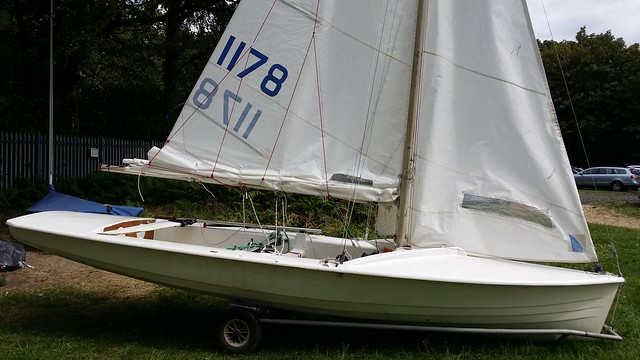
The reinforcement at the clew of Madrigal's Genoa is made of several layers of cloth that each seems to be the same thickness as the rest of the sail., but when assembled one over the other, make a very thick and strong place to attach the clew crinkle. I don't know if that method is ideal, or if the sailmaker was just using up bits he had lying around. :)
 
Indeed, having asked, I'm now in doubt that it matters much.

I think I was worried about inconsistent stretch in the patches versus the rest of the sail, but given how the patches are layered to create heavy reinforcement of the clew and tack, I doubt stretch needs to be a consideration.

More long weeks of sewing ahead...thankfully it's still winter. :)

Does anybody have a view about the correct proportions of each reef, relative to the whole mainsail?

My other mainsail has given solid service since 2013, when it was old already but new to me. The following year, I added an extremely deep reef (6ft of luff), which I admit looks a tad tame, and has caused comment in the past...

51868686167_9f96356427_z.jpg


...that's not a good photo because the reefed main doesn't look as tiny as it is...but with the unrolled genoa, the reefed sailplan still totals 100sq ft, allowing either ample sail for moderate conditions, or a rapid reduction to trysail-area, for squalls.

I've often been glad of the smallness of the reefed mainsail, mainly because I haven't mastered the trapeze, and hiking singlehanded on the Osprey when I'm barely heavy enough for a Laser Radial in a breeze, is a challenge.

But assuming I get into the trapeze this year, and if my track-sliders let me switch briskly between full sail and one or two reefs, I hope I won't need to decide before launching whether I want the overpowering full sail, or the bite-sized reefed main.

The question is, how much should each reef reduce the mainsail by?

For the Achilles, a ballasted yacht, the first (only) reef took about 90cm off a luff of about 6.5m (22ft).

For the Osprey I'm thinking 30 inches (75cm) for the first reef and another 30 for the second, enabling almost the same maximum reduction of area that my other mainsail has allowed all these years, but with a first reef allowing a happy midpoint.
 
Dan surely it is not luff length that matters but sail area. may I suggest that you calculate the area of your mainsail. Then decide what the max sail area that you think you can handle with your second reef. Then divide that so that the first reef gives you the area half way between a full sail & that second reef. If you just halve the luff length the sail area will not be equal as the lower areas will be bigger.
If , however, you find yourself sailing with a reefed main most of the time, then look for a sail from another dinghy to start with, that is smaller & thus does not need the first reef. This will be more efficient & much easier to handle, even if slightly bigger than your first reef option.
Lots of dinghy sailors will have a spare mainsail that they do not want & which is just cluttering the loft. Have a look through the list of dinghies with a suitable sail area & try a facebook request for a freebie.
 
Good advice there, thank you Daydream.

I realise (it's no secret, is it) that area is the factor that decides the effectiveness of a reef, but if a sail is a right-angled triangle (with the roach slightly warping the calculation), then the luff-length of each slab is key to the reduction in area.

I've never tried (partly because I've mostly been content with what I have*) a smaller, unreefed mainsail from a different class. My very deep reef makes a laughably petite sail (photo below) but has usually allowed me to get back from downwind day-trips when the sea breeze increased beyond my ability to keep the mast upward under full sail...

51875812925_bbe8acce32.jpg


...the full Osprey mainsail is a glorious thing to set and control singlehanded on a force 2 day, but isn't loose-footed, so is a bugger to take off and put back on if I change sails often. My preparations for launching are already lengthy when alone, so I leave the mainsail on the boom, hanging in unforced curves below it - my cover is the 'boom-up' type.

But it's true that on plenty of days, that deep reef left the boat needlessly underpowered. The only thing which prevented my sewing another, less extreme reef in the same sail, was the memory of the effort of putting the first one in. I am emboldened to get sewing again, having set myself various Osprey-goals since selling my bigger boat.

I'm rambling far off the sailcloth subject now, but it's amazing to me, to reflect on the work I have put in (and the amount of tools and materials I have bought and learned to use) for modifications to the Osprey, to enable easier singlehanding or to add non-standard accessories that the designer never considered...

...people invariably point to small, lightweight new designs as more suited to my style of sailing. I could now afford a modern, lightweight, thrilling singlehander like a Devoti D-One or an F101, or a classic wooden cruising dinghy or one of those graceless, plastic RS curiosities, but I have no feeling for them, and I still adore the classy presence of the big old Osprey.

31196623707_0f64756d2e_c.jpg


*...but also because despite stories of dinghy racers routinely selling off their little-used sails, I have never been able to find any reliable source for affordable sails, even on class association websites. It seems to be a realm that relies exclusively on word-of-mouth, and which has rejected internet. Or perhaps the problem is my rejection of Facebook. ?
 
Last edited:

Other threads that may be of interest

Top