S/S trim tabs - Antifoul or Polish.

Here they are mid summer , out of shot are the painted flaps -as I say seemed to work .
null_zpshtydbobp.jpg

Strangley after a fast sustained run say a few hours @ 1900 rpm 32 knots ,its the the hubs - -root of the blades that clean up like new while the tips stay as you see .
Also a shiney patch appears on the rudders behind the props about the middle 1/3 rd shines up like the pic post # 20 .
 
Last edited:
If the tabs are connected electrically to anything else sitting in the seawater that's made of a less noble material (Aluminium, cast iron, mild steel) then they should be painted. Not painting in this scenario could result in increased corrosion of these less noble components.
If the tabs are not electrically connected to anything else in the sea then painting is less important but your tab anodes will not last as long if the tabs are unpainted. Painting the tabs also means they are less likely to become fouled.
I don't think crevice corrosion will be a problem with painted tabs as it needs the presence of seawater as well as a lack of Oxygen & the paint should keep the seawater out.
 
If the tabs are connected electrically to anything else sitting in the seawater that's made of a less noble material (Aluminium, cast iron, mild steel) then they should be painted. Not painting in this scenario could result in increased corrosion of these less noble components.
If the tabs are not electrically connected to anything else in the sea then painting is less important but your tab anodes will not last as long if the tabs are unpainted. Painting the tabs also means they are less likely to become fouled.
I don't think crevice corrosion will be a problem with painted tabs as it needs the presence of seawater as well as a lack of Oxygen & the paint should keep the seawater out.

I used to paint the stainless steel tabs with primer and antifoul; it invariably fell off ( usually when reversing !).

Now, I just acid clean them and the drive ( with HCl. brick acid etc) at the end of each season and give the tabs a polish using Autoglym. Obviously I remove the tab and drive anodes first before the acid treatment. The tab anodes on my boats do erode, but they usually last between 2- 3 years, or more; not a lot going on there as far as electrolysis etc.
 
Last edited:
This an old thread that I have resurrected but does discuss my issue. Trim tabs and fouling. If I decide to put antifouling on the S/S tabs, a) Do I have to be sure it is not copper based? and b) does one have to leave a border between the anode and antifouling?
 
I just got down to boat ,hull has just got slime on , trim tabs and rams covered in shite.next year defo AF.
 
This an old thread that I have resurrected but does discuss my issue. Trim tabs and fouling. If I decide to put antifouling on the S/S tabs, a) Do I have to be sure it is not copper based? and b) does one have to leave a border between the anode and antifouling?
I have been antifouling them for the past 10 years with copper based International 350. You just need to ensure there is a very good electrical continuity between the anode, that sits on a foam pad, and the stainless steel so after painting scrape some paint off back to bare stainless just enough for the head of the bolt to make contact. However, despite the advice from the stainless trimtab manuacturers I am not convinced an anode is needed if the trim tab is not connected to a different metal. I stopped fitting trim tab anode 8 years ago and no change so far.
 
" You just need to ensure there is a very good electrical continuity between the anode, that sits on a foam pad, and the stainless steel so after painting scrape some paint off back to bare stainless just enough for the head of the bolt to make contact. "

That is a very interesting approach. Was the foam pad idea yours, or proposed by the manufacturer? If the latter, make?
 
" You just need to ensure there is a very good electrical continuity between the anode, that sits on a foam pad, and the stainless steel so after painting scrape some paint off back to bare stainless just enough for the head of the bolt to make contact. "

That is a very interesting approach. Was the foam pad idea yours, or proposed by the manufacturer? If the latter, make?
When you buy anodes they may come with a foam backing pad Hull Anode Backing Pads For Sale depends on the design of the anode and the arrangement of the fixing bolt but usually the pad is to seal the back of the anode to stop it wasting away from underneath which can allow the fixing bolt to become slack and the anode to no longer function. If your anode has a steel insert that is bolted to the trimtab so that wastage if the zink or aluminium does not affect the clamping of the bolt then no backing pad is required.
 
Last edited:
Thanks Plum. I have always just replaced the Technoseal anodes that the manufacture put on the boat with the same. They do not come with the pads but I see they do sell them.
The anodes come in pairs, one each side of the trim tab. Ensuring the electrical contact is via the bolt in this case is hard and old I think be worse with the pad.
I think I will turn to a non copper based antifouling for the tabs. I need to research it but perhaps Seajet 064.
 
I have the foam pads by they were not present when I bought the boat. I have tried it with and without the pads.
The pads seem to make not a lot of difference. But they might help prevent pitting of the tab where the anodes would otherwise touch the stainless steel tab.
I only have anodes on top of the tabs.
The trim tab anodes do sacrifice themselves in my case so they must be doing some good . But I am not convinced they are protecting the stainless steel trim tab as it doesnt need to be protected.
 
Thanks Plum. I have always just replaced the Technoseal anodes that the manufacture put on the boat with the same. They do not come with the pads but I see they do sell them.
The anodes come in pairs, one each side of the trim tab. Ensuring the electrical contact is via the bolt in this case is hard and old I think be worse with the pad.
I think I will turn to a non copper based antifouling for the tabs. I need to research it but perhaps Seajet 064.
Why do you need to turn to a non-copper antifouling for the trimtabs?
 
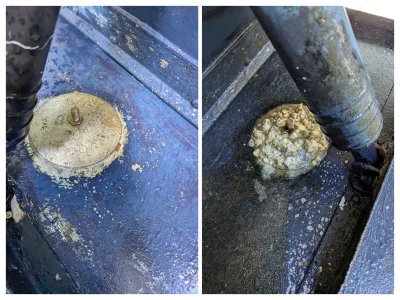
Thanks for your interest Plum. The setup is like this. S/S trim tabs with two Aly Technoseal domed anodes, one each side bolted through. The tabs appear to have been primed and then painted with Hempel Hard Racing (a copper based) antifouling. Now at the end of the season when I remove the anodes the S/S under the anode is pitted and the antifouling did little to stop growth. I should say there was NO paint under the anodes, bare metal. They were bolted up tight so there should be good anode to S/S contact.
I have to say I don't really know what is going on. Why pitting under the anodes? I thought perhaps if I polished them back to bare metal (proving difficult), started again with new anodes and got the copper out of the system I might have an easier time next year. I should add that the starboard anode is considerably more depleted than port.

PXL_20240912_092645882.MP-COLLAGE (1).jpg
 
Thanks for your interest Plum. The setup is like this. S/S trim tabs with two Aly Technoseal domed anodes, one each side bolted through. The tabs appear to have been primed and then painted with Hempel Hard Racing (a copper based) antifouling. Now at the end of the season when I remove the anodes the S/S under the anode is pitted and the antifouling did little to stop growth. I should say there was NO paint under the anodes, bare metal. They were bolted up tight so there should be good anode to S/S contact.
I have to say I don't really know what is going on. Why pitting under the anodes? I thought perhaps if I polished them back to bare metal (proving difficult), started again with new anodes and got the copper out of the system I might have an easier time next year. I should add that the starboard anode is considerably more depleted than port.

View attachment 184659
I have the same Bennett trimtabs, fitted 24 years ago! (I have had the boat 10 years). In the instructions is says the anode should be on the top surface (no mention of underneath) and the tabs should be primed then painted with antifouling (they do not specify copper or copper free antifouling). See here Bennett trimtab info & troubleshooting.pdf . Witn anodes fitted you should have less than 1ohm (0.5ohm is better) resistance between the anode and the stainless steel (suggest you check rather than just relying on the bolts being tight). I know this does not explain your pitting but it will help you to establish what it's not. I have been using copper based eroding antifouling for 10 years with no ill effect and, as said above, I stopped fitting tabanodes 8 years ago. Obviously, if your speed through the water is too great for a eroding antifouling then you may need a hard antifouling anyway. I have never heard of avoiding copper based antifouling on stainless steel. If all this is correct and the stainless is pitting under thezinc then there must be something else at work, beats me.
 
Top