RYA - lost the plot?

With a suitable tail on the ring one of these new-fangled inventions might offer the speed of release you require?
Swivel%20Snap%20Shackle%20With%20Eye.png

Yes, a soft bight to which one of these (spinnaker swivel) on the extension could be attached would do it.

Two pointers:~

These swivels are pulled open by attaching a lanyard to the ring.
The ring pulls out a piston that frees the locking.
It is prudent always to ensure the mechanism is properly lubricated to ensure ease of use, because they can become caked with salt deposit that makes the release a pain.

Often the tail attached to the ring pull is a short cord with a knot at the end.
it may be that if you are sailing and your hands are cold it is a better option to have a smallish loop lanyard you can get your fingers into to pull rather than gripping between fingers and thumb. A three or four inch closed loop is ideal.
 
This thread has been useful in showing there is not always one way and sometimes not even a best way of doing things. Provided you are open to new ideas you can always learn and find different solutions to problems depending on the situation. An open enquiring mind seems to me a pre-condition to ensure effective learning.

Absolutely.

Now turning to another aspect of best practice...some tips...

Harnesses.

Often you will see harnesses supplied with very long lanyards.
Not a good idea.
A long lanyard presents
the risk you might get it wound round your ankle and cause you to topple over.
Also if you fall overboard a long lanyard will drag you in the water and drown you.
the ideal length for a lanyard is the vertical distance from the deck to a point one or two inches above your navel.
You can rig two of these to your harness. One in use and the other clipped back to the webbing harness.
Then in hazardous deckwork you can alternate between one and the other as you go along.

Deck shoes.
More often than not deck shoes are fitted with leather laces.
They look good ashore.
And indeed it does not matter if ashore one or the other becomes undone.
But on deck an undone shoelace you really want to avoid.
Then it is better not to tie them in a bow, but instead to tie the ends in acorn knots.
Then the reef knot in the middle is guaranteed not to become undone.

Next tip...

Nails.
I know...I know...
In the days of square rig all hands on board were examined by the deck officer appointed by the skipper to ensure all fingernails were properly clipped.
One of you here has posted a sarcastic comment about me mentioning this earlier in the thread.
I assure you that a broken nail broken below the quick and turned backwards is not pleasant.
Get your nail clippers out and clip to ensure your nails are of the correct length.

Be prudent. Be sensible. Stay safe and comfortable. Good and happy sailing to you all.
 
Last edited:
This thread has been useful in showing there is not always one way and sometimes not even a best way of doing things. Provided you are open to new ideas you can always learn and find different solutions to problems depending on the situation. An open enquiring mind seems to me a pre-condition to ensure effective learning.

Completely agree. :cool:

Though some people still think they're right.. ;)
 
Why would you want to do that? Just tie it off at the gooseneck and it's all ready for the next time you need it.

I used to keep mine permanently rigged between the boom end and the vang flange on the boom but it had a habit of tapping away on the boom in any wind which was annoying. I just rig it now when I need it, with a round turn and two half hitches at the boom end - sacré bleu
 
This thread has been useful in showing there is not always one way and sometimes not even a best way of doing things.

Really? That's what you've got from a thread that started by questioning the RYA's direction and motivations, got sidetracked into the quality of course instruction, got further sidetracked into the surreal world of the lights displayed by submerged submarines, crashing yachts into jetties, long bowlines and a variety of other meanders. If it really took this thread to make you realise that on a boat any way of doing things is only Plan A to be contrasted and compared to B, C, etc. and depends on the details of the situation, then any training you have had failed.
 
I used to keep mine permanently rigged between the boom end and the vang flange on the boom but it had a habit of tapping away on the boom in any wind which was annoying. I just rig it now when I need it, with a round turn and two half hitches at the boom end - sacré bleu

I hope you practice your method every day, preferably accompanied by a bugle. By the left, quick ... round turn (toot! toot!). By the the right ... wait for it, wait for it, you 'orrible little men ... half-hitches (toot! toot!).
 
This thread has been useful in showing there is not always one way and sometimes not even a best way of doing things. Provided you are open to new ideas you can always learn and find different solutions to problems depending on the situation. An open enquiring mind seems to me a pre-condition to ensure effective learning.

If it really took this thread to make you realise that on a boat any way of doing things is only Plan A to be contrasted and compared to B, C, etc. and depends on the details of the situation, then any training you have had failed.

This thread has also been useful in showing an ability to read and comprehend what people have said is very important
 
One always reads VO5's posts in the hope that Jimmy the seagull will make a reappearance, but as it's a long way from gib to the bahamas I suppose it was a vain hope. Oh well, maybe next time. So your mate with the Dayskipper then...

I offered to skipper the vessel for him. He declined.
So I just let him get on with it ha ha.

The culprit was the owner of the boat. The rest of us were guests.

So you were just a passenger and let him get on with it. As an experienced sailor perceiving his lack of experience you did the reasonable thing: making the offer then respecting his rejection of your offer.

I was not so much interested in sunset but at the onset of nautical to astronomical twilight and gave instructions to be called at such time.

I stayed up all night supervising the night passage and attending to navigation and chartwork until dawn and helming the boat all the way myself.
[...]
The coast became visible and the owner assured me he felt confident because this was his third trip to Bimini. So I left him on the wheel.

Because I took it upon myself to do the entire night passage because there were obstructions to be dealt with and dog legs to be made. And the vessel was ketch rigged.

None of the others had any significant watckeeping experience in night navigation is the reason.

So here's the bit I don't understand. You were just a passenger. The owner was the skipper. Yet:
* you did all the chart work
* you issued instructions/standing orders
* you decided the watch system based on your perception of crew experience
* the owner obviously felt the need to assure you that he was ok to be left in charge

That sounds a lot like skippering to me. Perhaps you can call it being mate under the authority of the owner but in a situation like that (experienced person on board apparently taking charge, inexperienced person nominally in charge) as an experienced sailor you must surely know what tends to happen: The nominal skipper starts deferring to the more experienced sailor and stops effectively making decisions. Being the de facto but not the nominal skipper will often be unavoidable for professionals (instructors/assisted delivery) but isn't it important that you're consistent in your role? If you give the semblance of command all night aren't others (including the nominal skipper) going to be assuming that you are still the de facto skipper and be thrown into uncertainty if a crisis happens and you can't be found?

He had done his RYA training in the UK, and was very proud of his achievement.
[...]
I did not reveal I had the Ocean ticket, so as not to belittle him.

Sounds like you're proud of your Ocean ticket. If all RYA quals were all equally worthless you wouldn't have been belittling him :)
 
From time to time I sail with my brother in law. He has his way of doing things, I have mine and never the twain shall meet. On his boat we do things his way on mine we do it my way. We get on quite well and enjoy sailing together. Neither of us are YMs. My sister is, She did a course way back in the mists of time.

Their boat is about 50 year old and has been in the family for 40+ years. Its been around the world. 40+ years ago. None of us were on the voyage.

He as interesting technique. Which no doubt will be controversial. Used all his life. Quite why I don't know. :)

He uses his kicking strap as a preventer. On either rail the is an eye. to which he shackles the kicking strap. Secured in the usual way to a cleat on the side deck. His dad and him have been doing it this way for 40 years.
We have goose winged down the Minch just fine many times.
Its no the way I do it. It works for him. Its his boat

After all the idea behind a preventer is just to stop the sail coming across briefly if back winded just till you turn down and get things sorted.
 
Last edited:
Completely agree. :cool:

Though some people still think they're right.. ;)

As I teach (and have been taught) equally safe ways of rigging preventors in RYA accredited and recognised sea schools I'm rather underwhelmed by VO5's 'this is the way to do it' proclamations. Tying a long loop bowline is a simple way of ensuring the knot is within easy reach.

(By the way there's no alteration of course that will take the load off a properly braced up preventor.)

The longer I sail the more I realise that there's often more than one way to do things and sometimes a persons pet way isn't the only seaman like way to do something. (I'm trying hard to be polite here as pomposity is a particularly annoying trait; let the reader understand.)

From time to time I sail with my brother in law. He has his way of doing things, I have mine and never the twain shall meet. On his boat we do things his way on mine we do it my way. We get on quite well and enjoy sailing together. Neither of us are YMs. My sister is, She did a course way back in the mists of time.

Their boat is about 50 year old and has been in the family for 40+ years. Its been around the world. 40+ years ago. None of us were on the voyage.

He as interesting technique. Which no doubt will be controversial. Used all his life. Quite why I don't know. :)

He uses his kicking strap as a preventer. On either rail the is an eye. to which he shackles the kicking strap. Secured in the usual way to a cleat on the side deck. His dad and him have been doing it this way for 40 years.
We have goose winged down the Minch just fine many times.
Its no the way I do it. It works for him. Its his boat

After all the idea behind a preventer is just to stop the sail coming across briefly if back winded just till you turn down and get things sorted.

I remember a new boom being flown out to the Carib to be fitted to a boat that used that technique. The boat was in the trades and rolled the boom end under and one expensive new boom later they never did it again. However and as you say; it's their boat and his choice how he does things.
 
Last edited:
He as interesting technique. Which no doubt will be controversial. Used all his life. Quite why I don't know. :)

He uses his kicking strap as a preventer. On either rail the is an eye. to which he shackles the kicking strap. Secured in the usual way to a cleat on the side deck. His dad and him have been doing it this way for 40 years.
We have goose winged down the Minch just fine many times.
Its no the way I do it. It works for him. Its his boat

After all the idea behind a preventer is just to stop the sail coming across briefly if back winded just till you turn down and get things sorted.

I know a boat that lost her boom because the preventer was attached to the kicking strap. Such a preventer can put an awful lot of load on the gooseneck when it comes under load. I'd rather have the preventer at or near the end of the boom

And anyway, how does he adjust the leech tension if the kicker has been detached to be used as a preventer.
 
I really don't like that second picture which Babylon posted.

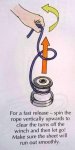
Pulling a sheet/halyard/guy off a winch in that manner is guaranteed to generate at least one, possibly more, twisted crossing turns which will jam itself in a sheave or turning block as the line gallops away from the winch. The jam will be exacerbated by the urgency with which the line is required to run freely.

Been there, done it, got the rope burns...

I agree, and its a method I only use with caution once I've eased off the intial tension. By the way, here is a more attractive picture of exactly the same technique from the RYA Competent Crew booklet:

DSC_0197.jpg

...And it's not in any formal qualification syllabus except the curriculum of nautical common sense.

But that's the point of this whole - now famously long - thread isn't it? Remove common sense from the equation and no human endeavour is fit for purpose.
 
Last edited:
I know a boat that lost her boom because the preventer was attached to the kicking strap. Such a preventer can put an awful lot of load on the gooseneck when it comes under load. I'd rather have the preventer at or near the end of the boom

And anyway, how does he adjust the leech tension if the kicker has been detached to be used as a preventer.

It tightens the leach quite effectively. The position being from the side deck mid ships. It pulls downward and also prevents the boom swinging inboard.
Not a method I recommend but as I said its his boat he can sail it how he likes.
The point being there is more than one way to do a lot of things. We each have our favourites. Its been said several times there is no RYA way.
Though If you choose an unusual method you may have to justify it to a sceptical chap the RYA if you want one of their certificates .:)

Although there may not be an RYA way. Sailing schools may often have a particular "way" which they teach and have found successful. :)
 
Trying to get back onto topic - I received my copy of the RYA magazine last week and was interested to read the multi-page article on the Olympics in Rio.

Not one word about the raw sewage in the bay that the sailors will be in the midst of. ISAF have swept it under the table and the RYA seems to be doing the same.
 
While you no doubt believe your scatological references are the height of wit (or something that rhymes with it) there is a serious mess in Rio for our Olympic sailors. Security is sadly lacking in a city known for its crime and the water pollution of the sailing venue is execrable with human and animal faeces, hospital waste and dead animals. Promises to clean up the bay have been broken and are unlikely to be fulfilled.
Why there is nothing from the RYA on this mess I don't know.
 
Top