RYA Diesel Course unhelpful. What shall I ask engineer to teach me on a Yanmar

This is one thing that I can do having changed the pump cover to a Speedseal. Speedseal also supplies an impeller removing tool.

TS

Same here, but I could not get the old impeller that was in there when I bought the boat out with the Speedseal tool as it had seized onto the splines. I made an extractor that grips it like the Jabsco tool, but is small enough to fit between pump and starter motor. I only had to use it once as I now put the impeller on with a smear of waterproof grease on the splines.
 
All you need:

0a8fb94dfb9734e4ca8704882928c8ea_zpsac03cf1d.jpg
 
Never having been on an RYA diesel course - I would make one philosophical point.
If you can't do it, you probably shouldn't try - there are in my mere 77 years' experience some who never can master engineering and their efforts usually lead to expensive mechanical disasters. Many of them have Russell university doctorates.
I learnt my "engineering" on a farm, then racing Austin 7s and Formula 500 cars - nowadays I don't try my hand at modern cars.
Incidentally most modern engines (and all the latest Yanmars) are self-purging, so the skill in bleeding a diesel engine is as obsolete as my skill @ balancing 4 SUs using a stethoscope.
The one certain way for the OP to learn about his engine is to strip and re-build it.
 
................
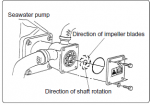
As others have mentioned, the Yanmar engineer who positioned the impellor had dreams of going off to join a circus as a contortionist and set up the engine so he could practice in his day job. A trick I've found is that you can screw a bolt of the right size into the old impellor, then pull.:)


I don't recognise the exact engine reference provided by OP - 4JH23-TE: My handbook extract
This Operation Manual describes the operation, maintenance and inspection, and handling
precautions for the 4JH3-TE/-TCE/-HTE/-DTE Yanmar Marine Diesel Engine.


and I don't have the impeller position issues where other engine components impinge on impeller access as referenced in some posts above. Access is a bit restricted but no problem removing/replacing mine

impeller.png


General servicing (from the manual)
Fuel oil
Check & supply of oil to the tank
Drain the fuel tank
Drain the fuel filter
Replace the fuel filter element
Engine
Lube oil
Check the quantity of lube oil
Replace the lube oil
Replace the lube oil filter element
Clean the engine oil cooler
Marine gear
Lube oil
Check the quantity of lube oil
Replace the lube oil
Wash the lube oil filter
Clean the oil cooler
Fresh cooling water system
Check & supply of cooling water tank
Replace the fresh cooling water
Clean & check the cooling water passage
Seawater cooling water system
Check the seawater outlet and discharge
Check & replace the impeller of seawater pump
Clean & check the seawater passage
Piping
Check & replace fuel oil pipe, cooling water pipe
Replace mixing elbow.
Electrical equipment
Check the alarm lamps & devices
Check & supply electrolyte in battery
Belt Adjusting the V-belt tension
Remote control handle
Check the remote control operation & grease
Adjusting the remote control cable
Intake and exhaust system
Wash turbocharger blower
Adjust the intake and exhaust valve clearance
Lapping the intake and exhaust valve
Fuel injection
Check & adjust the fuel injection pressure & atomizing condition
Check & adjust the fuel injection timing

..and as others have said - manuals available on line

Engine oil: bog standard diesel 10/40, 15/40 mineral oil - NOT semi-synthetic or fully synthetic.

Advances in antifreeze technology is such that Yanmar now recommend the red long life antifreeze (it used to be green) - available from Texaco garages - the full spec here: give me a mo and I'll dig it out and post here

http://ldmarineservice.com/files/yanmar_bulletins.pdf

http://europe.havoline.com/products/coolants-antifreezes1.aspx
 
Last edited:
Just a slightly different take on things.

I don’t like crawling around under engines. Beyond checking the oil, and the cooling level, belt tension, I’d
Sooner pay someone else.

If you are planning a long trip. Spend your money on having your engine and fuel system given a complete service pre-trip. Change all the filters belts and impellors. Carry the spares but a bit of prevention is better than doing a bodge up repair.

You are going on a sailboat the engine is just a convenience. You are not going to be motoring across.
If you are worried about being able to charge your batteries if your engine fails. Take a small portable generator.

Yes I’ve had an engine fail. I just sail it in to a place to get it fixed or home.
 
Judging by the various comments about the RYA course, it looks to me as if there's a serious lack of standardisation in the way the course is taught. We were taught by an engineer who looked as if he'd learnt his trade from Dr Diesel himself! And we had an ancient Bukh in the classroom on which he demonstrated all the various tasks that you would need to do to maintain a diesel and have a chance of getting it going in an emergency. There were a lot of supplementary bits and pieces that he had as well, such as a turbocharger, a heat exchanger and various bits of starter motors.

This obviously contrasts strongly with reports of courses where people didn't even see how to bleed a fuel system; surely the most basic necessity for most of our engines.

Seems to me that the RYA need to oversee the course content more tightly, and level up the underperforming courses.
 
The RYA "Terrify Yourself with Diesel Course" was brilliant. I went from a diesel virgin to confident to do all the routine stuff. When I start crossing oceans I will stripdown and rebuild the engine just to understand how it is set up, hold on I am not planning to use the donk.
 
When I did my instructors course I was surprised at the variation in basic skills of the candidates
There were the people who had the ability to take the course book and verbalise the content those who were already sail /power training instructors and then the hands on people who new exactly what they were doing but did not normally teach I dont recall any failures but it was the initial training course
If that was typical it would partially explane the range of comments in this post
 
Top