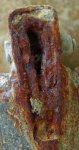
Rusting Spade Anchor

I did mine last season. Its easy enough. Just play a gas torch on the lead and it will drain out easily. Scottish galvanizers in Cumbernauld re galvanised it for me along with my Bruce. Just check the air vent holes in the shank are clear. I re melted the lead in a couple of stainless dog bowls on my barbecue. Then just poured it back in. No real problems.

I had melted my lead in an old saucepan, gas stove underneath and blow torch on top. The handle was stainless and was distinctly hot - you need to be wearing good welding gloves and wrap the handle with leather. Heavy duty clothes offer protection. If you are using something like a stainless dog bowl - you then need to have some way of pouring the motion lead from the bowl into the ballast chamber.

Planning ahead - carefully - covering all the options - its really not difficult - and as posted - the practice is not uncommon.

Jonathan
 
My next anchor will be a stainless ultra

Then note that the shackle hole is circular and will not take the bow of a shackle and there will be no articulation (and the shackle end will then be subject to 'large' tensile forces when loaded sideways). The design appears to demand you use the Ultra swivel. I don't think the swivel is a weak link - it does seem well designed - but why does everyone (who buys an Ultra) need a swivel (as swivels only work with lots of twists in the chain or with human intervention).

So I hope you have, very, deep pockets and a yacht that will be enhanced by some expensive jewellery.

Otherwise it is an excellent anchor, develops excellent hold, sheds mud (being stainless) and looks absolutely gorgeous - and best paired with Cromox duplex stainless chain and a stainless windlass.

I have tested the Ultra and tested swivels - so base my comments on actually using and testing both. I confess to not having the wherewithal to even contemplate an Ultra but it does have an impressive performance - up with the best.

Jonathan
 
Stating the obvious on this thread but the reason I did not buy a Spade was the number of rusty ones I have seen on foredecks. Maybe they get used more than other anchors.
 
I did mine last season. Its easy enough. Just play a gas torch on the lead and it will drain out easily. Scottish galvanizers in Cumbernauld re galvanised it for me along with my Bruce. Just check the air vent holes in the shank are clear. I re melted the lead in a couple of stainless dog bowls on my barbecue. Then just poured it back in. No real problems.

Just to clarify: Scottish Galvanizers are not in Cumbernauld, they're in Glasgow. In Cumbernauld you'll find Highland Colour Coaters. Scottish Galvanizers are a good reputable company and a worthy competitor to HCC, but they do not have anyone there who sails, and who knows anything specifically about chain and anchors. HCC do have a sailor (me!)
 
Sorry yes it was HCC. Very nice job they did. Much better than the original spade galvanizing.
 
Stating the obvious on this thread but the reason I did not buy a Spade was the number of rusty ones I have seen on foredecks. Maybe they get used more than other anchors.

It is worthy of note that Spade have been around since the early 1990s, earlier versions have a slightly different (and very unusual) fluke construction - I don't know when they changed to the current design. But an anchor with that history and the fact they are used by discerning owners (who might anchor a lot) would suggest it is not surprising that some look rusty. I have seen other brands/models introduced say later than 2006 - that also look decidedly tattie.

Jonathan
 
Stating the obvious on this thread but the reason I did not buy a Spade was the number of rusty ones I have seen on fore decks. Maybe they get used more than other anchors.

Agree, the fact the OP had one that was only 5 years old going very rusty for such a high priced anchor would ring alarm bells for me and it does fit with my own anecdotal evidence. Will not mention the make of my own, much cheaper anchor for fear of starting an anchor wars thread but neither my current one or my previous one had the problems the OP is having
Perhaps controversial, but if you are paying such a high price for a supposedly high quality anchor I would expect better
 
There were three reasons my spade rusted quickly. One very poor quality galvanising, two the design has sharp edges and three the two piece configuration results in wear points which promote corrosion. My other anchors in chronological order CQR, Bruce and Delta had the same usage rate and lasted many times longer before needing regalvanising.
 
If you have a steel Spade one place to watch is the bottom of the fluke/shank connection.

This area can sometimes corrode quite badly even when the rest of the anchor is in good shape. As it is underneath the fluke, it is easy to miss. Severe corrosion in this area only effects some anchors, but I have seen some bad cases where the loss of steel is enough to consider scrapping the anchor despite little corrosion elsewhere.

Spade changed the design of this area to try and reduce the problem, but it is still an issue. I suspect the problem is related to substrate (especially mud) becoming trapped between the shank and fluke and keeping the area wet. Cleaning of trapped mud is probably a good idea, especially if storing the anchor over winter. If you leave the anchor on the bow roller the underside is easy to ignore if you hose down the anchor. The ballast pocket can also collect water in some cases as dranage of this area is marginal. Ideally for long term strorage keep the Spade off the bow roller and this will give you a chance to inspect the underside of the fluke/shank joint.

If regalvanising your chain, check this area and consider, as Ian has done, having the shank treated at the same time especially if it is the earlier design. The shank of the Spade is detachable so it is an easy item to transport. It has no lead so is straightforward to galvanise. The extra cost of including the shank when regalvanising the chain should be quite small and this will help protect this area.
 

Attachments

  • F732D3E6-7AB5-48C5-B3BA-3C867F751EC9.jpeg
    F732D3E6-7AB5-48C5-B3BA-3C867F751EC9.jpeg
    103.7 KB · Views: 3
Last edited:
Top