Rode

Thanks, I already have the 50m of 8 plait though so was just deciding how to terminate it. It's currently sitting in a big vat of patio magic in an attempt to make it less slimy before I attempt splicing
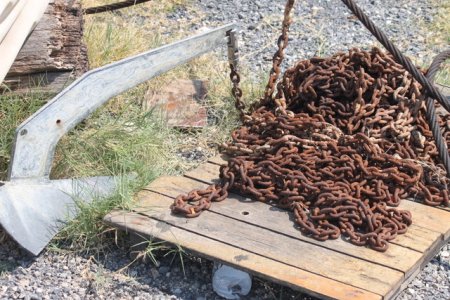
 
On commission we had 30m of chain, 8mm, and we supplemented this with 40m of 10mm 3ply, eye spliced at one end. We kept the rope in, what I call a milk crate (one without dividers). We never joined the rope to the chain but we did deploy 2 anchors, frequently. Later we replaced the 30m of 8mm with 75m of 6mm. This was a revelation - we no longer had to choose anchorages where the 30m would be useful and safe. We still anchored in a fork, frequently, The rope was neatly coiled into the crate and sat in a bow locker, seperate from the chain. The rope had 15m of 6mm chain attached at the splice. It was convenient in the crate as I could carry and deploy from a dinghy. If we used it we would retrieve the rope by hand and neatly coil it, again, as soon as possible - it was always then available.

The Anker Lina, spelling, seems very popular (same people as Ultra anchor) and they do various tapes, including nylon and Dyneema.

I fully appreciate that most people are not going to buy a new gypsy simply to allow them to downsize chain. Gypsies are extortionate - though I suspect there are lots of dusty gypsies lying unloved in workshops for those who did replace their windlass. You can carry so much more chain and still save weight. You do need snubbers, but you probably use one, a snubber, whether you downsize or not, Downsizing chain is for the time when you need a new windlass and/or when you buy a new (straight from the factory) yacht. As most people don't buy a new yacht - the numbers downsizing chain (and needing a smaller gypsy) are few and far between.

One of 'my' chains, downsized from 10mm to 8mm, is being delivered to the new owner, at Manly, Queensland, next week. The most popular change is from 10mm to 8mm, less popular 8mm to 6mm and never 12mm to 10mm. The 6mm is primarily for multihulls, most cats but one tri but I have done one performance mono. If I were commissioning a new yacht - I would not hesitate, smaller chain wins hands down. If I needed to replace my rode and the windlass was old - then despite the fact windlass seem to last forever - I would seriously look art retiring the old windlass and down size the chain. You don't need the weight of bigger chain, a snubber is as good as catenary, you have more space and less weight in the bow locker and if you need to retrieve by hand (for whatever reason) its so much easier.

Jonathan
 
Last edited:
For us the gypsy would be hard to change as the windlass is obsolete so we’re stuck with massively oversize 10mm unless we want to get spendy. I ordered the new chain today and started cleaning the slimy rope
 
For us the gypsy would be hard to change as the windlass is obsolete so we’re stuck with massively oversize 10mm unless we want to get spendy. I ordered the new chain today and started cleaning the slimy rope
What size boat do you have?
I had 10mm on my 27ft boat. I know chunky chain isn't fashionable these days but it does last longer.
 
What size boat do you have?
I had 10mm on my 27ft boat. I know chunky chain isn't fashionable these days but it does last longer.
Seriously? Can you actually wear chain out as in rusting away to the point that it loses strength to a dangerous level? 10mm is approx 3 times as strong and 3 times as heavy as the 6mm which is more than adequate for a 27' boa!
 
Thanks, I already have the 50m of 8 plait though so was just deciding how to terminate it. It's currently sitting in a big vat of patio magic in an attempt to make it less slimy before I attempt splicing
Why is the rope slimy? If its green thus slimy detergent might be better than patio magic. The latter offers a cosmetic and maybe quicker fix but....

Patio Magic is mostly bleach - the bleach will reduce the strength of the rope, by how much, maybe Thinwater will know.

Jonathan
 
Once you lose some gal the chain will rust. If you continue to use the chain, no reason why not if initially the loss in minimal, then the rule of thumb is 10% loss, then retire, this assumes the chain was correctly sized in the first place. The chain will reduce in size as the rust will be abraded away as you lose the corroded component.

I suspect the chain will be retired before it gets to the 10% loss level for reasons other than loss of strength - corroded chain will make a real mess in the locker and (depends on the run of the chain) and on deck.

Jonathan

Surely no member of YBW would use a rode like this?


IMG_3262.jpeg
 
Last edited:
I'm nn the wiser but I looked Patio Magic up to find it contains

: Benzalkonium Chloride 7.5%

I was unable to remove the attachments, apologies
 

Attachments

  • 1770957999335.png
    1770957999335.png
    662 bytes · Views: 1
  • 1770957999659.png
    1770957999659.png
    213 bytes · Views: 0
  • 1770957999563.png
    1770957999563.png
    338 bytes · Views: 0
  • 1770957999607.png
    1770957999607.png
    488 bytes · Views: 0
  • 1770957999752.png
    1770957999752.png
    1.2 KB · Views: 3
  • 1770957999440.png
    1770957999440.png
    325 bytes · Views: 0
  • 1770957999519.png
    1770957999519.png
    203 bytes · Views: 0
  • 1770957999305.png
    1770957999305.png
    328 bytes · Views: 1
  • 1770957999489.png
    1770957999489.png
    204 bytes · Views: 1
  • 1770957999390.png
    1770957999390.png
    316 bytes · Views: 2
  • 1770957999232.png
    1770957999232.png
    3.1 KB · Views: 3
  • 1770957999705.png
    1770957999705.png
    197 bytes · Views: 1
Seriously? Can you actually wear chain out as in rusting away to the point that it loses strength to a dangerous level? 10mm is approx 3 times as strong and 3 times as heavy as the 6mm which is more than adequate for a 27' boa!
The 10mm was on the boat when I bought it, I probably wouldn't have chosen it myself but it didn't see any reason to change.

Chain very much does wear out. It's just a function of time and volume of material. In full time tropical cruising where you anchor every night, you'll get 3-5yrs from a chain.

My current boat came with 12mm chain. There's not much galv left but I'm not too worried because the underlying steel is so heavy that I should still get a year or two out of it before I have to worry. And seeing as I have a spare 10mm gypsy, I will probably downsize to 10mm when I replace it.
If it's still in good nick when I get back to the UK I'll consider regalvanising instead, but it's quite rare to find that service and it's not always cost effective.
 
We live and learn

What is the active ingredient in Patio Magic?

If it cleans a patio it is unlikely to be kind to rope - but I'm very willing to learn (we just use dilated bleach that we buy in bulk (to clean a patio)

Jonathan
It’s very mild and can safely be used on canvas and decks as well. Not great if you get it in the sea but works perfectly for cleaning boats
 
The 10mm was on the boat when I bought it, I probably wouldn't have chosen it myself but it didn't see any reason to change.

Chain very much does wear out. It's just a function of time and volume of material. In full time tropical cruising where you anchor every night, you'll get 3-5yrs from a chain.

My current boat came with 12mm chain. There's not much galv left but I'm not too worried because the underlying steel is so heavy that I should still get a year or two out of it before I have to worry. And seeing as I have a spare 10mm gypsy, I will probably downsize to 10mm when I replace it.
If it's still in good nick when I get back to the UK I'll consider regalvanising instead, but it's quite rare to find that service and it's not always cost effective.
The point I was making is that the usable life of the chain, which is when the galvanising goes and it all starts to rust is similar irrespective of size as essentially the zinc coating is the same thickness. So no benefit in using heavier chain than necessary for strength purposes.
 
The point I was making is that the usable life of the chain, which is when the galvanising goes and it all starts to rust is similar irrespective of size as essentially the zinc coating is the same thickness. So no benefit in using heavier chain than necessary for strength purposes.
We don't all have the luxury of binning our chain the moment the galvanising is worn through. So when it's on its way out, heavier chain definitely does buy extra time.

It's the same with moorings. You don't just spec the riser for strength on day one. You buy as heavy as is cost effective and practical, so that it lasts longer.
 
We don't all have the luxury of binning our chain the moment the galvanising is worn through. So when it's on its way out, heavier chain definitely does buy extra time.

It's the same with moorings. You don't just spec the riser for strength on day one. You buy as heavy as is cost effective and practical, so that it lasts longer.
You are still missing the point - even if you use it for longer the proportional loss will be the same and will still get nowhere near dangerously weakened. It is not the chain that gives you extra time - that is your choice because it gives the illusion of lasting longer.
 
You are still missing the point - even if you use it for longer the proportional loss will be the same and will still get nowhere near dangerously weakened. It is not the chain that gives you extra time - that is your choice because it gives the illusion of lasting longer.
I must be missing the point, because I don't understand how using heavier chain doesn't, in your view, last longer. There's more material to wear away.
 
I must be missing the point, because I don't understand how using heavier chain doesn't, in your view, last longer. There's more material to wear away.
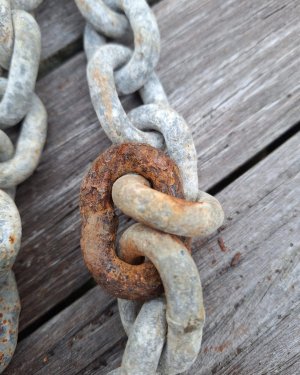
There is more material to wear away but there is a larger surface area being oxidised and then abraded. The heavier chain will abrade more than a lighter chain.

The reality, whatever it might be is - if the chain is simultaneously corroding and abrading the wear will not be even and unless you check every single link you will never be sure how uneven is the wear, on each link, and on the welds for each link. If you take your oversized chain and subject it to corrosion and abrasion and then test it for tensile strength - it will fail at the weakest link, the steel of chain is not homogenous nor are the welds all perfectly similar and the abrasion and corrosion will not be homogenous - and the wear/abrasion will seek out the weakest point. You will be unable to predict which link will be the weakest. see post 40

Taking a straw poll of rode life, from YBW and CF the answer seems to be 'about' 4 years of anchoring roughly every night. An argument is that 6mm has less steel to wear away - but 6mm is lighter and will spend less time on the seabed - so there is some 'cancelling out'. Additionally G3 is softer, and more prone to abrasion than G40 or G70 - but G7 might be less resistant to corrosion (I have not seen corrosion comparisons) - too many variable. But there is no evidence that 8mm has a shorter life to 12mm. its further complicated as if you follow my recommendation which is to use Thermal Diffusion Galvanising, not HDG, then the gal coating of TDG is harder than HDG.

Personally if the chain is like my picture in post 28 - I would condemn the chain without further thought.

Jonathan
 
Last edited:
I must be missing the point, because I don't understand how using heavier chain doesn't, in your view, last longer. There's more material to wear away.
I don't think chain corrodes or wastes away evenly. Manufacturing, storage and use can cause local differences in corrosion rate. My 60m 10mm chain had severe corrosion on a few links as well as worn galvanising on most links. I chose not to trust it.Screenshot_20260213_220833_Gallery.jpg
 
Top