Rocna's bad press by video - anchor thread don't read if you don't like anchor threads!

The USN did not patent the design, as similar Claw anchors had been around for some time. It was mounted at the stern along with a large drum for the chain and dropped just before they literally smashed their way through the coral to get to the beach. They had a poweful winch to pull them back off the beach afterwards. I tried looking for pictures of the particular class of boat, but they are all of the bow section, but you will see it in films of the war in Pacific, and the claw anchor involved looks just like a Bruce.
When I did my first circumnavigation the CQR was the most common main anchor, with the Danforth as a secondary, but the Bruce was starting to gain on it in popularity terms, particularly with bosts from the USA and the reason was the the Bruce works on a shorter scope and does not get jammed if dropped in coral by mistake. Some of the Americans also pointed out that they regarded the Bruce as a copy of a US Navy claw anchor.
Wiki mention the use of the stern anchor and the class of landing craft it was fitted to in the design and manufacturing section of thos page:
Landing Craft Support - Wikipedia
 
Last edited:
I reckon that there's a lot more to dependable anchoring than just buying this year's, or month's, most fashionable anchor. I use a fishfinder, which I find invaluable for finding a good clear bottom. Clear of weed, stones, or anything else that might prevent an anchor from performing properly.
For many years, I cruised in a 60ft converted Scottish wooden fishing boat, and almost always used a fabricated plough, which was pretty much identical to a CQR. It performed perfectly, but it weighed 140 lbs, so not really comparable with average yacht anchors. With that boat, my second and third anchors were both Danforths, also 140lbs.
For my present 36ft ketch, my everyday anchor is a 20kg genuine Bruce, on an all chain rode. My second is a Fortress FX23, which has roughly the same dimensions as the 20kg Danforth, which it replaced. My third anchor, which is admittedly very seldom used, is a 20kg Fisherman. All of these anchors have their uses in different conditions.
I make no particular claims, or recommendations, about my choices, but I would say that rather than going out and buying the current most fashionable anchor, it is much more important to use all available information about the proposed anchoring site, before dropping the anchor.

That's a very good choice of anchors!
 
Intriguing info, TNLI. I came across the "kite" WW2 anchor while trying to retrieve info on your historical comment.

World War 2 Kite Anchors Found and Recovered - Beckett Rankine

It's noteworthy that the designer, Alan Bekkett, indicates that anchors of that time could hold with a power about 10 times their weight. His lecture notes on the design of the 330kg anchor are

development-of-the-kite-anchor-by-allan-beckett.pdf (beckettrankine.com)

and the weight (mass) function observation may have led to the Bruce being used on oil rigs first. The kite is fascinating because, amongst other features it has a sealed air chamber to lift the body in such a way as to angle the point into the seabed.

BTW, here's a pic of a "claw" anchor.

YSNs7IB.jpg


which leads me to suspect that "claw" seems a good image word to choose when naming an anchor
 
The Bruce Anchor Sets Best - Practical Sailor (practical-sailor.com)

Bruce fans wil like that article, although the thing that amuses me about all the modern anchors is that is you look at holding power and resetting, the Danforth is still top of the tables, which is why it's often omitted from tests. That article also mentions the Bruce performing well in rocks.

A lot of the advertising associated with anchors like the Rocna make you think that there has been some king of revolution in performance terms, when in reality nothing has really changed. The important thing is to select the right type of anchor for the type of bottom and conditions, rather than think that one type of anchor will do. I might have been called a CQR fan, but in real;ity I like the Bruce and Danforth nearly as much. What I do not like are anchors that get bent or rust, and most of the new modern anchors have got a problem with one of the other.
 
Last edited:
The Bruce Anchor Sets Best - Practical Sailor (practical-sailor.com)

Bruce fans wil like that article, although the thing that amuses me about all the modern anchors is that is you look at holding power and resetting, the Danforth is still top of the tables, which is why it's often omitted from tests. That article also mentions the Bruce performing well in rocks.

A lot of the advertising associated with anchors like the Rocna make you think that there has been some king of revolution in performance terms, when in reality nothing has really changed. The important thing is to select the right type of anchor for the type of bottom and conditions, rather than think that one type of anchor will do. I might have been called a CQR fan, but in real;ity I kile the Bruce and Danforth nearly as much. What I do not like are anchor that get bent or rust, and most of the new modern anchors have got a problem with one of the other.
Having had a danforth and now a rocna the rocna is superior as far as I'm concerned. It digs itself in so much quicker that you noticeably feel the boat stop. The rocna has also been a lot more difficult to break out.
 
The Bruce Anchor Sets Best - Practical Sailor (practical-sailor.com)

Bruce fans wil like that article, although the thing that amuses me about all the modern anchors is that is you look at holding power and resetting, the Danforth is still top of the tables, which is why it's often omitted from tests. That article also mentions the Bruce performing well in rocks.

A lot of the advertising associated with anchors like the Rocna make you think that there has been some king of revolution in performance terms, when in reality nothing has really changed. The important thing is to select the right type of anchor for the type of bottom and conditions, rather than think that one type of anchor will do. I might have been called a CQR fan, but in real;ity I like the Bruce and Danforth nearly as much. What I do not like are anchors that get bent or rust, and most of the new modern anchors have got a problem with one of the other.
A slightly bizarre test and conclusion considering several of the new generation anchors aren’t included. When was the testing done and the article written?
 
A slightly bizarre test and conclusion considering several of the new generation anchors aren’t included. When was the testing done and the article written?

It seems to have been originally published in August 2,000 - which is why Rocna etc are not included (Rocna was brought to the public's attention in the 2006 anchor test). Many of the anchors are American (and I simply don't recognise them). Fortress introduced in the early 1990s (maybe late 1980s) is the most recent I recognise. Spade was introduced in the early 1990s but enjoyed terrible marketing (which has not changed much) and I doubt was available in America in 2000. The article was updated - but I doubt the testing was repeated (nor added to)

Linking the test is a bit like offering a link to a review of chart plotters, sail cloth, cordage or even yachts of the same vintage :). (and I chose the word vintage with care :) ).

The test might have been valid for the period (I'm far to young to know?) and for an American readership - many Practical Sailor articles are now slightly better focussed at an international audience.

Jonathan
 
Last edited:
What I do not like are anchors that get bent or rust,
Agree 100% with the first, something I have never experienced first hand. However, if you use any steel anchor enough eventually the protective coating will wear away around the fluke as sea bed sediment and rock is abrasive, with sand being the worse.

I found the Bruce Patent anchor good on the west coast of Norway as it could often find a rock edge to hook on to. However, its advisable to moor the boat back to the shore in the Scandinavian fashion to keep the pull on the hook. If the boat is allowed to swing it may let go as the direction of pull changes.
 
It is common practice with testing to compare the test results with test results made previously and test results available from other tests made by other people using the same or different protocols. If the 'new' results are different to other results then either the other results are wrong or the new results are wrong. You cannot have a series of test results for a product, in this case a Rocna anchor, that are different by a factor of 2 - without comment or explanation. This is particularly relevant where your test results potentially denigrate the product and to do so, without explanation, is trolling. There might be a good reason the results are at such a variance to everyone else - if which case - say so. If not the results are invalid and should be totally disregarded until such time as an explanation is available.

On the assumption the same protocols are used for all the other anchors - and this what we are led to believe - then if the Rocna results are flawed - then so are all the others.

I simply find it very difficult to accept that Lloyds, RINA, Australian Maritime Safety, West Marine, Voile and others (including members here and the 'general' market place) all got it so wrong, and consistently wrong and the Panope results are the only results of technical excellence.

I also find it interesting that the Mantus M1 seems to be located 4th in the overall excellence. Its hold in the best seabed available, based on a multiplier of 65 for a 15kg anchor is 1,000kg and this result is based on testing in ideal conditions. With a safe factor of 2:1 (not uncommon for anchors) this gives Mantus a 'hold' of 500kg - no yawing. nor horsing from chop - and it is rated 4th!....? And people rave over the Mantus M1. In contrast Spade is rated worse, not by much 5th, vs 4th, yet it has a hold beyond the limits of the equipment as do the 2 Excels. Now - which seabed to most prefer - clean sand or......?


I have said at the outset I am not a fan of Peter Smith, nor CMP but to repetitively denigrate a product which for example, is highly rated in use by most people here, and contradicts every previous test results makes the whole exercise questionable. Furthermore to ignore the difference in the results suggests a contempt for all previous tests (West Marine/Voile et al) and the results produced by the Classification Societies.

Many of the results look robust. The two Excels have a similar ranking. The Mantus M1 hold data in comparison with Delta is not unexpected (its what I have been saying and I have been enjoying the bile of the 'Mantus (M1) Lovers ever since). The poor showing in soft mud for most anchors is what Fortress defined - with the Mantus M1 being the best of a bad bunch. So the protocols look good - with Rocna being an outlier - that demands explanation (or complete removal of the data).

However you cannot remove, in my estimation, the most popular modern anchor from a test programme - without explanation

I do think Rocna is being unfairly hammered - 'why' is the unknown.

Finally - I have questioned the protocols - but also pointed out that most results look robust (its Rocna that is 'wrong' and everything else looks 'right' (except the position in ranking of the M1). The anchors we use, Excel, Viking, Spade all perform well - I cannot comment on the Mantus M2 and the Vulcan never having tested them.


Take care, stay safe

Jonathan
A lot of the confusion results from testing copies or Mk 2 versions. The first version of the Rocna suffered from mud fouling that results in failures to reset after a serious 180 degree veer. Like many modern lightweight anchors it is far too easily bent, although not as bad as the Fortress. The big surprise was the Steve finally did the right thing by testing a GENUINE CQR, as he tested a copy before and it was terrible.
 
Agree 100% with the first, something I have never experienced first hand. However, if you use any steel anchor enough eventually the protective coating will wear away around the fluke as sea bed sediment and rock is abrasive, with sand being the worse.

I found the Bruce Patent anchor good on the west coast of Norway as it could often find a rock edge to hook on to. However, its advisable to moor the boat back to the shore in the Scandinavian fashion to keep the pull on the hook. If the boat is allowed to swing it may let go as the direction of pull changes.
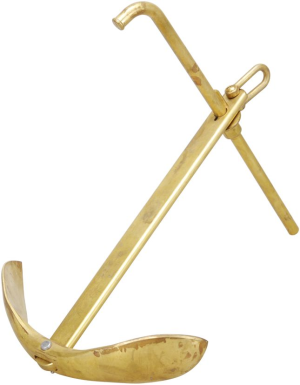
The Bruce is good in rocks, whereas a CQR can easily get jammed and a Danforth bent etc. Alas the Bruce can easily weed foul and does not produce as much ultimate holding power as other Lloyds or ABS approved anchors. Lewmar call their version the Claw. Picture of my favourite anchor, a bronze HERRESHOFF. 1717293507492.png
 
Top