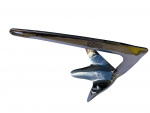
Rocna's bad press by video - anchor thread don't read if you don't like anchor threads!

This article mentions the bad copies of the CQR made from cast Iron:
Different types of anchor (yachtingmonthly.com)

Now the picture below is of a genuine CQR, as far as I can tell. There were some early non patented test examples with Pat Pend type markings, but they are not a genuine CQR but a series B or something. No idea what they used for steel or method of construction. Another give away for copies is the lack of a big shackle welded to the eye.
 

Attachments
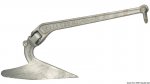
  • EN_01.145.xx.jpg
    EN_01.145.xx.jpg
    139.3 KB · Views: 5
Last edited:
This article mentions the bad copies of the CQR made from cast Iron:
Different types of anchor (yachtingmonthly.com)

Now the picture below is of a genuine CQR, as far as I can tell. There were some early non patented test examples with Pat Pend type markings, but they are not a genuine CQR but a series B or something. No idea what they used for steel or method of construction. Another give away for copies is the lack of a big shackle welded to the eye.
You may note the author of the article you quote.

They are not 'copies' but genuine CQR construction by casting.
 
I’ve replaced the CQR that came with my boat with a Manson, Why? Nothing to do with holding, 1. I felt a slightly lighter Manson would do the job as well as the CQR, which to date it has, 2. It was a fraction too long for the anchor locker and required a bit of ’jiggling’ to get in, 3. After almost losing a finger in after the blade swung around whilst I was ‘jiggling’ it in to the anchor locker it convinced me to go for a solid anchor.
 
OK it wa
You may note the author of the article you quote.

They are not 'copies' but genuine CQR construction by casting.
It was wrong of me to say copy in this rare case, but they are not regarded as genuine CQR's because they are marked patent pending. Marking them with 1/2 lnb weights is another indicator this is not going to be regarded as the real MCoy. The important point to make sure you check the markings on the shank I made is still very correct if you want the genuine CQR, so it must say Made in Scotland on one side and weight in whole lbs with Patent No on the other, not patent pending, and has a big welded shackle.

The interesting thing anout the CQR is that it has improved over the years, and I'm sure the latest one from Lewmar is going to be slightly better.

Anyone seen any tests for the Lewmar Epsilon ?? I hope it does not have patent pending on it. From this test it does not look too good:

Lewmar Epsilon 44lb Anchor Test/Review. Anchor Video # 109 - YouTube

Looking at the video has put me right off spades, if that is what they are classed as, cos if Lewmar can't get it right, then I doubt if any other company can. It seems that if thet hold well, pass the 180 degree test, then they are prone to being bent. The Lewmar one is very unlikely to bend as the tester pointed out, but it's just not holding correctly. It will be interesting to see if the correct that issue with a Mk 2, or just dump it and stick to their FZ Danforth, Claw and CQR's which all seem to be well proven.
 
Last edited:
The interesting thing anout the CQR is that it has improved over the years, and I'm sure the latest one from Lewmar is going to be slightly better.
Please explain, with detailed references. If an item is built according to the patent documents then the product should not deviate from those specifications. Any model that does deviate is not the same, as evidenced by Bruce Anchors court cases defending their name and design.

The history of the CQR, including "patent applied for" on the shank and the "type B" has been clearly explained by other posters, and aligns with my understanding.

You are starting to sound like a poorly designed chat bot limitied by its programming so that it is incapable of understanding and using additional information.
 
Last edited:
On a point raised by Vyv, there is indeed a huge difference between an anchor weighing under say 15 kilos and one weighing more than that, all other things being equal. Eric Hiscock advises not using a CQR under 35 lbs because it may not cut through weed.

Weight is important, but 35lb is way over the top for small boats like mine, except as a storm anchor. The CQR was niot designed for use in thick weed, the Fishermans and grapnels are far better in that respect.
 
I've alrea
Please explain, with detailed references. If an item is built according to the patent documents then the product should not deviate from those specifications. Any model that does deviate is not the same, as evidenced by Bruce Anchors court cases defending their name and design.

The history of the CQR, including "patent applied for" on the shank and the "type B" has been clearly explained by other posters, and aligns with my understanding.

You are starting to sound like a poorly designed chat bot limitied by its programming so that it is incapable of understanding and using additional information.

I've already defined what I regards as a genuine CQR in terms of how they are labelled in particular. If you want to know more then you can DYOR. I've never said anything about type B or patent pending anchors being regarded as genuine, and it's often bad news to buy new models of any product until you find out how good it is. Lewmar might be having an issue with their latest anchor, the Epsilon spade. It must be defined as a spade as none of the nit pickers said it's not one.
 
I
I’ve replaced the CQR that came with my boat with a Manson, Why? Nothing to do with holding, 1. I felt a slightly lighter Manson would do the job as well as the CQR, which to date it has, 2. It was a fraction too long for the anchor locker and required a bit of ’jiggling’ to get in, 3. After almost losing a finger in after the blade swung around whilst I was ‘jiggling’ it in to the anchor locker it convinced me to go for a solid anchor.
If you can't fit the recommended size of anchot in the anchor locker, then you have 2 sensible choices, firstly modify the locker, (Might not be practical), or do what the RNLI and myself do and store it above decks. If you do that just make sure it's difficult to steal if it's a nice stainless one like my 2kg baby Bruce lunch pick.
 

Attachments

  • s-l1600.png
    s-l1600.png
    653.7 KB · Views: 1
I

If you can't fit the recommended size of anchot in the anchor locker, then you have 2 sensible choices, firstly modify the locker, (Might not be practical), or do what the RNLI and myself do and store it above decks. If you do that just make sure it's difficult to steal if it's a nice stainless one like my 2kg baby Bruce lunch pick.

The anchor that came with the boat was a bit heavier than that recommended for my boat, but it suited the area that the previous owner sailed in, Your ’sensible’ choices don’t really seem that sensible to me, modifying the anchor locker would be extensive for little advantage, if the boat has an anchor locker I would rather us it than have yet another bit of kit sitting above deck to catch feet, sheets etc.on. They also don’t take into account the ’lost finger’ potential that anchors with moving flukes etc. provide when handling the anchor on a relatively small boat in a choppy sea.
The CQR as many have said is not ‘perfect’ so moving to a more recent design that has gained general admiration and is marginally smaller and lighter for an equivalent holding power, seems to me to be ‘the sensible option’, especially as it now fits perfectly in the anchor locker.
 
Last edited:
I’ve owned and used ‘genuine’ CQR anchors. The one that came with our current boat had all the credentials. (Made in Scotland etc) It still dragged and didn’t set half as easily or well as the Spade anchor I replaced it with.
I read the test articles assiduously as they came out after I’d bought it and was delighted to learn that I’d chosen well (on the advice of my old boss.)
Genuine or not, CQR anchors are old technology and many (or all) of the new generation anchors out perform them. Not many people disagree with this statement.

One caveat: there’s no such thing as the perfect anchor.
 
I have never been all that influenced by 'anchor tests' as the few early ones I read did not seem all that realistic. I have however, built up around 50 years worth of first hand experience with a variety of anchors and vessels.

On buying my first cruising boat in the 70's I also ordered two 35lb patent CQRs as they were state of the art in those days and the boat was going to spend most of its time on its own anchors, another came with my third boat in 1981.

One CQR moved to my second boat a few years later. While working on hydrographic contracts I came across an early Bruce and obtained experience with it. I obtained a 15kg Bruce Patent anchor for my boat. Using it in the same areas as I had used the 35lb CQR I was impressed by both the speed at which it set (about one anchor length) and holding. If it did not set I recovered it to see why - a big slab of rock jammed in the jaws and a herring barrel hoop being two reasons that I remember.

The CQRs were soon relegated to second anchors then garden clutter finally being left behind at the last house move. The big plough anchor that came with my current boat joined the CQRs in the garden as soon as I got it to my home port.

I have watched a sub 35lb genuine CQR being gently pulled along the sea bed by a horizontal rode in moderate conditions as it lacked weight to penetrate the sediment. I have also watched a similar genuine CQR being pulled through a sandy bottom with a hold, drag, hold, drag, rhythm as it lay on its side and the shank prevented it burying. My experience indicates that increasing anchor and chain weight increased the CQR's ability to hold.

I have been held securely in a wide range of winds up to and including hurricane strength by suitable sized Bruce anchors. My current boat has two Bruce Patent anchors and a Rocna main anchor and I have had no reason to think about changing that set up.

There is no way that I would now risk my boat and good nights sleep to a genuine CQR (or copy), but that is my choice, you are free to make our own.
 
I have never been all that influenced by 'anchor tests' as the few early ones I read did not seem all that realistic.
+1
IMHO anchor comparison tests are useful for writing magazines articles or advertising by whoever comes "first" in a specific anchor test, not much more.
I'd advise anyone talking in person (not through internet, forum gurus etc) to as many people they know who have extensive experience in anchoring in all sorts of situations --> there will quickly build a list of a few anchors (and rode line types) which are totally satisfactory, among which one can choose. After all, if a specific anchor is plenty ok for a given usage, apart from intellectual curiosity /commercial interest what is the interest in trying and determine whether another one "holds more"?
Example, I have made several 00s cycles of 180° reversals with my anchor and it never failed to keep on holding, if someone else finds those anchors are bad performers with 180° reversal pulls after a few tries all I can deduct is their test is different from the way I anchor, no reason at all for me to change anything (may I humbly suggest they should change the way their tests are made?) :)
 
Strewth th

The nit pickers are really out today. I'm sure the majority of boaters know what a spade anchor is, but at the same time the majority would not know what a stockless anchor is. So I suppose to keep the nit pickers happy I should post a picture and several links to make sure which one it is.

The UK Spades, (Incoming!!), were made in Tunisia, BUT just to confuse the issue if you read the US press they are now made in Mexico, but only the ones sold through the US dealer.

The only approvals worth considering are those that can be understood and are published in English or American. Obviously a nit picker will want to consider any class of apprval that allows them to justify buying their Rocna, or other anchor shown in the bent anchors picture.
The nitpickers are correct it is tough when confronted with your level of ignorance about the subject. In particular THERE IS NO SUCH THING AS A SPADe ANCHOR TYPE

There is only one design of anchor called SPADE as been explained to you many times. Why do you persist in ignoring the truth? Equally there is no such thing as a UK Spade anchor.

If you want to engage in intelligent debate you must learn to get your facts right and your terminology correct otherwise nobody will understand what you are talking about.

You can continue to believe that the CQR is the "best" but I am afraid that flies in the face of all the evidence. You can continue to believe that the CQR shank does not bend, but there is clear evidence that it does and that all shanks will bend if enough load is put on them. You can continue to believe that the Danforth is superior to other designs, but again this is not borne out by any tests of overall performance even though it has high holding power when used in one particular set of circumstances.

Nothing you have said so far is likely to convince anybody who knows about the subject that you have some unique insight.

As already suggested stop digging as every time you post something it only goes against you.
 
I have been influenced by the anchor tests like everybody else...the truth is though, buying an anchor is a once in a lifetime event...so while it’s of interest, once you have bought your anchor it’s now too late
 
I have been influenced by the anchor tests like everybody else...the truth is though, buying an anchor is a once in a lifetime event...so while it’s of interest, once you have bought your anchor it’s now too late

If you have to anchor in a variety of different anchorages and bottom types, you really need 3 different anchors as follows:

Main anchor: Genuine or Lewmar CQR, Delta or a Claw/Bruce if you need to keep the scope short due to crowded anchorages.

Secondary anchor, (This is in someways a spare, but essential in bad conditions): Steel Danforth from a good manufacturer.

Deep water, rocks or heavy weed specialist anchor: Traditional Fishermans or grapnel.

The Danforth and fishermans anchor are easy to store in comparison to a CQR, Delta or Bruce. The first 2 should have an all chain rode if practical.
 
Can I also say, while these anchor tests are very informative...I took advice from this forum in my buying decision....they told me to buy a Rocna (the bar stewards????)
 
I’ve owned and used ‘genuine’ CQR anchors. The one that came with our current boat had all the credentials. (Made in Scotland etc) It still dragged and didn’t set half as easily or well as the Spade anchor I replaced it with.
I read the test articles assiduously as they came out after I’d bought it and was delighted to learn that I’d chosen well (on the advice of my old boss.)
Genuine or not, CQR anchors are old technology and many (or all) of the new generation anchors out perform them. Not many people disagree with this statement.

One caveat: there’s no such thing as the perfect anchor.
I also had a CQR and it dragged. At Studland where the holding is pretty good. In the end I brought it back up and used my kedge instead (a hooker anchor - I've not seen many of these - perhaps this is something to do with the name?) I replaced the CQR with a Rocna and have been happy with its performance, although if I was buying now I might choose a different modern anchor.

Based on my experience of the CQR (which echoes yours), I would be quite surprised if the RNLI were about use it as their strategic bower anchor of choice (unless they were basing their choices on this webpage Anchor choice: anchor types and bottom types that they are best suited | Yachting News)
 
Top