Rocna's bad press by video - anchor thread don't read if you don't like anchor threads!

I am glad there are people like you. You love your old anchor designs. Without you guys these anchor threads would get boring way to quickly ?

No: What I like are cheap and reasonably reliable anchors. I run a big boat on a tight budget.

I’ve used CQRs for forty years and they are fine in the southern North Sea.

If money were no object I would carry an Ultra on one side and a Fortress on the other with chromox chains and a Lighthouse double windlass. As it is,I am saving up for them?
 
Once you discount the anchors which are not easily available in the UK, the one that rusts and is difficult to re-plate, the ones that look too feeble, the ones that are stupidly expensive, the ones not now in production and the one that bends in use. Your choice is probably quite limited, perhaps:

Rocna
Manson Supreme
Delta
Knox
Epsilon

In no particular order.

.

Thank you Doug. That list is really actually very useful.
 
Once you discount the anchors which are not easily available in the UK, the one that rusts and is difficult to re-plate, the ones that look too feeble, the ones that are stupidly expensive, the ones not now in production and the one that bends in use. Your choice is probably quite limited, perhaps:

Rocna
Manson Supreme
Delta
Knox
Epsilon

In no particular order.

.

I might have added an Excel, that you can buy from Jimmy Green and Viking you can obtain mail order (I have no idea on UK prices). I might not have included the Delta. If you had bottomless pockets I would have included Ultra (and if bottomless - matched with Cromox chain (one size smaller). :) .

I'm re-galvanising a Spade S60. I've never seen one before and was unaware that the smaller anchors have a simple plate shank. The larger S80, that we use, has the expensive fabricated shank. Removing the lead is not that difficult (blow torch), the galvaniser will grit blast and galvanising with 70m of 6mm HT chain. I've weighed the anchor before and after and adding back the lead is easier than removal, chop up roofing lead - apply blow torch. I'm doing this for some friends who are roughly half way round the world on a circumnavigation. It all seems to be what PBO is about.


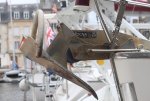
Any anchor can bend.

Before I saw this I would have said it was impossible - reality is different. No fault of the anchor - but if you abuse them this might happen. (Yes, I know I've shown this picture before)

Testing and reality are often not the same :)

IMG_9616.jpeg

Jonathan
 
Last edited:
The stunning conclusion is that the Rocna 2020 is not rated as good as a CQR and really not much better than a Bruce or Delta. 15 years ago that same Rocna was the best thing since sliced bread and in 2006 when YM reported on the West Marine tests - Rocna was the best anchor - in terms of hold. Hold is not measured for the Panope videos - a major and critical omission in my book - in fact I don't know how you can judge an anchor if you do not measure ultimate hold.

As mentioned by a forum member last week Rocna seems to be subject to some bad press. If I look at the spread sheet Rocna performs particularly poorly in terms of resetting, veering, tip weight to total weight and self launching.


If we go back some years Morgans Cloud removed their recommendation for Rocna as a result of Rocna anchors dragging resulting in yachts on beaches and I did some clogging tests, which underlined what MC had said - the fluke is prone to clogging and the anchor will not reset until it 'self cleans'.


If I walk round a local marine and check the anchors on bow rollers the most common modern anchor is a Rocna. Reading posts here, on YBW, Rocna is a common and popular anchor. I don't recall anyone on YBW complaining of the performance of a Rocna (but I may well have missed something).


My conclusion is that the Panope tests do not reflect reality - if they did I would not see so many Rocna anchors and we would have even more anchor threads - devoted to people dumping their Rocna in favour of other designs. The Panope videos are tremendously popular and are becoming or are very powerful. If they don't reflect reality - they are dangerous. If they damn a product that people find more than satisfactory do they praise a product for situations that don't exist.


I'm not a Rocna fan, I jointly wrote the article in YM with Vyv Cox on the bendy shank saga and I am aware that on retrieval a Rocna can lift a big clog of seabed - necessitating some effort with a deck wash. This same clot is part of the bad press that Rocna suffers - but this seabed clog actually does not seem to deter buyers. Though I'm not a fan of Rocna my views are partly emotive, the bendy shank saga, and I do think there are better anchor (though many would say a Rocna is the best). However I am not a great supporter of evidence that does not reflect what the market appears to think and I too think Rocna is being unfairly maligned.

Declaring our usage - we use an aluminium Excel, aluminium Spade and Fortress, are testing a Viking 10 as our primary (and neither of our aluminium anchors gets a good press either! :( ). I also think the Mantus M1 grossly overrated (in the spreadsheet) and am suspicious of the damning of the Epsilon (as I simply cannot believe Lewmar got it so wrong - very subjective :). ). I cannot comment on the Epsilon, Mantus M2, nor Vulcan, not on the spreadsheet - I have never used any of them

Take care, stay safe

Jonathan

Hi there and congratulations Neeves for luring in a silent reader to register with ybw forum to comment on another anchor thread, admittedly feeling forced to reply :)

At first thanks indeed for sharing your knowledge and expertise on various articles and forums, I've read many many hours and learned a lot. So did I by watching SV Panope's anchor testing videos incl stunning underwater footage of anchors' behaviour under mostly extreme conditions.

Both have in common requiring lots of time reading/watching - I enjoy feeding my curiosity and being entertained!

Reading this thread I was surprised about many contributors here obivously not taking the time watching, however dilligently taking time posting about hearsay or fractions (spreadsheets) of Steve's (SV Panope) content, which has been established with an incredible amount of effort, time and money invested over years to feed his own curiosity in anchor behaviour. His testing is a process, he is open for supportive criticism and is happy about encouraging new ideas to improve/expand his test methodology.

If you watched his videos, you'd know he doesn't get tired in repeating not claiming general validity, strongly encouraging to draw own conclusions from the videos, letting the videos speak for themselves and to discard unimportant columns in the chart if irrelevant for anchor choice or seemingly useless. Therefore watching is strongly recommended. There are no overall winners concluded nor is his testing finalized yet, there are said to be many columns to be added, that's his aspiration. Also to remove overrepresentation of his unique sandy mud seabed.

What makes his videos rather powerful is the underwater footage of very different anchor behaviour in a variety (yet not finished) of seabeds in harsh conditions. He is trying to sum the results up in his spreadsheets, like it or not, that's what he gets or thinks he gets by trial and error - I like this transparency and practical approach yet unmet in previous anchor testing. As he is processing, the most progressed charts are to be seen in the 20lbs class, not head to head anymore but averaged for units of anchor weight.
To recognize this progression, again, you needed to watch! If you don't, I'd advise please do not comment!

You might agree, major flaws in products are usually discovered by testing in exaggerated, difficult or even extreme conditions. Just refer to Mercedes Model A in 1997, a good car, like many others before, until the infamous moose test 1997, not a problem in daily life in common use, but in that very test in extreme conditions a major flaw was discovered. Would you call the testing "dangerous"?

Neeves as one of the first pointed out Rocna's clogging issues and resetting problems in conditions once the anchor had been disconnected from the seabed, in certain muddy seabeds years ago. So did Morgan's Cloud. I'd say happens rarely only in specific weather situations and seabed types. (= special extreme conditions)

One might question Steve's testing as a reflection of reality? I say at least it's apples to apples and flaws and differences are more likely to be discovered for the extreme situations in reality you don't wish for. Aren't anchors made for this?

Recalling Voile magazine tests 2012: Dragging anchors through one single (due to bad weather) sandy seabed at speeds of 0.1-0.4 kts, - reflections of reality? Isn't common anchoring practice aiming at static holding in various seabeds? Correct conclusions drawn? Please find holding results, 16kg anchors, for 0.1kts drags, closest to "static":

Kobra 2: 781kg, 2 stars
Delta: 542kg, 3 stars
Bügel 14kg: 2 stars
Spoon 15kg: 499kg, 1 star
Brake 12kg: 484, 1 star
Rocna15kg: 680kg, 4 stars
FOB Rock: 955kg, 4stars
Spade 15kg: 1286kg, 4 stars
Supreme (stainless): 671kg, 2 stars

So a Spade has almost double the hold of a Rocna? Equal stars? A Kobra has little bit higher hold as a Rocna resulting in 2 stars rather than 4 stars?
Yachting Monthly 2009 has a Kobra 2 (2nd best holding) as the winner against a Spade price/performance ratio. (hard sand/sandy mud, incl veering tests)

Yacht magazine anchor test 2009: Winner Kobra 2, static holding (test 250kgf, rather low!) high scope in three different seabeds. Rocna, Mantus, Fortress, Supreme, Spade not being tested... Anchor weights 10-16kg, apples to apples?
Tests terminated due to thunderstorms, concluding Ultra not being fully tested, Kobra 2 declared winner...

My conclusion: Different testers, different conditions, many variables, test methodologies mostly quite intransparent or tests not fully conducted due to bad weather, limited time/money, lacking subscribers. So which anchor(test) to favour?

Steve's videos show more than most of these magazine tests could reveal before and I cannot see unfair treatment of a Rocna. Instead he rather felt seemingly uncomfortable with Rocna's bad results. In his latest video #126 he is obviously quite happy about its good result, just like in the soft mud tests, where the Rocna really scored. So I cannot see any unfair treatment or bad intention at all.
Secondly Steve is not depending on adverts like magazines, something invaluable for independent testing.
Moreover most anchor testing would fail a scientific approach - so many variables and mostly inconsistent seabeds, lacking of repetitions (significance) in pulls, correct averaging. Professional anchor testing test tanks are used to minimize certain variables.
Prof Knox many years ago tried and did mostly well, still concerns about inconsistencies regarding anchor rode materials remain. Did his onshore winching tests reflect reality?- I doubt so. Still he was able to reveal some very interesting and new outcome and his studies also led to the development of his own proud design.

Most manufacturers even do not test or publish test results, Fortress and Viking do. The latter onshore sandy beach testing slightly uphill with 8:1 or even infinite scopes with 4x4 trucks and internal load cells. Viking claims model V7 to produce 900kgf holding, safety factor included, Steve's videos in sandy mud (you have to watch to find out ;-) ) apprx 380 lbs static hold. How about claimed hold vs reality, yes, different seabeds, scope.. variables.... but you can see it and draw your own conclusions. Btw I bought one as I believe it's an awesome anchor, just like I bought a cheap used FX-16 in immaculate condition, both for charter use - I don't like Marinas, and I don't like Bruces, Claws and Deltas/Copies either ;-)
 
"Most common modern anchor is a Rocna"- agree.
Steve also researches in his video #122 minute 5:24 for the lazy/impatient ones seeking to comment ;-) Marina Port Townsend USA, Aug 21. Furthermore: reading the comments you will find this:
GranSol Youtube video comment:

".... I work for a global marine electronics manufacturer so I visit Spanish and Portuguese ports of all kinds on a regular basis. Some time a go I did a similar survey noting brands of radar antenas in order to determine market share or radar manufactuers so I understand what it takes to complete the work you have done. Bravo! For anchors, Lewmar´s Delta rules in Spain by far with my estimate of 35%-45% of all anchors seen in bow rollers. Lewmar markets very powerfully in Europe plus the Delta fits very well in most bow rollers (some manufacturers even build them taylor made for this anchor). It also has a good price so it is supplied extensively as boat OEM equipment. Deltas are followed by Bruce in the second position and then Danforth and Rocna with CQR still with a substantial presence but more and more in older boats. Anchor market is very traditional. Once a manufacturer is able to build a reputation (based in real performance or not) the crowd follows and numbers boom. CQR, Delta and Rocnas are good examples of this. In my opinion, this happens because most sailors set anchor in extremely good conditions and later they state: "I have anchored 200 times and my anchor never failed me. My anchor is the best" and then others follow. Well, testing anchors with strong pulling forces is the real test and this is hardly done by most sailors so marketing and advertising plus domino effect do the rest. Keep it up!"

I guess says it all, also regarding comments on main market and popularity of anchors/reasons to buy. Btw Epsilon is said to be also coming as OEM/charter vessels.

Ref not complaining/reporting failures about Rocnas/happy customers:
People complain and report extremes, positives/worst alike. Normal daily life averages are considered boring. Anchoring is mostly about avoiding extremes.
I've come across a recent quote by Neeves, Jan 20 2020:
"Interestingly if you average Spade/Rocna and Excel and then average CQR/Bruce and Delta and plot the recommended vessel size against anchor weight - you will find 2 identical lines. Basically those older anchors which have about half the hold of the newer anchors are recommended for the same size vessels as are recommended by the newer anchors. Given the newer ones have twice the hold - safety factors have been doubled."

Let me add safety factors being doubled- people tend to oversize 1-2 sizes so why should there be reports of trouble? Btw people mostly buy cheap and convenient, products they remind thus having been highly promoted or marketed. Many of them don't care and buy what is available at their local chandlers/marinas in an (over-) size good enough to make them feel safe. Nothing wrong with that (I know Neeves' opinion reg oversize). Anchors have evolved and will most likely do their "boring" job in conditions up to 50kts, even with a low average of rating 3s, (Steve charts) just mho, beyond anybody would have left way earlier for safety/comfort already. Otherwise in depth researched to buy adequate gear, has been conducted, 2-3 properly sized specialist anchors.

Summing up, I honestly think Neeves' and Steve's "results" have many similarities: Viking having the hold of one upsize Spade (see soft mud vid and "surf sand"). Excel, Spade, Viking mostly at top of the pack. Fortress best in soft mud and loose sand, light weight aluminium anchors doing enough good (middle of the pack if I recall correctly) to not make a perceptible difference in favourable common anchoring grounds and conditions not exceeding 50 kts, otherwise you'd have already left your anchorage, appropriate sizing provided. Mantus M1 setting quickly, doing quite remarkable overall, lacking ultimate hold compensated by manufacturer's recommendation guide, Steve also tends to using main allround anchor one size up, pros and cons having been endlessly discussed on this forum.

I'd love to see both Neeves and Steve teaming up for the most advanced anchor testing EVER, rather than reading doubtful criticism of one another, anchor geeks alike :))

Also I would love to read about Neeves' Viking 10 test results, mentioned many times, no results written yet. I'm very curious, however no connection!

Don't worry never will I post kind of a novel like this again.

Happy anchoring, stay safe and take care!
 
I like that picture ! It’s say, ‘I held during a hurricane and I bent a little so yacht wouldn’t ‘

Nothing so dramatic, I was intrigued and spoke to the owner


- he got it caught under a rock, retrieved as much chain as he could, large MoBo went past. The wash bent the anchor and destroyed the shackle.

As I said (I'm not trolling) if asked I would have said bending the toe of a Rocna would be impossible - I'd be wrong. Really emphasising you cannot judge an anchor by simply looking at it.

Its a UK yacht, they were in Hornfleur. I don't know Hornfleur - it was my first and only visit - it appeared to be some sort of sailing in company or a club meet over the Channel - there were a lot of UK yachts, many rafted up.

Jonathan
 
Once you discount the anchors the ones that look too feeble,


You cannot judge an anchor as being feeble by its looks

I'm not going to illustrate by quoting examples of anchors - that might be construed as 'marketing'

But try this:

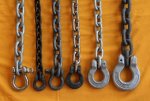
IMG_1263.jpeg

The left hand chain is an off the shelf Chinese 8mm G30 (specification MBS is 3,000kg - actual of 4,000kgs) the emaciated black chain is a 6mm G100, when galvanised it will have the same strength as the 8mm G30, slightly more than 4,000kgs (actually 4,400kgs). The rather spiffy stainless chain, the one in the middle, is a 8mm. G60 (duplex) and has a MBS of 6,000kgs.

Its the same with galvanising. You cannot judge quality by 'looking'

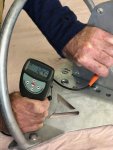
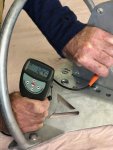
This is checking the gal of an anchor (normal specification for galvanising would be 70 or 80 micron (depends where you are)

IMG_6648.jpeg

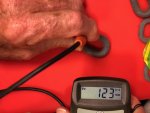
This is checking the galvanising of a chain link (chain galvanising thickness varies from around 50 micron or if you are lucky 100 micron). Specification is, again, 70 or 80 microns

IMG_7869.jpeg
The chain is an Armorgalv coating which is harder than conventional HDG - abrasion resistance is a function of hardness.

Looks are deceptive.

My guess at galvanising life of an anchor chain for a live aboard and assuming they do actually sail - then life would be 'about' 1,200 days at anchor. When you consider the thickness of 'normal' galvanising, say 60/70 microns, then 1,200 days is quite extraordinary.

Its the same with looking at an anchor and because it 'looks' wimpy you discard it as being inadequate in the strength department - you may be very wrong.

Bendy shanked Rocna looked identical (just as strong?) to those made with a Bis80 shank

Take care, stay safe

Jonathan
 

Attachments

  • IMG_6648.jpeg
    IMG_6648.jpeg
    66.1 KB · Views: 0
Don't worry never will I post kind of a novel like this again.

Happy anchoring, stay safe and take care!

Please don't be discouraged by the members here whose attention span is short - long well reasoned posts like yours should be encouraged.

One comment - when you buy an anchor cost might be an influence (and is used as measure by people testing anchors). However the price of an anchor should be irrelevant - it will last for years, it secures a device that costs, for example, more than a Ferrari (and probably lasts longer :) ) and its cost per night at anchor is - less than peanuts.

And you queried the performance of Viking - twice the hold of a similarly sized Mantus, due to better design and the thinner fluke (buries more easily (in the same way the thin flukes of the Fortress bury easily). I'm using the 'Z' shank, otherwise it would not fit on the bow roller. The 'Z' shank takes some getting used to looks .... wrong ...... but it works. Its the sort of development Dashew would love - people will laugh when they see it. I have 2 shanks - the conventional one and the 'Z' shank and I cannot tell the difference in terms of set and hold.

And why no report - Hold is measured 'outside the real world' as the tensions involved are well beyond anything one might see on a yacht for that size of anchor. Hold takes a huge investment to test 'user sized' anchors (like a Viking 10, 15kg Spade or 8kg aluminium Excel and needs to be conducted in more than one seabed and at least 3 times in each seabed. It takes time - and I simply don't have access to the seabeds that I would use for testing - blame Covid - I have been unable to travel outside 'home waters'. This latter has also constrained other testing as I cannot access the facilities I would use for tensile testing of rode components etc.

Here is a picture of the Viking on our bow roller using the 'Z' shank. We cannot use the conventional shank because the roll bar fouls the bow roller.

IMG_1749.jpeg


Keep posting - and welcome to the forum.

Take care, stay safe

Jonathan
 

Attachments

  • IMG_1749.jpeg
    IMG_1749.jpeg
    66.9 KB · Views: 2
Last edited:
Somewhere in one of Jonathan's long diatribes (probably #40), he suggests that people no longer buy Bruce anchors because they drag. No Jonathan, people no longer buy Bruce anchors because they simply are not made now in yacht sizes.
No, they drag. My friend has one. Trying to anchor it with good anchoring practice, in a grassy bottom. Five attempts to get it to hold. He cam over after for drinks afterwards and announced that he had 'had enough of the useless piece of sh*t. He was going to buy a Rocna'.
It is a genuine Bruce anchor that he used for years in the Med without problem but it was useless in the Caribbean seagrass.
We had similar experience 17 years ago in the Caribbean with our Bruce anchor. It was ok once set but getting a set was difficult. In those days we had a manual windlass. Doing numerous drops and retrievals until it set wasn't much fun when it's blowing 25 kts. It was enough for us to buy a new Spade anchor. It was a revelation. We have been using them ever since.
 
No, they drag. My friend has one. Trying to anchor it with good anchoring practice, in a grassy bottom. Five attempts to get it to hold. He cam over after for drinks afterwards and announced that he had 'had enough of the useless piece of sh*t. He was going to buy a Rocna'.
It is a genuine Bruce anchor that he used for years in the Med without problem but it was useless in the Caribbean seagrass.
We had similar experience 17 years ago in the Caribbean with our Bruce anchor. It was ok once set but getting a set was difficult. In those days we had a manual windlass. Doing numerous drops and retrievals until it set wasn't much fun when it's blowing 25 kts. It was enough for us to buy a new Spade anchor. It was a revelation. We have been using them ever since.
No anchor is perfect for all conditions and types of seabed. If you want to anchor on grass ? then you need something with a pointy toe, and a high proportion of its weight bearing down on the toe. Strangely, one of the oldest and currently most despised anchors, the "fisherman" would be excellent for piercing through the grass to get a proper grip. There's no point in condemning an anchor just because you choose to use it inappropriately.
 
No anchor is perfect for all conditions and types of seabed. If you want to anchor on grass ? then you need something with a pointy toe, and a high proportion of its weight bearing down on the toe. Strangely, one of the oldest and currently most despised anchors, the "fisherman" would be excellent for piercing through the grass to get a proper grip. There's no point in condemning an anchor just because you choose to use it inappropriately.
If you want one good anchor that does most seabeds then choose a good anchor. There are far better anchors than Bruce these days
 
Thank you Doug. That list is really actually very useful.


Good show.
Following advice I see the Sarca Excel is now available, though you could almost buy three Deltas for the same money. It looks reasonably constructed and I don't think there have been reports of it being wobbly in service.
Be prepared for someone to reveal a shocking flaw in the thing, whatever you buy. :)

.
 
The trouble with writing an anchor, or almost any other product on a sailing forum, review:

If you write a good review and recommend the items - then you are accused of having some sort of relationship with the manufacturer.

If you write a bad review you are then accused of trolling.

Somehow a review has to be wrapped up with all of this in mind :(

Take care, stay safe

Jonathan
 
Jeez! I’m none the wiser after reading all this. I was going to buy a Rocna 15 but now I‘m not so sure :(

I feel your pain! The choice will come down to what fits your bow, type of normal seabed where you are (what are others using where you sail) and what gives you confidence to sleep at night. All this extreme testing is fine but 99% of anchoring is done in 'normal' conditions. the 1% for us leisure sailors is when we either retreat to a harbour or keep watch. If this was not the case there would be hundreds of failed anchoring events leading to a bad end every year. Keep it all as interesting as it is, in perspective.

Once you discount the anchors which are not easily available in the UK, the one that rusts and is difficult to re-plate, the ones that look too feeble, the ones that are stupidly expensive, the ones not now in production and the one that bends in use. Your choice is probably quite limited, perhaps:

Rocna
Manson Supreme
Delta
Knox
Epsilon

In no particular order.

I'd add the Kobra2.

I have a Jeanneau 34, sail on the west coast of Scotland, have used a 16kg Kobra2 for 10 years, replaced with a 15kg Rocna and used for the last 5 years and both have allowed us to sleep at night.
 
I've had a Delta on my boat for 18 years, and it's never dragged once, not even when sitting-out hurricane Tomas in Antigua. So I see no need to change it for an over-priced fashion statement.
 
Good show.
Following advice I see the Sarca Excel is now available, though you could almost buy three Deltas for the same money. It looks reasonably constructed and I don't think there have been reports of it being wobbly in service.
Be prepared for someone to reveal a shocking flaw in the thing, whatever you buy. :)

.

See post 70, second paragraph.

We have been using a SARCA Excel as out primaryl for 15 years, initially (maybe 10 years) the steel version since then the aluminium version. Both No 4 , 15kg and 8kg respectively. We are now long term trialling a Viking 10 as our primary. Our rode is 75m of 6mm HT chain and we do use long snubbers. We are a 38' cat.

We cannot tell the difference between the steel and aluminium version (except one is lighter :) ).

We also have a S80 Spade and an A80 Spade. The steel version stays at home. we cannot tell the difference between the Spade and Excel - though I'm twitchy about the strength of the shank of the aluminium Spade. I'd agree the Kobra is a good, budget, choise. We have one, bought in Preston Marina and carried home as luggage on Cathay - I'm also twitchy about its shank. The aluminium Excel has a HT 7075 shank predicted by some as prone to corrosion (news to us - it looks much as it did when new - but then we are not experts - we just use things). We often anchor in a 'V' to manage winds with a lot of shear resulting in cyclical veering and the Spade neatly matches the Excel for performance

The Excels work in most seabeds - but a disaster (as are most anchors) in soupy mud (where you need a Fortress). If weed is not to thick then both work well in weed - but the Excel has the edge as it has a sharper toe.

The Excel will fit virtually any bow roller (even if it does not fit your wallet :( ) that will a accept a Delta.

The steel Excel shank will accept a 10mm/3/8th" Crosby shackle, or equivalent, Peerless, Campbell, Yoke, but the aluminium version is a better fit with a 1/2" shackle.


I've had a Delta on my boat for 18 years, and it's never dragged once, not even when sitting-out hurricane Tomas in Antigua. So I see no need to change it for an over-priced fashion statement.

If you are happy none of us are going to complain, we had a copy CQR, it was a liability - we had to change. It was not a fashion statement (no-one sees most cat anchors they are well hidden) or in use.

I'd hardly call a Kobra 'over priced'.

Take care, stay safe

Jonathan
 
Nobody has ever claimed that a copy CQR is any good, so I am not sure what point you seek to make by telling us that you own one and it’s no good.

You seen surprised that Steve’s results tell him that the genuine CQR works well. When he started his tests he only had a copy, and it was useless. When he tested a genuine one, he was surprised.
 
Nobody has ever claimed that a copy CQR is any good, so I am not sure what point you seek to make by telling us that you own one and it’s no good.

You seen surprised that Steve’s results tell him that the genuine CQR works well. When he started his tests he only had a copy, and it was useless. When he tested a genuine one, he was surprised.

Now - was this aimed at me? :)

Not entirely true

Our cat came with a Manon Plough, the builder assured me it was a good anchor, we found differently. When I investigated further I found that our copy CQR weight 5kg more than the was embossed on the shank - the MD of Manson told me I was lucky - it would be even more reliable. I had no ideas about anchors - I believed what I was told. It was a complete surprise that our copy was so awful and prompted me to investigate anchor - and here we are now! This was all 15-20 years ago. I was amazed that someone a few years ago would buy a Manson Plough, a copy CQR, he thought he was buying the Bees Knees - but he had obviously done no research, it was not only me that was a mug. CQRs ruled the roost, or seabed, for years - their longevity attests to their success. But they became increasing expensive (the method of manufacture was expensive) and other models proved more popular - because they were more reliable, for example Spade then Rocna, Supreme, Excel. The beauty of the models introduced in the period 1990-2010 was that they required no skill to deploy, engage and set and then offer reliability when set. It had nothing to do with some sudden inadequacy of CQR but the sheer simplicty of using - say a Spade.

A genuine CQR works well - but is not as good as a Excel, Spade, Rocna etc etc. If I wanted to design and make an anchor - people would laugh if I said my measure of excellence is a CQR. Even Simpson Lawrence recognised that the CQR has some weaknesses, maybe the skill need to deploy, engage and set - as they put effort into the 'replacement' the Delta. Though Gordon Lyall, who was TD at SL told me the major catalyst for the Delta was Bruce.

The key characteristic that everyone mentions of the new batch of anchors is the fact they lock up so sharply or abruptly - so much so - you can be caught off balance - no-one, or no-one I can recall - ever says this of a CQR. You just deploy, reverse up and hold tight - no skill required. I also don't recall it being said of Bruce or Delta.

We used a genuine CQR, one of the originals made in Scotland - they are no longer available. We had no problems with our CQR but as you cannot buy a 'genuine' one without searching every scrap yard - they are not a sensible recommendation.

They have been superseded, unsurprising after almost 100 years. There are better anchors that set more reliably and have a hold superior to a CQR, by a factor of 2 times. CQR were a very successful anchor - but they have passed their sell by date. You may have bought a genuine CQR - but your ambition is to replace it with an Ultra - so a CQR might be 'adequate' but in your view an Ultra is better. I assume you are not buying the Ultra for its bling value - but for its characteristics as an anchor (which are admirable - and comparing anchors of the same weight and Ultra will also have twice the hold of the CQR - so Steve might say a CQR 'works well' but many anchor now work so much better).

There is no reason why an articulated anchor like a CQR could not improve on the original version. It could be made with HT steel - which would allow some flexibility in the shank design. It could have a sharper toe - which would allow it to engage better in weed - but the copies available are, as said - rubbish, not even good copies of the original.

To me making a case for a CQR is like making a case for a Morris Minor over a current Mini, Suzuki Swift or Fiat 500 - I appreciate the current motor vehicles have no character nor attached nostalgia - but in my book the new ones are undoubtedly better (We drove a Walkinshaw XJR (in the UK and then Oz) - which was a marvellous car but needed skills beyond my pockets to keep road worthy - and yes I still think of it wistfully - but would I buy one now - no chance).

Take care, stay safe

Jonathan

And getting back on topic - to suggest that a Rocna is 'as good' or 'as bad' as a CQR to me seems perverse - and I (and others) were interested in the views from the forum. The fact that many seem to have the same questions I have, or the same scepticism, based on their use suggests it was a valid question to raise and not a question that only I wondered about.

Now.....we don't have the answers as to why Rocna is equated with a CQR - but there is an undercurrent that suggests people don't entirely believe in the result. There is no suggestion that the results are 'wrong' but maybe that the protocols are sufficiently different to 'real life' as to cast doubts on the veracity of the results as a vehicle to choose an anchor for the real world. Steve may repetitively underline that his tests procedures are extreme - but if they are so extreme as to not match anyones experiences in real life - who, or what, are the target audience.
 
Last edited:
One comment - when you buy an anchor cost might be an influence (and is used as measure by people testing anchors). However the price of an anchor should be irrelevant - it will last for years, it secures a device that costs, for example, more than a Ferrari (and probably lasts longer :) ) and its cost per night at anchor is - less than peanuts.
True, with my above mentioned anchor choice it took 5 nights at anchor to compensate for the expensive costs of Croatian marinas :)

Thanks a lot for mentioning your experience with Viking 10 and the Z Shank, I love the design and thinking behind it! Also good to know the Galva thickness, mine had minor issues in that respect, but your measurements are very reassuring and their staff is very responsive and helpful. I only tested mine away from real life scenarios in a hard garden substrate with a winch and 4,5:1 scope. Biting/setting ability is impressive, however this thread is about unfair video press about Rocna, so I won't go into too much off topic.

Now.....we don't have the answers as to why Rocna is equated with a CQR - but there is an undercurrent that suggests people don't entirely believe in the result. There is no suggestion that the results are 'wrong' but maybe that the protocols are sufficiently different to 'real life' as to cast doubts on the veracity of the results as a vehicle to choose an anchor for the real world. Steve may repetitively underline that his tests procedures are extreme - but if they are so extreme as to not match anyones experiences in real life - who, or what, are the target audience.

Attached is his latest updated chart, (new here obviously no pic upload available rather than links, so I'll post the video o_O) Rocna double the hold of CQR in sand, nothing wrong with that imo. Skip to minute 19:34


all the best!
 
Top