
Rocna reversal phenomenon

We have had many discussions about this in the past. Stainless steel for welding should be the low carbon grades, 304L, 316L, etc. For really critical items 347 is best, as this is low carbon and contains niobium, a preferential carbide-forming metal. The electrodes should be selected carefully to give low carbon content, maybe with slightly raised chromium levels. Again, 347 is a good choice, especially in the 19-9 grade.

Since we've drifted a bit ....
What about stainless to mild steel? 309(L) seems popular Google , then paint the weld?

Above waterline of course.
 
Since we've drifted a bit ....
What about stainless to mild steel? 309(L) seems popular Google , then paint the weld?

Above waterline of course.
This link explains https://www.bssa.org.uk/topics.php?article=101 Yes, 309 seems to be a good choice. I guess you would be painting the carbon steel anyway, so continuing it over the weld makes sense,
 
Thanks, hadn't found that link, good concise info :encouragement:

When I welded stainless steel mounting plates to my steel deck I used 309 stick welding rods.

Welding stainless to stainless I use 316L tig wire or 316L stick rods.

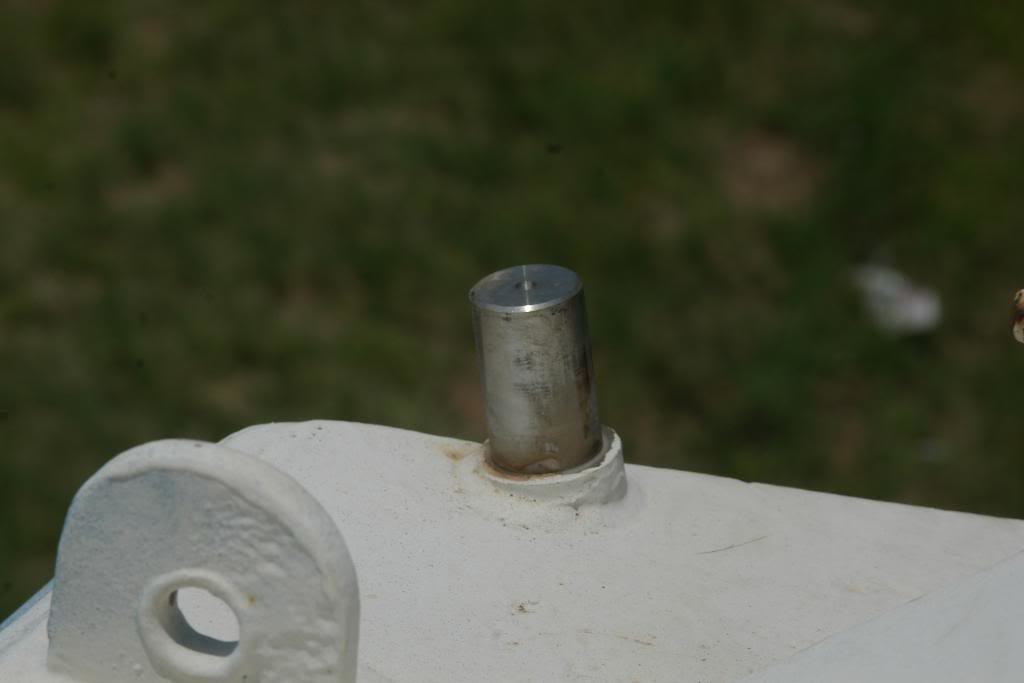
These stanchion pins of 316 welded to mind steel deck using 309 rods the painted over the welds and the lower part of the pin.

36086505735_7a23a0a169_b.jpg


On the left are my winch mounting plates of mild steel and just aft are my foot turning block mounts in stainless welded with 309 rods

36046374126_ff53a8b243_b.jpg


Most of my deck mounted fittings are done that way.
 
Getting back to chain twisting, I always drop my anchor on free fall, using the clutch screw as a brake once the anchor is on the bottom. ( I've never felt the need to push the chain down into the water using power :D). The result is that it's going quite fast over the bow roller. Even although the roller is shaped to suit the chain, to prevent it from rotating, it probably does, and I'm perfectly willing to accept it. That means that I have to accept that when it comes up, the chain may well have a twist in it. That's why I made my bent link, which solves the problem.
 
Getting back to chain twisting, I always drop my anchor on free fall, using the clutch screw as a brake once the anchor is on the bottom. ( I've never felt the need to push the chain down into the water using power :D). The result is that it's going quite fast over the bow roller. Even although the roller is shaped to suit the chain, to prevent it from rotating, it probably does, and I'm perfectly willing to accept it. That means that I have to accept that when it comes up, the chain may well have a twist in it. That's why I made my bent link, which solves the problem.

Two reasons why we use power. Firstly, Jill doesn't like motoring at close quarters to other boats so she does the foredeck. The windlass clutch is not her favourite mechanism, so motoring the windlass it is. Secondly, a lot of our anchoring is for stern-to berthing. Controlling the anchor chain from the cockpit is probably the biggest and best aid to this manoeuvre, leaving Jill free to take lines ashore. As we approach the wall I can leave the prop driving in astern and control our position precisely with the windlass switch. If we dropped the anchor without the facility to motor it one of us would have to be on the foredeck, especially in cross-winds where it is important to arrest the chain as promptly as possible.
 
Sorry to bang on, but I'm still amazed that the anchor, which is such an unstable object upside down, doesn't right itself when its shank reaches the bow roller.

Then I saw an image posted above. Is the problem that deep Vee roller, locking the anchor shank into the bow upside down? My rollers have a much smoother profile than that (there's a port and a starboard one and either would hold a warp well but the starboard one, being in line with the windlass, is used for the anchor.) The (Rocna) anchor flips early and every time; I wonder if this is about the roller?
 
Two reasons why we use power. Firstly, Jill doesn't like motoring at close quarters to other boats so she does the foredeck. The windlass clutch is not her favourite mechanism, so motoring the windlass it is. Secondly, a lot of our anchoring is for stern-to berthing. Controlling the anchor chain from the cockpit is probably the biggest and best aid to this manoeuvre, leaving Jill free to take lines ashore. As we approach the wall I can leave the prop driving in astern and control our position precisely with the windlass switch. If we dropped the anchor without the facility to motor it one of us would have to be on the foredeck, especially in cross-winds where it is important to arrest the chain as promptly as possible.

That's fair enough. I wasn't criticising. We are always anchoring out in the "open", with no other lines to worry about.
 
We do the opposite - we power down, one reason being the windlass is IN the bridge deck locker and sits on a pedestal over the chain locker (the bridge deck locker is split in two with one big hatch - the chain portion is forward of the bulk of the locker). Releasing the clutch needs opening the hatch, bending down, reaching into the locker and locating the winch handle to release - not difficult - its simply easier to put a foot on a deck switch - laziness and convenience rule (and Josephine deploys the anchor). Without exception we would have the engines running - so that we have the flexibility to locate ourselves for depth and distance off and as the engines combined are generating, at maximum, 180amp/hrs - I've never worried about power consumption.

I also accept we might induce twist as we deploy and further twist might develop at anchor but assume much of this will fall out on retrieval, especially if we stop retrieving when the anchor is about 2-3m below the bow roller - the chain is marked at this point specifically for this - and then any remaining part or whole twist is managed by the boomerang. Our chain is marked at 10m intervals and at either end each alternate metre is painted for 5 metres. Marking is bright yellow paint and cable ties. This end marking means I know how much chain is buried, by the anchor, when we are going to reach the bitter end and when the anchor will be 5, 4, 3m etc from the bow roller..

Because we have the chain marked, and I can see the marks from the helm (and I imagine a chain counter might be easier) I can retrieve single handed and never need to worry about the anchor passing into/onto the bow roller incorrectly aligned. Its right every time - and is now simply not an issue.

I still need to secure the anchor once it is fully retrieved (we use a claw on a dyneema strop that I clip to the chain by hand, also used when the chain is deployed as the ultimate back up), but I can do that at leisure. If we will be in big seas - and 3m - 5m swells are not unusual - I'll also lash the anchor.

My Boomerang is an unashamed copy of Norman's bent link - but based on HT, 800 MPa, steel plate (given to me by Bisplate) with holes as I lack Norman's skill in welding but have access to angle grinder, large bench drill, most importantly, a sympathetic galvaniser. I also made a boomerang from 7075 alloy - but it demands considerable patience - as even surprisingly low heat, not much above 100 deg C, will destroy the temper.

Jonathan
 
Sorry to bang on, but I'm still amazed that the anchor, which is such an unstable object upside down, doesn't right itself when its shank reaches the bow roller.

Then I saw an image posted above. Is the problem that deep Vee roller, locking the anchor shank into the bow upside down? My rollers have a much smoother profile than that (there's a port and a starboard one and either would hold a warp well but the starboard one, being in line with the windlass, is used for the anchor.) The (Rocna) anchor flips early and every time; I wonder if this is about the roller?

I don't understand how the Rocna can 'flip'. It just comes aboard upside-down. Our previous Delta did the same with the original Sadler bow roller, which was a very large radius curve. The reason I went for a deep groove roller was primarily to stop the anchor from banging from side to side when sailing, which it does perfectly. It also guides the chain nicely, hence my surprise that the anchor can reverse itself when we used a shackle connector.
 
We do the opposite - we power down, one reason being the windlass is IN the bridge deck locker and sits on a pedestal over the chain locker (the bridge deck locker is split in two with one big hatch - the chain portion is forward of the bulk of the locker). Releasing the clutch needs opening the hatch, bending down, reaching into the locker and locating the winch handle to release - not difficult - its simply easier to put a foot on a deck switch - laziness and convenience rule (and Josephine deploys the anchor). Without exception we would have the engines running - so that we have the flexibility to locate ourselves for depth and distance off and as the engines combined are generating, at maximum, 180amp/hrs - I've never worried about power consumption.

I also accept we might induce twist as we deploy and further twist might develop at anchor but assume much of this will fall out on retrieval, especially if we stop retrieving when the anchor is about 2-3m below the bow roller - the chain is marked at this point specifically for this - and then any remaining part or whole twist is managed by the boomerang. Our chain is marked at 10m intervals and at either end each alternate metre is painted for 5 metres. Marking is bright yellow paint and cable ties. This end marking means I know how much chain is buried, by the anchor, when we are going to reach the bitter end and when the anchor will be 5, 4, 3m etc from the bow roller..

Because we have the chain marked, and I can see the marks from the helm (and I imagine a chain counter might be easier) I can retrieve single handed and never need to worry about the anchor passing into/onto the bow roller incorrectly aligned. Its right every time - and is now simply not an issue.

I still need to secure the anchor once it is fully retrieved (we use a claw on a dyneema strop that I clip to the chain by hand, also used when the chain is deployed as the ultimate back up), but I can do that at leisure. If we will be in big seas - and 3m - 5m swells are not unusual - I'll also lash the anchor.

My Boomerang is an unashamed copy of Norman's bent link - but based on HT, 800 MPa, steel plate (given to me by Bisplate) with holes as I lack Norman's skill in welding but have access to angle grinder, large bench drill, most importantly, a sympathetic galvaniser. I also made a boomerang from 7075 alloy - but it demands considerable patience - as even surprisingly low heat, not much above 100 deg C, will destroy the temper.

Jonathan

We anchor under sail when feasible, admittedly not a high proportion of deployments.
 
Sorry to bang on, but I'm still amazed that the anchor, which is such an unstable object upside down, doesn't right itself when its shank reaches the bow roller.

It's CoG isn't going to be high enough to make it right itself until the shank is near-horizontal, by which time the portion of shank in the roller is very wide (height-wise, not thickness-wise) - so I think you would need a wide flattish roller for it to un-invert itself, wide enough at least for the shank not to hit the plates either side of the roller.
 
It's CoG isn't going to be high enough to make it right itself until the shank is near-horizontal, by which time the portion of shank in the roller is very wide (height-wise, not thickness-wise) - so I think you would need a wide flattish roller for it to un-invert itself, wide enough at least for the shank not to hit the plates either side of the roller.

I suspect that’s exactly it, and that what’s stopping some other people’s Rocnas from self-righting is the shank getting jammed between the side plates of the bow roller. My fairly basic Beneteau is blessed with two ‘wide, flattish rollers’.

I’ll try to video that last 1-2 seconds of retrieving my anchor and post it, so that others, including the supremely well-informed Vyv Cox, can diagnose. All I know from the narrow perspective of our own boat is that I can’t imagine why a Rocna wouldn’t self-right on its roller, or why it would stand on its spine with its weight in the air!
 
I suspect that’s exactly it, and that what’s stopping some other people’s Rocnas from self-righting is the shank getting jammed between the side plates of the bow roller. My fairly basic Beneteau is blessed with two ‘wide, flattish rollers’.

I’ll try to video that last 1-2 seconds of retrieving my anchor and post it, so that others, including the supremely well-informed Vyv Cox, can diagnose. All I know from the narrow perspective of our own boat is that I can’t imagine why a Rocna wouldn’t self-right on its roller, or why it would stand on its spine with its weight in the air!

I think that the OP, and I, are experiencing that the anchor comes up reversed before it reaches the bow roller. With a slotted roller to retain both the chain and the shank of the anchor, in addition to the point correctly made by MikeBz, there is no way the anchor can rotate. However, as said earlier, with a smooth concave roller it happened just the same, although maybe then the non-rotation of the anchor was more to do with MikeBz's point.
 
I think that the OP, and I, are experiencing that the anchor comes up reversed before it reaches the bow roller. With a slotted roller to retain both the chain and the shank of the anchor, in addition to the point correctly made by MikeBz, there is no way the anchor can rotate. However, as said earlier, with a smooth concave roller it happened just the same, although maybe then the non-rotation of the anchor was more to do with MikeBz's point.

So perhaps just removing the roller axle bolt and replacing the roller with a more gently curved one, with no slot in the middle, would permit the inverted anchor to right itself?
 
So perhaps just removing the roller axle bolt and replacing the roller with a more gently curved one, with no slot in the middle, would permit the inverted anchor to right itself?
Seems to work OK with mine anyway, just time it right with the remote so the shank is just over the roller and wait for a moment as the anchor spins round if it does come up upside down.
 
So perhaps just removing the roller axle bolt and replacing the roller with a more gently curved one, with no slot in the middle, would permit the inverted anchor to right itself?

As already said, firstly I have had that arrangement that did not make any difference and secondly that having a grooved roller is considerably better for stowing the anchor.
 
As already said, firstly I have had that arrangement that did not make any difference and secondly that having a grooved roller is considerably better for stowing the anchor.

Because the groove makes it stay upside down?! Seriously, not trying to be thick here - trust me, I do it naturally...
 
Top