Rocna or Vulcan

  • Thread starter Thread starter C08
  • Start date Start date
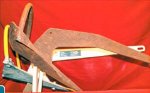
I have a 9kg Vulcan but I have only used it a few times as a lunch hook in sand. It seems to bury itself as evidenced by the need for a vertical pull to finally extract it from the seabed. I can feel when it lets go. As mentioned by Neeves, it does wobble on the bow roller and I can't bring it up tight or the tip hits the hull. I need to see if I can rig something to improve that although I rarely sail with the anchor on the roller as I'm on a swinging mooring and need to keep the roller free. I chose the Vulcan because it fits in my bow locker - a Rocna with the roll bar would have been too bulky.

I'm very pleased with it but I really need to use it in more challenging conditions to provide a valid assessment.
 
In tests the Spade and Rocna come out very well but the Spade has the edge on resetting in sudden wind shifts I believe. Apparently it barely even breaks out whereas the Rocna breaks out and then skips along the ground before resetting. There is some talk of this on MorgansCloud.com and on youtube. I've never been in a place when the wind has switch 180 degrees quickly but apparently it does happen in the tropics if caught out in a storm.

Possible no doubt, but in quite a few years with a rocna I didn't have that happen. Thankfully :) in some major squalls!
Transits were always rock solid when it all died down again as was the gps trace.

If anything initially the spade sets a tiny bit slower, but that could just be perception.
 
I bought a 12kg Vulcan at a really good price from Storrar marine pre £ nosedive to replace a worn 25 lb Sowester plough. I suppose you'd say that sets the bar pretty low for an improvement. The main difference is that I now sleep below instead of in the cockpit. Neither the Rocna nor the Knox would fit in my bow roller. I'd agree that it's a bit to difficult to stow securely- mine broke loose coming off Portland Bill and put a few dings in the gelcoat. It also fits in the anchor locker which is useful as the bow roller is now needed for my mooring line.
 
Wise words from Jonathan. A good unbiased review IMHO.

What he said is not a review it's a commentary on its provenance. I don't think that adds anything to the (lack of) information on its performance. Although asking why you would buy a relatively expensive anchor when there are no independent reviews is fair comment.
 
If you take most anchors and alter the tension on the shank by small increments over a period of time most anchors will reset without any issue - in fact they will not need to reset - as the tension moves round the clock face slowly the anchor shank will follow the chain. This is nothing novel - its not 'new', good anchors, Spade, have been doing if for decades (most of the other new anchors are only just a decade old). The same happens with a lightly set Fortress - it will simply realign with those 10 degree increments in tension.

If however the change in tension angle does not allow this 'incremental' change and the tension goes from a 35 knot NEly seabreeze to a 35 knot southerly (frontal system) over a 30 minute period, as we can get on the southern portion of Australia's east coast with the southerly being a particularly sudden and damaging change - it could be different. In a tropical thunderstorm, if the centre of the cell passes overhead the change can be much quicker than 30 minutes. (It was in such a thunderstorm that one of the bendy shanked Rocna's bent - the tension can be quite high.)

It is not the slow change that is the issue but the sudden change - and then the anchor will somersault.

Morgan's Cloud comment comes after a few yachts, one a rather large catamaran with a very big Rocna anchor, ended up on beaches dragging clogged Rocna behind them. They are coming to a conclusion of a worst case scenario - which is prudent if you are making recommendations to which people take notice.

Tests show that if an anchor is clogged with mud (usually with weed to bind it) then the anchor will not reset until the clogged material washes out. An anchor that sheds any seabed quickly will reset quickly. Simply consider how long it can take you to 'power' wash clean your own anchor if/when you anchor in mud. And if you do not believe any of this - next time you pull up a clogged anchor - drop it down again and see how long it takes to set compared to when it was clean. Its an easy test

In sand this is not an issue and as most of us anchor in sand anchors would reset quickly - if they have been forced to sommersault.

If you power set hard in a tidal anchorage it is very unlikely that at a change of tide, even though the tension may go through 180 degrees without any intermediate tension between the noon set orientation and the new 6 'o'clock orientation, the tension from the tide will impact the anchor - it will probably just sit there (sort of aligned back to front). Add some wind and it will obviously be different.

Jonathan
 
It is acknowledged (Noelex has read and adopted the mantra,) that modern anchors set with the toe and shackle engaging simultaneously. This results in some of the chain burying as the anchor sets. The deeper your anchor and the more chain you can bury the less impact any movement of the yacht will have on the anchor (as the buried chain has to move in the seabed before it impacts the anchor).

There are some image there of 'set' Vulcans. They are some of the very few available - so whether they are representative - I don't know. (I made it very clear in an earlier post that I had not tested a Vulcan. But you will notice in each of them the shackle has not engaged, at all with the seabed. There is also a picture of a Mantus as one of the links - it too has the shackle clear of the seabed - and the shank horizontal. This is typical for a Mantus and is well illustrated in this video

https://www.youtube.com/watch?v=LDC0g1GzdUc

If you take an image, side view, line drawing will do, of a Mantus with the shank horizontal you will find that the fluke is at 16 degrees to the horizontal, and the horizontal is the seabed. If you consider the Vulcan as illustrated in the images you will find the fluke angle higher - but nowhere near the fluke seabed angle of a Rocna or Spade, which would typically be 30-35 degrees.

Maybe you can draw you own conclusions.

Jonathan

edit


Post 2285: http://www.cruisersforum.com/forums/f118/photos-of-anchors-setting-126073-153.html

Post 2300: http://www.cruisersforum.com/forums/f118/photos-of-anchors-setting-126073-154.html

Post 2593: http://www.cruisersforum.com/forums/f118/photos-of-anchors-setting-126073-173.html

Close edit
 
Last edited:
Jonathan, you have used my name and videos to support your contention in several posts recently, but I am afraid that strongly disagree with your arguments.

Your description does not coincide with how I see anchors performing underwater.

In one magazine article that you wrote on "Fluke Angle Comparison" you posted this photo, supposedly comparing the Rocna to the Mantus.

I am not alone in wondering how you could possibly align the two anchors at such different angles for the photo.
 

Attachments

  • IMG_2114.JPG
    IMG_2114.JPG
    113.4 KB · Views: 9
Last edited:
Jonathan, you have used my name and videos to support your contention in several posts recently, but I am afraid that strongly disagree with your arguments.

Your description does not coincide with how I see anchors performing underwater.

In one magazine article that you wrote on "Fluke Angle Comparison" you posted this photo, supposedly comparing the Rocna to the Mantus.

I am not alone in wondering how you could possibly align the two anchors at such different angles for the photo.

The 10kg Rocna is set up to show how I observe a well set anchor aligned. The 15kg Mantus is set up how I see, what you describe as, a 'well set' Mantus aligned.

Invariably in you video, Mantus Marine video of the Mantus underwater and most of your original images the Mantus when 'well set', your words, has the long of the fluke horizontal and in the original images the long of the fluke clear of the seabed.

I find most other anchors set with the shackle and toe engaging and burying together such that chain begins to bury almost as soon as the toe engages - looking at images of Spade, Excel and Rocna - they are all very similar and I use the Rocna 'set up' the image you provide to illustrate.

I note you do not have the courtesy to acknowledge where the image came from.

Jonathan

edit


Post 2285: http://www.cruisersforum.com/forums/f118/photos-of-anchors-setting-126073-153.html

Post 2300: http://www.cruisersforum.com/forums/f118/photos-of-anchors-setting-126073-154.html

Post 2593: http://www.cruisersforum.com/forums/f118/photos-of-anchors-setting-126073-173.html


The evidence is not my data, my images. The evidence are 'independent' images shown to be indicative of performance. I have simply taken that evidence and measured fluke angles - anyone can make the same measurements - and if they wish quibble that its 30 degrees or 27 degrees, or 16 degrees and 18 degrees - but the differences are huge.

The fact you have not appreciated that the Mantus fluke/seabed angle is 'only' 16 degrees is not my manipulation. Moreover it is you who have stated that shackle point, toe and chain engage together - in contradiction to your and most other images of a Mantus. I'm simply pointing out the contradiction - that you have said you are going to explain, quantitavely (along with short scope and bigger being better in difficult seabeds etc)

close edit
 
Last edited:
This video of a Mantus, provided by Mantus themselves, shows their anchor being set in what looks like icing sugar. The anchor buries neatly leaving only the roll bar visible looks great.

https://www.youtube.com/watch?v=iDqa8HKEFac

Bot look again - as the anchor sets, and their are 2 'sets' the long of the shank is horizontal. Also though some of the chain buries, maybe 100mm!, the shackle is effectively 'at the surface'.

Now look at the image that Noelex kindly posted and you will see that the shank of the Mantus is also horizontal, same configuration (or as close as I could get) to the configuration in Mantus and John Smith's video). With the shank horizontal the fluke is at 16 degrees to the seabed.

Which is more effective a shovel orientated at 30 degrees or one at 16 degrees?

Again this is not my 'data' but data provided by John Smith and Mantus themselves. You try and find a different interpretation of the angle - and then wonder why every other anchor has a fluke seabed angle of around 30 degrees, sometimes higher (and then think about the shovel).

The evidence of the Vulcan also setting shallow, Vulcan being the subject of this thread, is statistically weak - there are simply not enough images in the public domain - and as I said - I've not been given access (and its is less and less likely that I will). However the few images available do not make me, personally, very confident (despite the few positive posts). Many people are happy with a CQR or Delta, which look even worse (different worse) than the set of the Vulcan - an initial look at the Vulcan suggests caution.

Statistically the analysis of the Mantus is sound - too many images from too many sources showing the same thing. Its not a bad anchor - just inefficient use of steel and money - and certainly does not merit the hype.

Jonathan

edit

If you look at this video

https://www.youtube.com/watch?v=J8WJGNeeYzs

Again the Mantus buries - but note that at the end of each set the shank end seems to be pointing above the horizontal, so the fluke angle is going to be less than 16 degrees. There is a short section with a Rocna (and the shackle is not buried, either.) For some reason when they did this test they used a rope rode.

Note that the Mantus videos are produced by Mantus themselves and are marketing aids to sell the anchor - so best case scenario.


Then


To compare with a Rocna (and recall I don't get Xmas cards from CMP - so it would be unlike me to be pointedly nice

look at this video, not selling Rocna either simply showing how they set (and compare the set anchor with the image Noelex kindly posted - my mock up)

https://www.youtube.com/watch?v=CfstdnOwq_s

You might also like to compare the final set position of the Rocna in the video, shackle point buried, with the few images I link to of the Vulcan - and make a comparison.

I emphasis none of this evidence is 'mine', I've analysed (as anyone can analyse to determine if my conclusions are biased)

close edit
 
Last edited:
I have a 15kg Vulcan on a 37 foot, lightish boat. Vulcan performed very well - like glue mostly. I think it made me overconfident and - one time - I didn't set it properly (over sand) with reverse power. Near disaster ... But I still don't know why it didn't reset itself? So it's not just the science of angles, but also the human factor. Apart from that one episode I have found the Vulcan to be quick setting and reliable.
 
I have a 15kg Vulcan on a 37 foot, lightish boat. Vulcan performed very well - like glue mostly. I think it made me overconfident and - one time - I didn't set it properly (over sand) with reverse power. Near disaster ... But I still don't know why it didn't reset itself? So it's not just the science of angles, but also the human factor. Apart from that one episode I have found the Vulcan to be quick setting and reliable.

You reiterate what many have said previously that 'anchoring' is as much about ability or technique AND seabed as about the anchor, or at least technique, ability and seabed cannot be overlooked. Many have also made the point that modern anchors are very forgiving and do not demand the attention required to ensure reliability that is necessary in the older models. But, and I keep stressing - anchors are compromise, they are generally designed round one seabed, sand - if you anchor in mud or weed - your anchor may disappoint.

It cannot be ignored that there are a vociferous group who are quite happy to use a CQR, Delta and Bruce - which suggests, or simply confirms, that in the right seabed and/or with the right technique (used consciously or subconsciously) these anchors are perfectly acceptable

It seems unlikely that I have raised any doubts in owner's minds of their own anchor in terms of the importance of fluke seabed angle. And if doubts are raised, I apologise. I can only confirm that Mantus appears to stand out from the crowd - as far as I can ascertain, Knox, Excel (alloy or steel) Spade (alloy or steel), Rocna, Kobra, Supreme, Ultra, Fortress, Guardian all appear to have the commonly accepted fluke/seabed angle of around 30 degrees + or - 5 degrees in sand. My assessment is based on my own use of these models, all of a size to be a primary on our catamaran, but also on underwater images posted variously by owners of their own anchors. It is this very exceptional conformity that initially threw me as I had simply had never seen a fluke/seabed angle so low - so simply did not look for it. The sheer volume of images on Noelex thread on CF was the key - though it took a long time, years, for the penny to drop (and I reconfirmed the conclusion by looking at images of anchors with owners other than Noelex, Noelex video, Mantus' own videos (which might be 2 different anchors) and my own 15kg and 5kg Mantus models).

Fortunately CF has an American focus and not many here appear to have become disciples - so there is hopefully no issue.

I have seen only a few images of a Vulcan and they are borderline, consistently around 25 degrees - but these images might not be typical - and I hoped I underlined that I was not damning the anchor, statistically the evidence is weak.

But all other anchors and maybe some I missed, all fit within that accepted and conventional 35-25 degrees.

Mantus does set quickly and appears to be forgiving of technique - so it does have an advantage over the older styles.

Jonathan
 
Here in the USA, Spade contends that the Vulcan is a copy of the Oceane / Sword anchor that they discontinued years ago because it did not perform to a high enough standard.

I believe that this decision was made prior to the death of Alain Poiraud, the founder of Spade who was certainly a pioneer in anchor design.

Whether the Vulcan anchor is different enough from the Oceane / Sword to not have the same performance shortcomings (as noted by Spade) remains a viable question, since as previously stated, no performance test data is available from an independent source or the manufacturer.
 
Last edited:
Here in the USA, Spade contends that the Vulcan is a copy of the Oceane / Sword anchor that they discontinued years ago because it did not perform to a high enough standard.

I believe that this decision was made prior to the death of Alain Poiraud, the founder of Spade who was certainly a pioneer in anchor design.

Whether the Vulcan anchor is different enough from the Oceane / Sword to not have the same performance shortcomings (as noted by Spade) remains a viable question, since as previously stated, no performance test data is available from an independent source or the manufacturer.

Just as well I have a Fortress kedge as a back up then!:smug:
 
... ... ...
Whether the Vulcan anchor is different enough from the Oceane / Sword to not have the same performance shortcomings (as noted by Spade) remains a viable question, since as previously stated, no performance test data is available from an independent source or the manufacturer.
From the low key, even reticent, attitude of Rocna to this product suggests to me they have their own reservations about its performance. I would wait a while before buying a Vulcan
 
Just as well I have a Fortress kedge as a back up then!:smug:

I hope your kedge is big enough to be a primary! Evidence I has seen, from Fortress, suggests to me that, in common with other high performance anchor manufacturer's, they overspecify their product. The next size down seems to be more than adequate in decent sand - though a bigger anchor (the size they recommend) will offer full security in gloopy mud. A big anchor would certainly be useful if you ever need to anchor subject to the full wrath of a hurricane - but this actually seems rather unlikely.

Jonathan
 
in common with other high performance anchor manufacturer's, they overspecify their product. The next size down seems to be more than adequate in decent sand


Try telling the owners of the boats on the beach that their anchors were "overspecified" and you might get lynched :)
 
Try telling the owners of the boats on the beach that their anchors were "overspecified" and you might get lynched :)

Very droll,

Maybe they should have listened to the weather forecast.

Before you have your next wisecrack

Justify saying a Mantus is better than Rocna; a Mantus allows one to use short scope; explain the contradiction that 'modern anchors set with toe and shackle simultaneously, but a Mantus does not exhibit this; provide the data that supports your idea that a bigger anchor of the same design is better than a small one in a difficult seabed and explain your complete absence of comment on the torn cracked toe of you favourite anchor. When you have finished that - maybe discuss fluke/seabed angles, or lack of.

In the meantime be careful of the lynch mob of sycophants who bought a Mantus.

Jonathan
 
Last edited:
Top