Rivets for mast steps

I did a trial recently and used aluminium rivets with the same type of steps fitting them to a section of old mast. they supported my 80 kg fine. When I applied a long lever the stainless steel step deformed without pulling the rivet out.
The issue with aluminium rivers and the stainless steps is corrosion due to the dissimilar metals.

Having seen what happens to aluminium cleats with stainless fixings I'd not be happy up on s/s steps fixed with aluminium rivers.

Ali steps and Ali rivets in an Ali mast would be my choice (but I am a cheap-skate)
 
I did a trial recently and used aluminium rivets with the same type of steps fitting them to a section of old mast. they supported my 80 kg fine. When I applied a long lever the stainless steel step deformed without pulling the rivet out.
The issue is not the load-bearing qualities of newly deployed aluminium rivets on a stainless item, but their integrity after six or seven years in close proximity, in a marine environment. That's the reason for the OP's question as to whether he should use aluminium or monel.
After that sort of interval, you could remove your s/s steps, fixed with ali rivets, with your teeth.
 
My experience of fitting stainless steps to aluminium mast, I fitted nylon washers between steps and mast, slid some water hose over tooth of steps, made climbing comfier also stopped any annoying rattling but my best tip is buy a rivet gun attachment for cordless drill from eBay less than £20, you’ll be so happy you bought one. Position all 4 rivets before tightening any, it only takes 1to be slightly out to really screw up the position of the other 3.
If you ask I’ll try and track down my suppliers and put it up on here.
Keith
 
I managed to borrow one of these. Brilliant tool if you can get your hands on one or similar. Forget using the basic hand squeeze gun for 5mm monel. Whilst you can maybe set a few with it, trying to set 100 plus will give you an extremely sore hand and lots of frustration along with some improperly set rivets that maybe need to be drilled out and redone.
Did you use monel rivets ?
I have looked at the attachments you can get for cordless drills but always felt that they looked to flimsy for monel rivets.
 
Lazy tongs riveters are difficult to use up a mast. When the mandrel breaks, because you are pushing down hard, the riveter is liable to skid across the mast and scrape it.
Long arm riveters are much easier to use and less likely to cause damage.
The riveter you've got will wreck your hands.
 
To clarify, as the OP, I will be fitting the steps with the mast down.

Having seen an aluminium windlass body secured with SS bolts as it dissolved, I am convinced about the value of monel rivets.

I have been offered the loan of a heavy duty rivetter so I think I just need to get the steps and rivets and start marking the mast.
 
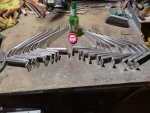
Home made aluminium steps , aluminium alloy rivets, two holes at base one at top , Plus the addition of a blob of grey OB1 adhesive on each mating surface. Been used several times , seems rock solid . Obviously Always wear some additional protection..like a spare halyard.
To be fair ,I think the OB 1 will hold my 90 kg .
 

Attachments

  • 20220930_145210.jpg
    20220930_145210.jpg
    457.7 KB · Views: 33
  • 20220930_151013.jpg
    20220930_151013.jpg
    735.6 KB · Views: 38
  • 20220930_151041.jpg
    20220930_151041.jpg
    381.2 KB · Views: 35
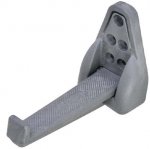
I have 4 of these - less risk of corrosion and perhaps more forgiving in terms of less sharp edges.

BUT One broke at 10 years old due to UV - fortunately I only have up to boom level and didn’t fall off. A second step was found to be seriously cracked. Hence all 4 replaced. I used the same again for simplicity, and will probably see me out, but might take different view if had been 30-40 for full mast, instead of just 4 near deck level so easy to check.
 
Whilst I like Wingcommander's home made steps, my own view on mast steps is that the commercial ones cost a lot and all provide extra weight and windage aloft. My own planned solution was two steps at the masthead to allow me to stand up high enough to fit or remove the wind instrument or service the anchor light, plus two at the bottom, high enough to enable me to reach a bit higher when stowing the sail. Alas covid and the inability to get to the boat caused me to sell before putting the idea into practice. I could actually haul myself up using my mast climber, though it was hard work and I preferred to be winched up. Two steps at the top plus a mast ladder to get to them actually seems like an even better idea to me.
 
I have 4 of these - less risk of corrosion and perhaps more forgiving in terms of less sharp edges.

BUT One broke at 10 years old due to UV - fortunately I only have up to boom level and didn’t fall off. A second step was found to be seriously cracked. Hence all 4 replaced. I used the same again for simplicity, and will probably see me out, but might take different view if had been 30-40 for full mast, instead of just 4 near deck level so easy to check.
So they're plastic, hence less weight aloft. Can you post a link to a supplier?
 
The issue is not the load-bearing qualities of newly deployed aluminium rivets on a stainless item, but their integrity after six or seven years in close proximity, in a marine environment. That's the reason for the OP's question as to whether he should use aluminium or monel.
After that sort of interval, you could remove your s/s steps, fixed with ali rivets, with your teeth.
I have posted on this a number of times. There are two compositions of aluminium pop rivet, one is pure aluminium that has poor resistance to marine corrosion. The other is a 5xxx alloy, same as your mast is. My 40 year old spars were all built using alloy rivets that remain as good as they were then.

The two types are usually referred to as 'aluminium' and 'alloy'. RS do them and doubtless many others.
 
I have posted on this a number of times. There are two compositions of aluminium pop rivet, one is pure aluminium that has poor resistance to marine corrosion. The other is a 5xxx alloy, same as your mast is. My 40 year old spars were all built using alloy rivets that remain as good as they were then.

The two types are usually referred to as 'aluminium' and 'alloy'. RS do them and doubtless many others.
However, I would be surprised if your spars are part "aluminium" and part stainless, which is why it is normal practice to use Monel where dissimilar metals are involved.
 
Top