
ghostlymoron
Well-Known Member
Thats outrageousI have a mariner 6, but last time I looked a charging coil was around £1k, just not worth it.

Thats outrageousI have a mariner 6, but last time I looked a charging coil was around £1k, just not worth it.
That's correct Steve.
Generally speaking, twin core is more expensive and pretty bulky when several runs are used. It's normal to use mostly single core cable for a job like this. Obviously things like the mast light should be 2 core.
There is no -VE connection to the isolator switch, you nailed it in the first paragraph above.

Re single/twin core, I didn't see an option for single core on 12v planet, and I don't know why lamps are obviously twin core. Can you enlighten me? And tell me which items can use single core and what else would need double? Don't all my items have +ve and -ve connections? Does using single core mean just one cable is needed from , say depth log? Or does it mean two single core cables, one from the switch box and one to the bus bar?
Sorry, I need this stuff in words of one syllable.

Thanks all, based on what you have told me, here is my proposed circuit diagram:
View attachment 79021
Any issues with this?
couple of quick questions on it. Is the inline fuse ok there? or better before the isolator (the distance between isolator and battery is under 12") and based on the kit I'm wiring up, is 20a a bit on the low side? Would 30a be better?
I have read about having seperate terminal blocks wired to the switch box, seems like extra faff & space, is this necessary?
I'm thinking 1mm single core tinned for the gps/depth/compass/usb/cig lighters; 1.5mm single core for the vhf and stereo and 1.5mm twin core for the autopilot and the plotter. Would you change any of those configurations?
Last question, if I add an extra solar panel, do I add another mppt controller? or can one controller handle 2 different solar panels?

Thats outrageous

It is isn't it! Not sure what I was looking at, but your comment made me look again quickly, and saw charging coils on ebay for £20! So messaged a local marine engine mechanic and he said charging could be added to the outboard for £130 if the flywheel didn't need changing, £230 if it did. That puts a whole new complexion on it! So thank you for bringing it up on the thread and making me revisit it.
I wont do it now, no budget for it, but it will go on her treat list for the future, along with new sails


This might helpGot that now, thank you. A very simple and lucid explanation, I like it.
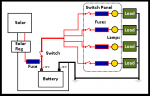

I thought about it but decided that as each load circuit was fused it would be unnecessary, but it would be a different story if there was an alternator involved.It needs a main fuse in the supply to the switch panel.
I thought about it but decided that as each load circuit was fused it would be unnecessary, but it would be a different story if there was an alternator involved.
The charging you get from a charging coil and rectifier on an outboard engine is usually pretty pathetic.
Usually very few amps unless the engine is running at a moderate RPM or more, even then not many and very few Ah unless you are running the engine for a good few hours. Ideally you only run the engine for a short while and at little more than a fast idle to get on or off the mooring / in or out of the marina etc.
My outboard, being the sail version, came with battery charging as standard but I still had to take the battery home periodically for recharging until I invested in a small solar panel
My advice would be not to waste money on retro-fitting a charging kit but to invest in more solar panels
I put the lamps in as a last minute thought, I forgot to put in the negative return wiresPossibly best not to actually wire the indicator lamps in series with the loads.

