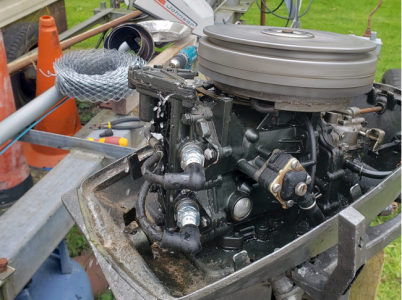
Reviving an old Johnson Seahorse 6

Don't be too quick to bin those coils - get your meter out and check for continuity. The cracked insulation may only be a wax.

Sorry Neil, they may well show continuity but the insulation will almost certainly have broken down.. Almost certainly the cause of the poor sparks.

I would not bother to give them a second look. They are quite typical of the way old Johnson and Evinrude coils fail.
My idea won't work. The points open when the spark is needed, so parallelling them it would never spark.

Plenty of replacement magneto coils available. Most are about £20 each. But I have found one on ebay clearly saying £20 for a pair. However although it looks the same and the seller says they fit the 6HP engines from 1950 to 1976 it has a different part number.

The parts list linked above says mine should be 0580416 but the ones being offered say equivalent to part nos
584477 582995 582921
0580416 was the original part number.
That has been replaced several times over by the other numbers listed Any of the other numbers in the parts list will fit
0584477 is the latest and comes complete with a new grommet for the HT lead.
Sierra and CDI replacements also available.

What is the number of the parts being offered ?

Mark the position of the old coils by scribing a line on the mounting pad. ( unless you happen to have the coil aligning tool )

1755298016437.png
 
The new magneto coils arrived yesterday. Installed, points gap set and tested and now both plugs have a good spark.

And she runs. I would show you but this site does not allow me to upload a short MP4 video.

2 issues now, it is running somewhat smokey. I hope that is just because I an using 40:1 to try it, mixed for my chainsaw. I have seen conflicting reports whether these should run on 50:1 or 100:1

Water seems to be flowing as it should, exiting from the vent on the leg. But there is a leak I need to investigate. I hope it just needs a new gasket on this cover.

1755773701727.png
 
The leak was just one of the bolts holding that plate on was loose.

Now trying on 80:1 mix, still a little smokey but a LOT less so. I previously had a Mariner 4 2 stroke and running on 100:1 even that was a little smokey.
That cover is the thermostat cover. It would be good idea to check that at some point.

Re fuel mix .From 1964 onwards 50:1 is the recommended fuel mix . Definitely not 100:1 ( that was failed " experiment" in the mid 1980s)
Because, AFAICS, although the big end bearings are needle roller bearings, the crankshaft bearings and the piston pin bearings are not a 40:1 mix might be a good idea. Using a TCW3 outboard oil of course.

BTW the latest recommended plugs are Champion J6C , gapped at 0.030".
IMO NGK B6S or B7S would also be suitable.

.
 
Last edited:
Yes ... ignore the old 100:1 fuel days .... that was an experiment to ruin ! Based on pressure to reduce oil content - environmentalists ....

50:1 is the correct ratio. And as another says : TCW oil s that's formulated for cooler running water cooled motors etc. You can get a Universal rated 2str oil now that serves both Air and Water cooled ... but if not easily found - stick with the TCW.
 
A further question on these old engines.

I find this one is a long shaft version. I am going to measure up tomorrow and see if it is feasible to add a mount to keep this on the transom of our boat as an auxiliary engine.

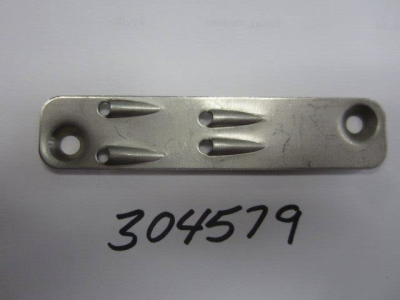
Normally you expect to keep the cavitation plate of an OB under water, but I see there is a vent just above the cavitation plate so I assume with this engine that must be underwater. What is the official guidance here. I fear we may have a conflict and it would end up too far down the transom to be workable.
 
A further question on these old engines.

I find this one is a long shaft version. I am going to measure up tomorrow and see if it is feasible to add a mount to keep this on the transom of our boat as an auxiliary engine.

Normally you expect to keep the cavitation plate of an OB under water, but I see there is a vent just above the cavitation plate so I assume with this engine that must be underwater. What is the official guidance here. I fear we may have a conflict and it would end up too far down the transom to be workable.
Yes the model number tells you that it is a long shaft. The 5" extension piece between the exhaust housing and the gear case is an obvious give away too.

It would be for a transom or mounting bracket height of 20"

Generally a long shaft engine, mounted closer to the 15" height for a standard shaft engine, is a better bet for a sailing boat because it keeps the prop in the water when the boat is pitching in a bit of a chop.

Initially I had a standard (aka short) shaft engine on my 19' Sea Wych but later changed to a long shaft "sail" version of a 6hp Evinrude. This has other modifications to make it more suitable for mounting at the same height as a 15" shaft model.

I dont understand the "vent" above the anti-ventilation plate unless this is actually an early version of the "sail" version. Are you sure you are not looking at the water by-pass cover.

1756051974381.png
 
Last edited:
Top