Reverse cycle air con / heating info

OK a simplified answer based on you comparison of a heating element and heat pump, the latter typically 3 to 4 times more efficient than a resistive heating element heater. Over 10 years, using a heat pump could save approximately 70-80% of the CO2 emissions compared to using a standard resistive heater.

For example, if using a resistive heater results in 10 tons of CO2 per year, a heat pump could save 7-8 tons annually, totalling 70-80 tons over 10 years. Exact savings depend of course on your location, energy source, and usage patterns.

If only we could reduce the cost of electrical energy! Nuclear and Hydrogen but many might disagree with me on this :)
 
If only we could reduce the cost of electrical energy! Nuclear and Hydrogen but many might disagree with me on this :)
I was talking to a geologist (on the science side) who said that we can harvest Hydrogen just like we harvest Oil. Like Oli, harvesting Hydrogen requires refining but he was very upbeat about the concept. Apparently, Hydrogen exists in some rock structures and has the potential for reserves as big as Oil. This was a real eye opener for me. It sounds like the future.
 
I was talking to a geologist (on the science side) who said that we can harvest Hydrogen just like we harvest Oil. Like Oli, harvesting Hydrogen requires refining but he was very upbeat about the concept. Apparently, Hydrogen exists in some rock structures and has the potential for reserves as big as Oil. This was a real eye opener for me. It sounds like the future.
The same problem exists for this as for manufactured hydrogen. It doesn't want to be contained.
 
OK a simplified answer based on you comparison of a heating element and heat pump, the latter typically 3 to 4 times more efficient than a resistive heating element heater. Over 10 years, using a heat pump could save approximately 70-80% of the CO2 emissions compared to using a standard resistive heater.

For example, if using a resistive heater results in 10 tons of CO2 per year, a heat pump could save 7-8 tons annually, totalling 70-80 tons over 10 years. Exact savings depend of course on your location, energy source, and usage patterns.

If only we could reduce the cost of electrical energy! Nuclear and Hydrogen but many might disagree with me on this :)
Solar panels on your roof to charge your electric car and heat/cool your house during the day - solar panels are so cheap these days it's a no-brainer really.
 
Decent control gear adds expense and night time energy recovery in winter is of course reduced, with PV, when you may need it the most. Battery storage takes up space and lifetime cost including maintenance can extend payback. I have specified some large PV arrays in the past but not done any calc's recently, increasing energy costs make heat pumps and PV arrays more viable.

We may have some spare capacity in the grid, given recent changes reducing commercial and domestic lighting loads (marginally) with LEDs but if everyone switches 'too quickly' over to heat pumps and electric cars (often charged over night, which is good but with PV without battery storage perhaps not so good), without giving grid capacity some very serious thought (with this or any other useless Government highly unlikely) I do wonder how it will all pan out. So its lets get on with now Nuclear and Hydrogen for me!

Don't get me wrong: I know a lot about heat pumps and PV as I have been specifying and have installed numerous installations for decades, I am considering changing my existing boiler over to heat pump and may install a PV array too in 2025 now that I am retired! For those that may be unaware, due to reduced flow and return temps that some (not all, in recent years) heat pumps operate, you may need to change the size of your heat emitters (radiators) to get the same heat output; a recent development though is to use existing sized rad's with small quiet fan modules clipped to their bases to increase their output (another project for Hurricane to use old PC fans and 3D printed enclosures ;-) Most problems can be overcome I suppose, man's and on rare occasion women's (Tee-Hee just kidding) ingenuity never ceases to amaze me!
 
CLASH (#43) is spot on with regard to containing and distributing Hydrogen, we have to use very high grade SS pipework distributions and equipment as the molecule size is so small, it can leak through almost any material and build-ups at high level are of course explosive! In labs (we have specified many systems (for Imperial and NPL in recent years) we strategically place H2 detectors/alarms and use ATEX rated equipment to include supply and extract fans to dilute/avoid problems. So generating stations both Nuclear and H2 can be dangerous but risks can be mitigated by good design IMHO.
 
We may have some spare capacity in the grid, given recent changes reducing commercial and domestic lighting loads (marginally) with LEDs but if everyone switches 'too quickly' over to heat pumps and electric cars (often charged over night, which is good but with PV without battery storage perhaps not so good), without giving grid capacity some very serious thought (with this or any other useless Government highly unlikely) I do wonder how it will all pan out. So its lets get on with now Nuclear and Hydrogen for me!
The grid capacity is already there. The National Grid says that reduced consumption due to the efficiencies you mention (and others) mean that peak grid usage is 16% lower than it was in 2002 and that if everyone switched to EVs now, this would only increase peak demand by 10%. Still below what it was over 20 years ago.

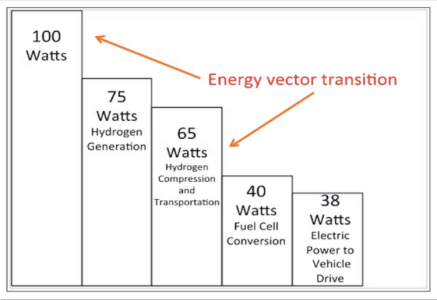
Hydrogen for cars is a solution looking for a problem imo. It is incredibly inefficient with just 38% of the energy consumed in generating the H2 reaching the wheels compared to between 83 and 95% for EVs. (ICE is between 25 and 35% on average).

For those that may be unaware, due to reduced flow and return temps that some (not all, in recent years) heat pumps operate, you may need to change the size of your heat emitters (radiators) to get the same heat output;
The answer is to replace rads with underfloor heating which already operates on reduced flow and return temps - around 40° compared to 65°+
CLASH (#43) is spot on with regard to containing and distributing Hydrogen, we have to use very high grade SS pipework distributions and equipment as the molecule size is so small, it can leak through almost any material and build-ups at high level are of course explosive! In labs (we have specified many systems (for Imperial and NPL in recent years) we strategically place H2 detectors/alarms and use ATEX rated equipment to include supply and extract fans to dilute/avoid problems. So generating stations both Nuclear and H2 can be dangerous but risks can be mitigated by good design IMHO.
And maybe that's the only possible use case for hydrogen, providing the cost of production can be reduced to a meaningful level and green hydrogen can replace the current grey product that uses fossil fuels for production. Otherwise we're just robbing Peter to pay Paul.
 
I've never really understood the appeal of hydrogen for cars, when BEVs work just fine. The attraction seem to be faster refill time, compared to charging a battery, ability to operate where there is no electric supply, and of course the appeal of still having an old fashioned piston going up and down complete with explosions - hopefully only inside the engine block if you are lucky. A very expensive solution with a host of problems though.
 
I've never really understood the appeal of hydrogen for cars, when BEVs work just fine. The attraction seem to be faster refill time, compared to charging a battery, ability to operate where there is no electric supply, and of course the appeal of still having an old fashioned piston going up and down complete with explosions - hopefully only inside the engine block if you are lucky. A very expensive solution with a host of problems though.
You obviously haven't heard the most hilarious part of (the bulk of) hydrogen cars. They're EVs. Yep, all that expensive hydrogen is used to generate electricity to drive a motor. There are some that use combustion, but they're very niche and not likely to be adopted. And boy is it expensive. Currently around $36/Kilo which with an average tank size of about 5Kg is $180 a fill. Most people who bought them did so because they got three years of free hydrogen.
 
Hydrogen for cars is a solution looking for a problem imo. It is incredibly inefficient with just 38% of the energy consumed in generating the H2 reaching the wheels compared to between 83 and 95% for EVs. (ICE is between 25 and 35% on average).
It is easy to throw out non-supported statements about energy efficiency and comparisons without stating precisely what and where from the basis of energy measurement is taken from.

Surely EVs should take account of the full generation, transmission and battery storage losses (most won't be from PV), but often (conveniently) simply quote the efficiency of the vehicle's motor/s once the energy has left the battery.

Does a battery achieves anything close to 83% energy in : energy out - and this may completely ignores the considerable delivery losses ?

A petrol engine should also take account of losses of mining, refining and delivery.

But then offset against these should be the considerable taxes and duties, as these are certainly not paid for in equal measure by EV users (at least yet anyway !).

None of these are simple things to measure, gauge or compare, so simply making statements like the above could be considered misleading.
 
It is easy to throw out non-supported statements about energy efficiency and comparisons without stating precisely what and where from the basis of energy measurement is taken from.

Surely EVs should take account of the full generation, transmission and battery storage losses (most won't be from PV), but often (conveniently) simply quote the efficiency of the vehicle's motor/s once the energy has left the battery.

Does a battery achieves anything close to 83% energy in : energy out - and this may completely ignores the considerable delivery losses ?

A petrol engine should also take account of losses of mining, refining and delivery.

But then offset against these should be the considerable taxes and duties, as these are certainly not paid for in equal measure by EV users (at least yet anyway !).

None of these are simple things to measure, gauge or compare, so simply making statements like the above could be considered misleading.
Well said!
 
It is easy to throw out non-supported statements about energy efficiency and comparisons without stating precisely what and where from the basis of energy measurement is taken from.

Surely EVs should take account of the full generation, transmission and battery storage losses (most won't be from PV), but often (conveniently) simply quote the efficiency of the vehicle's motor/s once the energy has left the battery.

Does a battery achieves anything close to 83% energy in : energy out - and this may completely ignores the considerable delivery losses ?

A petrol engine should also take account of losses of mining, refining and delivery.

But then offset against these should be the considerable taxes and duties, as these are certainly not paid for in equal measure by EV users (at least yet anyway !).

None of these are simple things to measure, gauge or compare, so simply making statements like the above could be considered misleading.
It was supported in the video I linked. But if you need pictures, here's one from this article. Which compares with BEV at a minimum of 80%. And the below chart doesn't apply full generation and transmission losses wrt hydrogen production but does for vehicle charging, so the figure is closer to 85% than 80% if comparing like with like.

Taxes and charges have nothing to do with efficiency. The internal combustion engine is extremely inefficient in delivering the power produced by the engine to the wheels.

1735249696741.png
 
Last edited:
Odd that some of the Worlds top Universities and research establishments have H2 filling stations, are running H2 powered cars and investing heavily in labs developing this technology, I must refer them to this Forum, it could save them millions...:) H2 and Nuclear for me....

I love those that say battery powered EVs are all electric, but just like H2, don't they rely on chemical energy in batteries which is converted to electrical energy....😊
 
With regard to grid capacity: I did not only mention the increased capacity of charging EV's over night but also the use of changing over from gas fired boilers to electric heat pumps, for air conditioning, heating and hot water, the latter may be operating 24/7 in winter! Albeit the latest heat pump models have for years been soft start and reducing inductive load components, it still concerns me that if people change over too quickly, I foresee grid capacity issues. I am sure they have people working on this of course!
 
Odd that some of the Worlds top Universities and research establishments have H2 filling stations, are running H2 powered cars and investing heavily in labs developing this technology, I must refer them to this Forum, it could save them millions...:) H2 and Nuclear for me....

I love those that say battery powered EVs are all electric, but just like H2, don't they rely on chemical energy in batteries which is converted to electrical energy....😊
Since there were less than a thousand H2 filling stations world wide as of the end of 2023 (16 in the UK), I somehow doubt that this is in any way significant other than for possible research purposes.

But perhaps you should follow your own advice and actually cite some sources rather than just throw out non-supported statements.
 
With regard to grid capacity: I did not only mention the increased capacity of charging EV's over night but also the use of changing over from gas fired boilers to electric heat pumps, for air conditioning, heating and hot water, the latter may be operating 24/7 in winter! Albeit the latest heat pump models have for years been soft start and reducing inductive load components, it still concerns me that if people change over too quickly, I foresee grid capacity issues. I am sure they have people working on this of course!
Yes. But since there is already an estimated 6% excess capacity after all cars are BEV (which isn't possible since 1/3 of households in the UK don't have the capability of installing home charging) and since heat pump installation is unlikely to be even close to the same uptake in the same time frame - because there is no legislative sunset on other forms of heating as there is on ICE cars, grid capacity is never likely to be a problem.

But as you say, they are likely to have plans in place. Not least the ever increasing solar and wind energy generation. Domestic solar is likely to supply a considerable portion of that.
 
H2 and Nuclear for me....
This is the equivalent of saying "I don't want to change" since H2 is already a dead technology having had decades to develop and never having got past an infinitesimally small part of the overall picture in that time and nuclear which takes typically 10 to 12 years to plan, build and commission a reactor.

In that time, the take up of EVs has grown steadily and solar and wind have taken over as the primary new power generation installations.

You don't have to change, but the rest of the world will carry on regardless.
 
Can you explain what the appeal of hydrogen is to you, rather than a battery? It comes up so often, what is the appeal?
H2 can be used in IC engines. This is the JCB, Caterpillar, John Deere approach. They can use their current diesels, modified to run on H2 and save gazzilions on batteries and e motors. The same tech will be used for HGV’s. Batteries don’t have the power density. A BEV 44 tonne truck will have 18 tonnes of batteries. The tech doesn’t work for freight, except local delivery. In the future, there will be synthetic fuels that will work as diesel. Probably 10 years away from economic viability. We will be using this in our boats.
 
H2 can be used in IC engines. This is the JCB, Caterpillar, John Deere approach. They can use their current diesels, modified to run on H2 and save gazzilions on batteries and e motors. The same tech will be used for HGV’s. Batteries don’t have the power density. A BEV 44 tonne truck will have 18 tonnes of batteries. The tech doesn’t work for freight, except local delivery. In the future, there will be synthetic fuels that will work as diesel. Probably 10 years away from economic viability. We will be using this in our boats.
Yeah, this is likely the use case for H2 in the future. Because of its bulk, it's not really feasible for cars - the Toyota Mirai for example has a very reduced cabin space due to the size of the H2 tanks.

May work in boats too, but the problem is that it's currently still relatively very expensive and would take up a lot of space in the boat.

Edit: Also (and maybe it's just me) but I just would not like to be sitting on a boat full of a highly explosive gas at a pressure of 700 bar.
 
Last edited:
Top