Replacing Windows - Glass or Plastic?

Trident

Well-Known Member
Joined
21 Sep 2012
Messages
2,891
Location
Somewhere, nowhere
Visit site
I have a catamaran with large bridge deck windows. They are currently stuck on top of the GRP (VHB tape and Sika) but are now scratched and also since the decent Sika primer was scrapped the new stuff is lousy and has let through some leaks over the last 7 years of use .

So I plan to change them this autumn and change how they fit. The plan is a GRP frame on the inside of the window opening, which means 8mm glass or acrylic will sit on that frame and stick with the new MS polymer sealants. The window panels will be about 3-5mm smaller all around than the opening. The GRP is 5-6mm thick so the "glass" will stick out a couple of mm and the gap around the "glass" will be filled with sealant and nicely finished in to the protruding edge of the pane

I can go with 8mm acrylic or polycarbonate or 6 or 8mm toughened glass. Obviously glass is better for scratches etc and should remain clear forever but.. will movement in the boat cause it to crack? It will be supported on all edges by 30mm of GRP lip to sit on and surrounded by a 5mm flexible sealant gap and then the GRP of the coach house. There have been no signs of gelcoat cracks etc over 40 years on the coach roof but it will move like any GRP - my instinct is that a 5mm bead all round will provide enough flexibility to protect the glass (similar to what is in an ally framed window) but does anyone have any experience that may say different ? TIA

 
If it is any reassurance, my rear two windows were fitted to curved surfaces. The frames were slowly tightened to the grp over a couple of weeks and gradually conformed to the curved surface.
That was 35 years ago.
They haven't cracked yet.
Glass is a fluid.
 
I think you need to speak to the manufacturers of the sealants you propose to use.

Your focus for the thread is the thickness of the product, acrylic, glass, polycarbonate not on the area. Your overlap is tiny, or seems to be tiny

The windows will expand and the sealant has to accept that expansion, or it will fail.

If your windows are large, its a cat - the windows will be large and will expand more than the underlying GRP - the sealant needs to accept that expansion.

3M make, made, a sealant that was used on our cat windows but when the windows started to crack we replaces the windows and used a product from a local company Fixtech, specially formulated for window application . The 3M product was used in the Petronas Towers - there was nothing wrong with it - Fixtech offered a better support service. They invested a lot of time to talk to me of the issues and to send chapter and verse by eMail. Our overlap was 100-120mm and there was a specified thickness of the sealant. Our windows were simply stuck to the GRP. The 3M product lasted for 20 years and the Fixtech product is 'only' 5 years old.

We replaced one window at a time. It took an age to cut the old windows, a filleting knife was the best tool, We then had to clean up the GRP surface. Making chisels scrapers from the acrylic of the windows was the best tool to remove the old sealant. You need lots as they blunt easily - but don't scratch the GRP. We had to keep the sun off the windows as the sealant set off. We also had to keep the windows under pressure and stop them sagging, slipping down the GRP. We screwed wood battens over the windows, screwed into the GRP where the outer fillet would be and back filled when we removed the screws. Our windows were at an angle, 'streamlined' and we hung 25kg water bottles on the windows to keep the adhesive under pressure.

I have pictures of our procedure - when you get to that point ask and I'll post them.

Sort out the sealant first.

Our windows were 10mm - you need it with big windows. We came back from Tasmania on one trip and had 8 hours of over 55 knots and seas breaking over the cabin roof.

IMG_7285 3.JPG

All our windows are slightly curved, the wooden battens and cured adhesive was the answer. The two windows at the front corners of the cabin roof were curved and needed a former and heat to shape them, Most of the windows were about 500mm x 500mm

Jonathan
 
I have a catamaran with large bridge deck windows. They are currently stuck on top of the GRP (VHB tape and Sika) but are now scratched and also since the decent Sika primer was scrapped the new stuff is lousy and has let through some leaks over the last 7 years of use .

So I plan to change them this autumn and change how they fit. The plan is a GRP frame on the inside of the window opening, which means 8mm glass or acrylic will sit on that frame and stick with the new MS polymer sealants. The window panels will be about 3-5mm smaller all around than the opening. The GRP is 5-6mm thick so the "glass" will stick out a couple of mm and the gap around the "glass" will be filled with sealant and nicely finished in to the protruding edge of the pane

I can go with 8mm acrylic or polycarbonate or 6 or 8mm toughened glass. Obviously glass is better for scratches etc and should remain clear forever but.. will movement in the boat cause it to crack? It will be supported on all edges by 30mm of GRP lip to sit on and surrounded by a 5mm flexible sealant gap and then the GRP of the coach house. There have been no signs of gelcoat cracks etc over 40 years on the coach roof but it will move like any GRP - my instinct is that a 5mm bead all round will provide enough flexibility to protect the glass (similar to what is in an ally framed window) but does anyone have any experience that may say different ? TIA
Toughened glass will not crack, it shatters into a million tiny pieces, same as the side windows in a car. Car windscreens crack, but they are laminated. The cost of laminated glass for one offs would, i suspect, be prohibitive.
 
I can get toughened or laminated - toughened is stronger , laminated will remain intact but "break" - I guess for being water tight even if obscured by cracks laminated is better. Fortunately they are flat rectangle sheets so each window panel at 130 x 70 cm is quoted from glass suppliers at under £100 each whether toughened or laminated - almost double if I want tinted versions of either .

I can of course get toughened and laminated glass (any reasons not to?) - that at 10.8mm comes in at £175 but is heavy compared to polycarbonate - 45kg for two compared to 16kg ... that may be a deal breaker for a cat..

The sealant I plan to use is one of the new generation MS polymers that is both very strong and allows over 30% movement without breaking and is specifically suggested for glass and acrylic installs because it will move. I'll do some sums on the thermal expansion differentials to see how much movement from that is likely.

The current set up has a wooden beam central across each window (internal and vertical) to add extra support - the original windows from the manufacturer did not , but instead and a reasonably sizeable wooden internal window frame in wood that split the single pane in to two visually and thus also offered the central support. I will be replacing those with carbon fibre beams for the same central support against waves with an interface of a rubber strip where glass touches carbon
 
Toughened glass will not crack, it shatters into a million tiny pieces, same as the side windows in a car. Car windscreens crack, but they are laminated. The cost of laminated glass for one offs would, i suspect, be prohibitive.
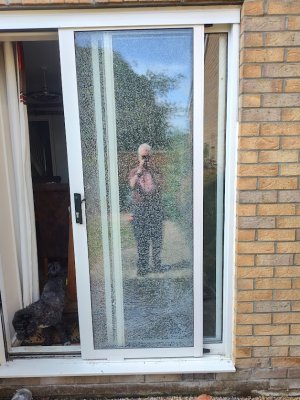
I recently had experience of this. A patio door was struck by a stone thrown up by a strimmer, and the glass in the double-glazing unit shattered into thousands of pieces; the whole area of the panel (about 6' by 4') shattered despite the blow being low down. Fortunately, the glazing unit has some kind of film (I think) that held the pieces in place, so it remained precariously intact until the glazing company replaced it.

I would not use toughened glass in a location where it MIGHT be struck by a hard object (e.g. a shackle) and where it's integrity is essential to keep the boat from flooding.

IMG_20250529_103433701_HDR.jpg
 
Our acrylic was tinted, in can be sunny in Australia (which seems most unlikely in today's mid winter, temp to day was tops of 13 deg and in summer 35 deg (but the windows get hotter (we had sun covers). I don't know if that might be a factor in choice.

Jonathan
 
Our previous boat, being a cat, came with very expensive aluminium framed glass windows. They looked great but were a constant source of leaks. The movement of a solid glass construction was way more than the frames could handle. It may have been different if the boat was cored but solid glass is massively more flexible than cored construction. We never solved the leaks even when I had new aluminium framed windows made for the particularly leaky ones at quite a lot of expense. I though the more substantial fully welded frames would be better but they weren't. A waste of nearly £1000 several years ago.
 
Our acrylic was tinted, in can be sunny in Australia (which seems most unlikely in today's mid winter, temp to day was tops of 13 deg and in summer 35 deg (but the windows get hotter (we had sun covers). I don't know if that might be a factor in choice.

Jonathan
Our windows are clear glass in the front and tinted glass at the sides. We have a fine mesh cover for the front ones, it lets light in, but not much heat. We can see out, but you can't see in. Highly recommended for anyone with big windows.
 
Our previous boat, being a cat, came with very expensive aluminium framed glass windows. They looked great but were a constant source of leaks. The movement of a solid glass construction was way more than the frames could handle. It may have been different if the boat was cored but solid glass is massively more flexible than cored construction. We never solved the leaks even when I had new aluminium framed windows made for the particularly leaky ones at quite a lot of expense. I though the more substantial fully welded frames would be better but they weren't. A waste of nearly £1000 several years ago.
Interesting - I have quotes from two framed glass companies (one having very good reputation and will do clamp on ally framed windows for the front for £900 a pair or £1400 double glazed ) - I had decided against it based purely on the ally frames looking rather more old fashioned than my current set up. It had never occurred to me that if fitted properly they might leak with modern sealants etc .

Now I think about it I have in my career working on boats changed lots of old framed and leaky windows for something else - always old and often with chalky ally which I assumed was the reason they leaked ; naïve of me .
 
Our windows are clear glass in the front and tinted glass at the sides. We have a fine mesh cover for the front ones, it lets light in, but not much heat. We can see out, but you can't see in. Highly recommended for anyone with big windows.
I have the mesh nets too for all windows even though they are grey tint (but then we have been in many hot places in the boat) but last year applied the one way mirror foil to them all - absolutely game changing - it cuts out very little light but reflects a huge amount of heat and provides great privacy in a saloon that has 90% windows on 3 out of 4 sides
 
I have the mesh nets too for all windows even though they are grey tint (but then we have been in many hot places in the boat) but last year applied the one way mirror foil to them all - absolutely game changing - it cuts out very little light but reflects a huge amount of heat and provides great privacy in a saloon that has 90% windows on 3 out of 4 sides
That's interesting, i should look into that for our side windows, although some slide so might scratch easily. Do you have a link to what you used ?
 
Our windows are clear glass in the front and tinted glass at the sides. We have a fine mesh cover for the front ones, it lets light in, but not much heat. We can see out, but you can't see in. Highly recommended for anyone with big windows.
I think its called Phifertex. We had it on our sprayhood windows and now on the new hardtop windows. Excellent at keeping the heat out.
 
Glass is much nicer to live with in windows and hatches. In particular, toughened glass should last a lifetime without ever becoming hazy or scratched. If feasible, I strongly recommend utilizing this material.

The drawback is weight, which is a factor in a catamaran with its large windows and more weight-sensitive hull design.

Glass exhibits distinct properties compared to Perspex or polycarbonate. However, the calculations for marine windows indicate that the required thickness for these three materials is nearly identical. If you maintain your existing Perspex thickness, the overall “strength” of glass will be comparable. Nevertheless, I would refrain from making the glass thinner. Our pilothouse windows, designed by a naval architect and are 12mm thick. These have a smaller opening than you require (and the size is an important factor in determining the required thickness). This suggests anything less than 8mm would be marginal if you are planning to go offshore.
 
As a side note, if you are designing new window surrounds and frames, consider incorporating a means of attaching something to the outside of the window.

Our boatbuilder added some simple threaded holes spaced around each window that will take a 6mm bolt. These can be used to attach shade (we use Phifertex), perspex covers to provide extra insulation, or storm covers should the worst happen and a window is broken. It is easy to incorporate at the build stage, but harder once the windows are installed.
 
Top