Replacing through hull fittings

peter2407

Well-Known Member
Joined
11 Sep 2008
Messages
1,064
Visit site
Next topic - I had the heads outlet seacock replaced season before last. I now want to replace all/most of the others, but do it myself. Questions - how can I identify required size/spec etc, where to buy, what to buy, any tips on doing this (specifically re any weather requirements re curing time) and lastly .... doing all this afloat is OK according to Dave down the Pub - do you agree? (Kidding, just kidding - clearly I would have to do them one after the other, not simultaneously ..... ;-)
 
A simple job, I've done it on two boats now.

To find the size of each one, measure the outer diameter of any exposed thread and compare against the "major diameter" column on http://en.wikipedia.org/wiki/British_Standard_Pipe#Pipe_thread_sizes . The "BSP size" column is then the size you need to order.

Buy DZR from ASAP: http://www.asap-supplies.com/marine/dzr-threaded-skin-fitting-connections . Bronze would also be ok but it's more expensive for no real benefit. Ignore their note about bonding, that's completely wrong according to current thinking.

The hardest part is removing the old fittings. If you're lucky they'll unscrew with a Very Big Spanner, but more likely they'll need to be cut out. I favour a tile-cutting saw the size of the pipe, to separate the flange from outside, but there are other valid ways.

Bed it on sikaflex. Normal advice is to do it up nearly all the way, leave it to set for a couple of days, then fully tighten to compress the rubber.

Optionally, trim the skin fitting (before installing) so that there's just a few millimetres of spare thread between the back nut and the valve. Especially on small ones, leaving it untrimmed adds a lot of leverage to potentially break something. Shorter is also tidier.

Strictly speaking, a parallel-threaded valve onto a parallel-threaded fitting without a fibre washer or o-ring is an incorrect BSP assembly. But it's standard for seacocks in Europe, you make a workable seal with a healthy but not excessive dose of plumber's PTFE tape on the fitting.

If you need the valve to face in a particular direction, you can add a second nut on the thread to lock up against it.

Pete
 
I would simply add that the job can also easily be done between tides if you can dry out somewhere. In that case though I would use a polysulphide sealant if you are changing skin fittings which will happily cure underwater.
 
I thought the OP was just changing the seacocks not the skin fittings.

An interesting question of terminology...

Traditionally, a seacock was one item (like the Blakes type) so the distinction didn't arise. Some people still insist that a seacock has to be bolted to the hull, like these Perko ones: http://www.asap-supplies.com/web_images/Products/Products/large/420104.jpg , and the now common skin-fitting-with-a-valve-on-top is not a seacock at all.

I don't follow that view - instead I apply the term to anything that a hose attaches to, which passes through the hull, and can be turned off. So I would call the whole assembly of skin fitting, backnut, ball valve, and hose tail, together, a seacock.

I wouldn't call just the valve perched on top of the skin fitting, a seacock. I'd call it a ball valve (or on an unmaintained 70s or 80s boat, a gate valve), one component part of a seacock.

We don't know what the OP meant by the term, but I'm guessing he wants to replace the whole lot, probably because he's recently heard about the Great Brass Seacock Scandal.

Pete
 
I have done this a few times. The worst bit is getting the old fittings off. I have never managed to unscrew one even with a huge spanner.
After trial and error I have found the best way to get the old fittings off is to CAREFULLY work round the flange on the outside of the hull with an angle grinder. Work from the inside edge of the hole to separate the flange from the tube which goes through the boat. After the flange falls off (may need prompting) the whole assembly can be lifted into the boat.
 
As with most things to do with boat-fitting replacement, it's easy to fit but the problem comes with trying to get the old one out.
Great description of how to do it, Pete.
Perhaps you should, for the benefit of BenJan owners go into the Great Brass Scandal in more detail.
 
Sorry chaps - should have been more specific. Yes, it is a case of all hull fittings, but it only seems sensible that what they are attached to - to a limited extent, ie the drain pipe from the sink should be ok, but the stainless steel jubilee clips x 2 plus the seacock itself should be replaced. Anyone have differing views? Either way, DZR all the way through?
 
Last edited:
the stainless steel jubilee clips x 2 plus the seacock itself should be replaced. Anyone have differing views? Either way, DZR all the way through?

I've generally reused jubilee clips as long as they were in good condition and not a really cheap and flimsy design.

I have a feeling that nuts (as used to lock the valve in position if you're not just screwing it all the way down the thread) aren't always available in DZR, but since they're not in contact with the water I was content to use brass. Otherwise yes, all DZR (or bronze).

Pete
 
Removing skin fittings almost always requires cutting the old one out. I use a Dremel(ish) with a cutting disc to cut away the outer flange on the skin fitting. It's easier to control than an angle grinder and if you do make a slip is much more forgiving than a larger tool. Usually takes me several discs as they're quite fragile but easy enough with a bit of patience.
 
You don't always have the option of changing just the ball valve without changing the skin fitting anyway, as it can quite frequently be difficult to remove on its own.

Make sure you buy BSP and not the tapered thread (BSPT, IIRC).

Not sure I'd want to change between tides. It's rather relying on everything going smoothly.
 
This is all part of work that will be done ashore. Re the removal of the old skin fitting, I assume that means that the replacement has to be bigger? ie if the external diameter is say 4 cms, and i dremel around it, the replacement would need to be say 5 cms? Is that correct? Can I add any more question marks?
 
if the external diameter is say 4 cms, and i dremel around it, the replacement would need to be say 5 cms? Is that correct?

Peter,

No, the hole in the hull shouldn't be enlarged. When you cut the old fitting out with the grinder you are only removing that part of the through hull that protrudes outside (and lays flat alongdide) the hull. There should be no (intentional) GRP cutting as part of the process.

I'm doing the same job and am going for all bronze except the valves which have to be DZR as there are no all-bronze valves made. I have been using Aquafax who have been super-helpful on the subject, gold star to them!
 
This is all part of work that will be done ashore. Re the removal of the old skin fitting, I assume that means that the replacement has to be bigger? ie if the external diameter is say 4 cms, and i dremel around it, the replacement would need to be say 5 cms? Is that correct? Can I add any more question marks?

As Robinh says, you cut off the flange with the Dremel. Don't enlarge the hole.

I've found ASAP the best for replacement fittings (and I'm pretty sure they do Bronze ball valves if you want them Robinh). What I like is that they tell you the spec of the fitting, which gives you a lot more confidence than something as ill-defined as 'bronze'.
 
Re the removal of the old skin fitting, I assume that means that the replacement has to be bigger? ie if the external diameter is say 4 cms, and i dremel around it, the replacement would need to be say 5 cms? Is that correct?

No - you cut the fitting, not the hull!

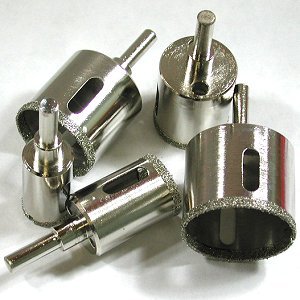
I briefly mentioned my preferred technique above - I have a set of tile holesaws which coincidentally have exactly the same diameter as the "pipe" part of a skin fitting. So when applied to the fitting from the outside, they neatly sever the flange from the pipe. Although meant for stone and tile, they cut through the soft brass quite effectively.

41pazqQ3w3L.jpg


On the ones originally fitted to Ariam at least, the saw fitted inside the chamfer on the edge of the hole so was nicely self-locating. Otherwise it's possible that a wooden plug might need to be knocked into the hole to guide the saw.

Another common technique is to use a grinding disc to make a deeper and deeper chamfer on the hole until it goes right through the metal at the corner between pipe and flange. And on Kindred Spirit I cut through the nut on the inside and hammered the fitting outward. Many ways to skin the cat - but all of them involve cutting the skin fitting, not the hull.

Pete
 
No - you cut the fitting, not the hull!

I briefly mentioned my preferred technique above - I have a set of tile holesaws which coincidentally have exactly the same diameter as the "pipe" part of a skin fitting. So when applied to the fitting from the outside, they neatly sever the flange from the pipe. Although meant for stone and tile, they cut through the soft brass quite effectively.

41pazqQ3w3L.jpg


On the ones originally fitted to Ariam at least, the saw fitted inside the chamfer on the edge of the hole so was nicely self-locating. Otherwise it's possible that a wooden plug might need to be knocked into the hole to guide the saw.

Another common technique is to use a grinding disc to make a deeper and deeper chamfer on the hole until it goes right through the metal at the corner between pipe and flange. And on Kindred Spirit I cut through the nut on the inside and hammered the fitting outward. Many ways to skin the cat - but all of them involve cutting the skin fitting, not the hull.

Pete

Pete - apologies, I replied before seeing your post. Where do you source your magical hole cutters? Are they SDS or regular ie will they fit a regular power drill?
 
A simple job, I've done it on two boats now.

To find the size of each one, measure the outer diameter of any exposed thread and compare against the "major diameter" column on http://en.wikipedia.org/wiki/British_Standard_Pipe#Pipe_thread_sizes . The "BSP size" column is then the size you need to order.

Buy DZR from ASAP: http://www.asap-supplies.com/marine/dzr-threaded-skin-fitting-connections . Bronze would also be ok but it's more expensive for no real benefit. Ignore their note about bonding, that's completely wrong according to current thinking.

The hardest part is removing the old fittings. If you're lucky they'll unscrew with a Very Big Spanner, but more likely they'll need to be cut out. I favour a tile-cutting saw the size of the pipe, to separate the flange from outside, but there are other valid ways.

Bed it on sikaflex. Normal advice is to do it up nearly all the way, leave it to set for a couple of days, then fully tighten to compress the rubber.

Optionally, trim the skin fitting (before installing) so that there's just a few millimetres of spare thread between the back nut and the valve. Especially on small ones, leaving it untrimmed adds a lot of leverage to potentially break something. Shorter is also tidier.

Strictly speaking, a parallel-threaded valve onto a parallel-threaded fitting without a fibre washer or o-ring is an incorrect BSP assembly. But it's standard for seacocks in Europe, you make a workable seal with a healthy but not excessive dose of plumber's PTFE tape on the fitting.

If you need the valve to face in a particular direction, you can add a second nut on the thread to lock up against it.

Pete
In a previous thread on this topic, someone said that it's better to use sealant on the threads, as PTFE tape is normally used by plumbers on a fitting they might wish to subsequently open. They said that PTFE is excellent at reducing friction and there is the possibility of the joint unscrewing itself in the rough and tumble environment of a boat.
 
I use a Dremel(ish) with a cutting disc to cut away the outer flange on the skin fitting...Usually takes me several discs as they're quite fragile but easy enough with a bit of patience.

Have you tried the fibre-reinforced Dremel cutting discs (much like an angle-grinder cutting disc, but a little thinner and obviously much smaller)? Much more robust than the ordinary discs, although they do require a special carrier.
 
Top