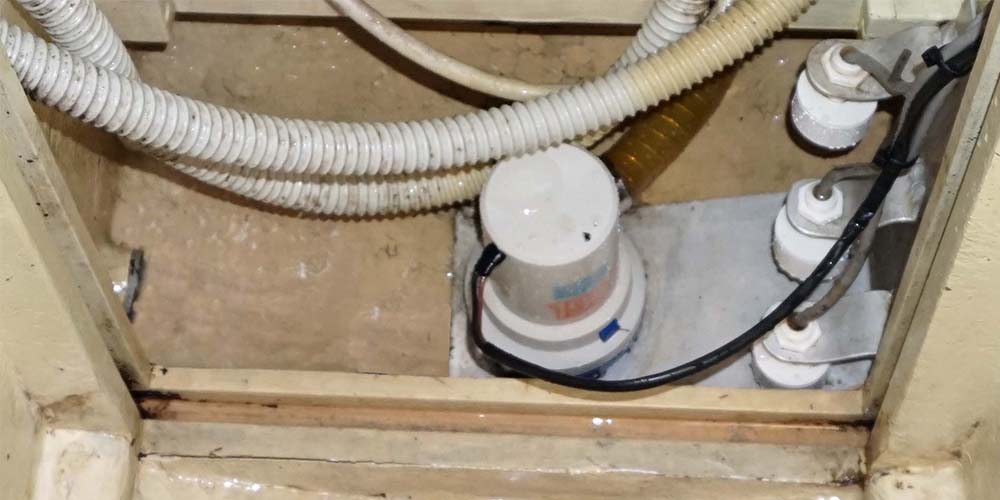
Replacing seacocks, what type to use

Some of the seacocks on Boadicea have become quite stiff and show external corrosion, so I am gradually changing them all to Forespar Marelon. So far so good and very simple to install. On a par with DZR cost wise, but no electrolysis issues. They even include a bung for the skin fitting to allow the valve to be dismantled with the boat afloat.
 
fully agree on both points
Well B, since you appreciated a couple of suggestions which were rather geeky (borderline with negligible, if I'm honest :o), here's another one.
A bit more tricky this time, and possibly even less relevant, but that's a matter of personal judgement.

As a premise, personally I'm not a big fan of the capability to use engines raw water pumps to suck water from the bilge.
I mean, the principle as such makes perfect sense, but as a matter of fact I never heard of anyone actually using such feature, let alone save the boat with it.
So, if I were speccing a new boat, I'd rather have other types of redundancy - one possibility for covering also the scenario of a catastrophic electrical failure being for instance mechanical pumps driven by engine(s) or genset(s) PTOs.
At least, that eliminates the risk to set the boat on fire if the engines (and their exhausts!) can't be cooled enough, eventually losing the vessel due to an arguably even worse situation.... :rolleyes:.
Therefore, I'd be very tempted to answer your question about the T-valves along the lines of getting rid of it altogether.

Having said that, if you wish to keep the functionality, here's an additional trick that you might consider, in the context of an overall pipes refitting.
First of all, I'll start admitting that I'm not sure to remember the hull sections arrangement on BA.
By "sections", I mean separate w/tight compartments.
IIRC, there's a lazarette astern with a w/tight door to the e/room, and in front of the e/room there's a large section for the whole accommodation area (master cabin first, then the two guests, then the VIP), and eventually the crew area at the bow. So, four compartments overall, leaving aside the anchor locker which I guess is above the w/l anyway, so not relevant in this context.
Now, I suppose that in all these compartments you have some "local" electrical bilge pumps - as you surely have in the e/r.
But from your pics above, as I understand on both engines the bypass is meant to suck the water directly from the engine room. This means that if the water ingress is anywhere else, the backup and/or support of the engines as bilge pumps is zero.

One possibility to address this issue is the following, which I happen to know because it's standard on all DPs (and possibly also used by other builders, not sure about that).
If on top of the local bilge pumps you also have a secondary large pump, which can suck water from each section through a manifold with separate valves, you can leave the bypass of one engine as it is, and connect the other one in parallel to this central pump, before the manifold.
This way, even in the event of a catastrophic electrical failure disabling all electrical bilge pumps, you will still have the option of sucking water from anywhere in the boat using either one or the other engine.
Mind, this is not difficult to arrange if you already have a centralized pump with selectable hoses going in each compartment. It can even be easy peasy, if such pump is already placed inside the e/r - to the point of wondering why the builder didn't originally arrange the bypass in such way...
But, and it's a big but, if you don't have such central pump, with its compartment-specific hoses already installed through the w/tight bulkheads, doing it as a refitting (as opposed to during build) can be a real PITA, and probably not worth the hassle.

Just a thought, anyway! :encouragement:

PS: sorry, I didn't have time to write a short post, so I wrote a long one instead... :o
 
Last edited:
That makes good sense MapisM. Just to add a few ideas, and not to disagree with yours:

1. I agree that using the engine to pump bilge water is somewhat pointless, though it does no harm. People say (on here and elsewhere) that they then have a 500hp pump, but that is total nonsense as you know. They have a 100watt pump. The flow rate of those pumps is nothing special

2. In addition to what you suggest I would have a bilge alarm system with 5 or so sensors to sound a high bilge water alarm (I have two such on my boat, for redundancy). These require electrics, but the alarm sounds at a water level far below the batteries

3. FWIW, I have a 230v submersible flood pump driving a 3 inch fire hose, sored in a grab bag (it weights 40 kg perhaps!) which I would deploy to save a sinking ship. Requires genset but mine are high enough that they will work for quite a while in a flooding situation. (Also works in reverse as fire pump to bring the sea onto the boat, but I might choose to abandon ship in a fire!)

4. I have a hydraulic pump (a normal centrifugal pump driven by a hydraulic motor) for my hydraulics cooling. It is powered by the 2x engine PTOs or by the 400v 3ph electric hydraulic pump. I have not done this yet but I have a plan in my head to create take offs/T valves on both inlet and outlet. The inlet would allow me to pump bilge water without electrics; the outlet take off would allow me to cool a main engine that had a failed impeller, so I could get home without needing to change the impeller on a hot engine. Flow rate would be ok for developing a decent level of HP/knots, I think, but not enough to pump out bilge water from a big hole in the hull

Just a few thoughts, anyway
 
Note that you can't get all bronze ball valves in the UK. A chrome plated bronze ball is the best I found. Often the valve stem is brass too. It's not a terrible thing, but why spoil the ship for a ha'penny...
 
Pumping water from the bilges using the engine cooling system wouldn't work for MTU engines.
The engine raw water pumps are not the rubber impeller style of pump - they are conventional centrifugal pumps and require priming when the system is empty.
So if any air got into the system, the whole thing would require re-priming - not the kind of thing you would want in any situation.
 
Just to add a few ideas...
Yup, 100% agreed ref 1.
And on top of not being as powerful as many folks believe, the use of engines as bilge pumps is inherently tricky, and demands a lot of attention. Not something I'd fancy dealing with, upon an emergency situation.
Of course I'm not getting rid of it now that I've got such setup, but as I said I don't think I would have specced it, if given a choice.

Impossible not to agree also with your point 2 of course, but I that's pretty normal in most boats, I reckon.
Though the specific arrangement can be very different: my previous and current boat are at the two opposite extremes of the scale, in this respect.
In the old lady, each compartment has an electric pump whose floating switch, on top of turning the pump on, activates the alarm - period. "No frills" doesn't even begin describing the builder's philosophy... :rolleyes:
In the current boat, not only each local pump is backed/supported by the large diaphragm pump plus manifolds which I previously mentioned - and possibly also by the engine, as a last resort - but there's also what is possibly the most sophisticated alarm logic I ever came across (all standard setup btw) - see pic:
zrkejlri_o.jpg

The lower floating switch turns on a beep alarm and a led in the dashboard, located inside a drawing of the boat to visually see the compartment involved. At that point, you can manually activate the pump till the light turns off.
If you do nothing and the water rises further, the intermediate switch turns on the local pump automatically.
If the water rises further, reaching the higher switch (which in theory should never happen, as long as the pump works properly and its capacity is enough) an additional light and a loud alarm go off.
There's that set of triple floating switches in each watertight compartment, aside from the e/r where there's one of them at the front and another at the back, each with its own pump.
Very different boatbuilding philosophy, as I said...! :)

Btw, back to the bonding vs. not bonding debate, it's no coincidence that the latter boat has everything bonded, vs. nothing on the former.
Sort of supports the logic that not bonding, rather than a scientific choice, is just a way of cutting costs wherever something ain't strictly necessary...

Ref 3, that's a very nice to have bit of kit indeed. Care to post more about it?

All understood and agreed ref 4.
That's definitely a clever idea, though obviously applicable only in a boat already equipped with STAR hydraulic stabs. :encouragement:
 
Pumping water from the bilges using the engine cooling system wouldn't work for MTU engines.
Yup, and all made in bronze - at least on the 182 series engines which I evaluated in more detail.
An excellent bit of kit indeed, built to last forever, with as close to zero maintenance as it could get.
I'd rather have that and lose the water pumping function any day of the week. :encouragement:
 
We always have the hand pump - a hand lever operated pump with diverter valve to pump from the appropriate zone.
But I was told - if you think you need to use this, you should be thinking of abandoning ship.
 
The gate valve set up that you have there is pretty horrible! And incorrect use of your two valves can sink the boat, whereas with a T valve that can't happen because it will never allow the sea to be connected to the bilge

I don't think there is a risk of sinking the boat with the original setup, as there seems to be a one-way valve in the bilge suction pipe,

quickly browsing the internet, I can't find a suiteable bronze 3way valve, (at least not from the regular marine brands... ) so I think the most conveniënt solution is to copy exactly what I have with a additional flushing point. (and or a connection to the bilge pump manifold cfr Mapism)
 
We always have the hand pump - a hand lever operated pump with diverter valve to pump from the appropriate zone.
But I was told - if you think you need to use this, you should be thinking of abandoning ship.

some years ago, I was obliged to install a hand bilge pump, a requirement for the UK flag, coding
I choose the biggest handpump from Whale,
and my conclusion after testing was that i'ts capacity was totally useless in case of a emergency,
Soon after the coding survey, I re-installed the hose connections from the manifold to the orriginal 2nd big 24V bilge pump, and omitted the hand pump.

FWIW, I have a big (3000GPH iirc) 24vDC pump, with 2" firehose ready with cable and clamps, stored in the ER, in case of emergency's, ...
 
Fwiw, I have two valves also in the DP, whose pipes are very large too - by heart I'd say 3".
So, maybe you are right in assuming that bronze T-valves of that size just don't exist...
I can't remember what Deleted User has on his boat, which surely has equally large (if not larger) pipes, and also the bypass for sucking water from the bilge. Maybe he can confirm if he also has two valves or just one T-valve?

PS: Anyway, I would replace the gate valve with a ball valve, in your setup.
 
Last edited:
Top