Replacing Perkins 4108 with equivalent YANMAR 4JH45 or Volvo D2

That is somewhat misleading. The origins of the engines are pretty clear as I explained earlier, and at the same time suggesting you can't go "wrong" with any of them but that there are sound reasons for choosing one rather than another. Actual power, choice of gearboxes, layout of service points, location and style of exhaust, availability of parts and service for example. Also some engines have electronic components - Volvo have an electronic interface with the control panel and Yanmar of this size is common rail injection which may influence choice. While the base engines may in some cases be the same (Beta and Nanni use Kubota, Vetus and Sole use Mitsubishi for example) the detail of the marinisation is different which may make one a better choice in a particular installation than another. Nobody makes raw water cooled engines now except the venerable Yanmar 1GM a design that dates from the late 1970s.

BTW your last sentence in the quote does not make sense - Honda don't make inboards or base engines and the relationship between Beta and Kubota is simple - Beta is an authorised mariniser of Kubota engines, along with Nanni and Westerbeke.

I was only commenting .. not making technical statement. Think most people are bit tired of that.

As to Honda - it was just an example of generality - not to imply they made marine engines. But to throw a manufacturer in that does have other brands sitting on their production as well as their own.
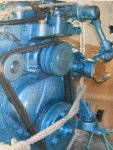
 
PCUK it does seem to me that some Perkins 4108 / 4107 were more reliable than other 4108/4107 by hearsay. Mine has been brilliant . The necessary upgrades for perfection in my case was spin on fuel filter cartridges. And fitting a dual pulley system rather than standard single , as the single belt cannot reliably drive a high power alternator (oh for the amount of times I have had to change single belts sometimes in precarious situations !)
 
PCUK it does seem to me that some Perkins 4108 / 4107 were more reliable than other 4108/4107 by hearsay. Mine has been brilliant . The necessary upgrades for perfection in my case was spin on fuel filter cartridges. And fitting a dual pulley system rather than standard single , as the single belt cannot reliably drive a high power alternator (oh for the amount of times I have had to change single belts sometimes in precarious situations !)

Those modifications are of benefit to most engines - not only Perkins.

I have seen a few boats where owners have installed higher rated alternator and then wondered why there's screeching sound and next bits of belt flying off !
 
Yes indeed Refueler. I have never seen Balmar adverts include statements of the requirement for a dual pulley system, but it certainly is a requirement. Actually to be fair to Balmar their big alternators do come with a dual pulley but they do not draw your attention when buying to the fact that you must change the engine pulley to dual. Of course on the 4108 , no belt so no cooling so no engine! Not a happy situation when underway, and only detected if you keep an eye on the exhaust water flow (or temp gauge if it is working). Out of habit I am still continuously aware of exhaust water flow when on the helm
 
Last edited:
I wonder if there are suitable 4108 replacements with direct shaft/ gear drive (rather than belt drive) for raw and fresh water coolant pumps?
 
I'll drag out my manual on the 4 series ... but wouldn't you have two pumps if Heat Exchanger system ? One to draw up the seawater to the HE ... second pump for coolant round engine ?

My change removed the seawater pump and the shaft driven coolant pump pulls the seawater to push round system. Changed belt of course because no longer having a belt driven pump.

Here's the 4-108 equivalent of my 4-107 shaft driven pump

Perkins 4.108 Raw Water Pump

Before anyone jumps on me .. I am not posting with in mind to 'push' OP to my solution. Just offering it up as a consideration.
 
Yes there are 2 pumps - the fresh water (w/antifreeze) is driven by the belt. The raw sea water is driven by shaft/gear connected/synchronized internally with the fresh water pump shaft . Ideally it would be nice to have both driven by shaft/gear independent of any (failing) fan belt
 
Returning to corrosion, I like the idea of an anode in the HE system . Where is it on the Beta and could one be made and installed in the 4108 without risk of particles falling off and blocking any pump/pipes/thermostat?
 
Last edited:
Regarding the pumps failing when a fan belt breaks, it seems that maybe I have got this entirely wrong . Looking at the Fresh Water coolant pump, it does not seem to have any shaft behind it so how could it be synchronized with the salt water pump, and how could the fan belt breaking result in no water out the exhaust?? I have been certain for many years that this is the case when my fan belt used to break....Is my memory failing - maybe the indicator was that the exhaust water turned black as the engine overheated??
 
Last edited:
Why would pumps need to be synchro'd ??
Only the shaft driven pump adaptor plate has to be carefully aligned and synched to the drive inside the engine. There is a specific procedure in the workshop manual for it. That is why if you remove the shaft driven pump - you need to leave the adaptor plate in position ...

But the belt driven ?? Why synch'd ??

I'll check my Workshop manual ...

Manual talks about Thermo Syphon system - assisted by pump. Nothing about synch'g the two pumps
 
Last edited:
Thanks Refueler. This is getting me worried about Alzheimers! How was the exhaust water my signal for broken fan belt / overheating engine? The belt drive comes directly from the crankshaft so synch'd to rpm, and the shaft drive raw sea water also synch'd by shaft /gear indirectly to crankshaft rpm, so both synch'd indirectly with each other, to state the obvious I suppose
 
Last edited:
The shaft drive pump is half engine RPM ... the belt driven is a ratio of the sizes crankshaft pulley to the pump pulley to determine its rpm.

I think we are drifting way off from your original course ....

Have you considered having an independent non dealer Diesel mechanic look over your engine and give verdict / advice on its condition ?

Its an expensive job swapping out engines ... not only the engine cost - but also possible gearbox / shaft / coupling / engine bearers / prop etc.
 
I have always followed shaft alignment procedure when changing sea water pump but never really considered why timing/synch'ing was at all relevant to getting that sea water pumped through and out
 
Way off course yes. Anyway, no I am not willing to pay a diesel mechanic to come and look. I did myself remove the engine in 2003 with two extra pairs of hands sliding on timbers and hoisting with block and tackle from the boom, and sent it off to Norfolk (J R Halstead Marine, now retired sadly) for a full reconditioning (new pistons , bearings, etc the lot ) in 2003 simply because it was a 1985 motor and I had done a lot of hours on it over the previous 10 years. My 4108 runs a Volvo/ Parker hydraulic drive mounted to the fly wheel which drives the propeller shaft, and so the 4108 sits back to front in the tight engine compartment, which incidentally makes any pump or belt maintenance an absolute pain. My replacement engines (choice of the aforementioned 3 ) will mount onto the stringers with only minimal modification and I do have a reasonable sized milling machine and lathe to do fly wheel modifications.
 
Last edited:
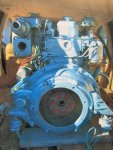
Always nice to have a few pics - this is post reconditioning in 2003. It is now rather less photogenic! But the fuel filter shown (horrible for getting air into system when changing) has now been replaced with spin on type
 
J R Halstead sourced and fitted them - no idea but seemed it was no issue for him then. As I said, John Halstead is retired now and no longer does 4108 reconditioning. He called himself HMS (Halstead Marine Services) and was based in Brundall Harbour Riverside Estate but his business is now closed down. I see you are in Norfolk so may be worth a shot to snoop about and ask questions if nearby. If I remember correctly he worked with his son Sam. He may have made them up himself because he had comprehensive engineering machinery to reface head and regrind crank etc
 
Last edited:
Regarding corrosion on the Bowman HE for the 4108, I found this "The Bowman PE180-3483 heat exchanger unit features an aluminium LM6M body with a cupro nickel tubestack and neoprene end covers fitted. Bowman recommend NOT fitting zinc anodes because the tubes used in the construction of the heat exchangers are copper-nickel alloy, and as such they do not require a zinc anode. It is possible that if a zinc anode is fitted it can actually destroy the copper-oxide film built up by the tube as a natural defence, which can allow the tube material to be attacked. " So this is why the body corrodes so badly. Would a non-zinc anode be a good idea. Maybe a pure aluminium anode that is sacrificed before the aluminium body??
 
Top