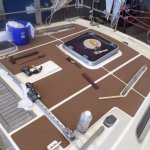
Replacing a teak deck with Kiwigrip

Kelpie

Well-Known Member
Joined
15 May 2005
Messages
7,766
Location
Afloat
Visit site
We're viewing a boat that has a teak deck that is at the end of its life. This fact is reflected in the price to some extent, but it's still a daunting prospect.
I've been watching the excellent videos from Mads 'Sail life' on Youtube, and I would want to copy what he has done- strip off all the deck fittings, then the teak, then find the areas of damaged core and cut these out and replace, and finally apply suitable primers/undercoats and then finish with Kiwigrip.

I would be looking to do this myself, so what I really need to get an idea of is the costs for the materials. The boat is a 40ft centre cockpit Westerly. It's a pretty big deck area to be fixing! I don't yet know what state the core is in, but I guess I have to assume the worst and budget to replace all of it.
Is there a better replacement material than balsa? How much more would this cost?
What might I be needing in the way of epoxy- it seems quite hard to estimate.

My very rough guesstimate is that this is likely a £2-£3k job, but a lot depends on how much core needs removed, and what else I uncover along the way.

Does this sound in the right ballpark?
 
OK, but don't for a moment assume it's an easy DIY job - if indeed it is a DIY job. To start with, the boat will need to be out of the water, with the mast and rigging removed. Then you'll need to remove all the deck fittings; you'll find that some of them are bolted with the nuts covered inside the boat in GRP which needs cutting off, and you'll no doubt find that some of them have fixings which are concealed under the headliner. The pulpit and pushpit will probably need to come off. If the balsa core is rotten, it will take a very long time to repair it. Working on your own, it will take months, or years, and for all of that time you won't be able to use the boat you've paid for. It would be infinitely easier to pay a bit more and get one without the teak - and it'd be cheaper in the long run.
 
This guy has a fairly good series of videos showing his method... removing the teak by reducing it to dust was a bit crazy but otherwise an interesting series..

It maybe that your core is ok ? perhaps just fill the holes and apply epoxy...paint etc....

or put the boat somewhere handy, build a tent....and away you go... no matter what it will take longer cost more etc but then the materials will not be too expensive and you get to really seal and bed all of your deck fittings etc....

best of luck..

BTW I repaired a million holes in my deck and primed and painted over them about 6 years ago and only now does it requires a repaint but I'd say the filler that I put on top of the fibreglass filler (P38?) has popped off in no more than about a dozen places...

https://www.youtube.com/channel/UCA-mL08YYfYN-8-trk07ORA
 
I know our boats Ali but we went through the same dilemma, so the question on costs, ares is a 55ft ketch the teak deck was the cheep thin teak with ply underside which had been glued down and riveted (960 holes to fill, but who's counting), time was the biggest cost, we then painted with two pack three coats with the final coat added non slip beads all less than 500 quid, so far the paint has faired very well, we live on board constant walking on deck, much cooler than teak and it can be pressure washed. We were going to use kiwi grip but went for the cheep option which has lasted over 4 years and still locking good and grippy, you can see the pics on Shearmyste.wordpress.
 
I replaced the treadmaster decks on my 1986 Westerly Sealord in 2014/5.
Sailed her from Chile to NZ ( and then back) for an overhaul that included the deck, osmosis, etc , etc, etc... it was a big overhaul...

Now... I can't comment on removing teak but we removed our old treadmaster ourselves... took maybe a week in total... didn't keep notes on time taken.
Considered Kiwigrip.... cheap... easy to apply... but we would have wanted a dark tint and they don't recommend that.... loses its 'grippyness'... light good for tropics... dark good for high lats and muddy seaboots....

Major issue with Kiwigrip would be neatly taping around fittings...

Employed the yard to apply the treadmaster.... no deck fittings needed removal... you can see in the pics that the chainplate staples had been removed but that was for replacement... originals were/are a major problem in Sealords. Didn't take that long... taking patterns and cutting out the new panels was the major item... not the glueing down.

So - bearing in mind that treadmaster in NZ is quite expensive v/v the UK and the labour was a major item what was the cost?

UKP 7,800 at today's rates.

If you trawl through this site https://yachtcamomile.co.uk/job-list/chainplates/ you will find some good info on replacing decking in the cockpit area.

What Oceanlord are you looking at?
 

Attachments

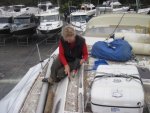
  • IMG_1821.jpg
    IMG_1821.jpg
    60 KB · Views: 4
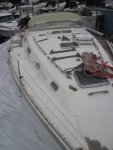
  • IMG_1832.jpg
    IMG_1832.jpg
    44 KB · Views: 5
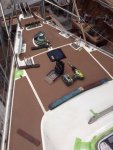
  • IMG_2464.jpg
    IMG_2464.jpg
    153.4 KB · Views: 3
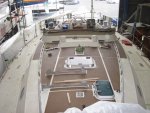
  • IMG_1946.jpg
    IMG_1946.jpg
    59.3 KB · Views: 3
  • IMG_2564.jpg
    IMG_2564.jpg
    183.2 KB · Views: 3
Fully re-coring a balsa cored deck, and making good to a high standard is a massive job.
I doubt £3k would cover the yard storage fees to DIY it.

I would suggest a specialist survey to scope the job. Hopefully most of the balsa will be sound.
Also you need to know exactly how the deck was built. What's cored, what's solid, how thick, everything.
It's structural.
 
Bit of a 'how long is a piece of string question'. It all depends on whether there is in fact any core damage from leaks through where the screws went through the deck (assuming it is screwed)(Deck will be a 5-6mm fibreglass layer on top of the core with about the same or slightly less the other side). Are there any obvious 'spongy' areas? The only way you may find out is by taking up the teak deck. If there are no damaged, or only a few very small areas then your budget maybe fine. If it's a case of major areas of deck needing to be re-cored it could be a lot more and take a lot of time. More on the time side if you are doing it yourself. Worst case could be months and several thousand more depending what is lurking. So reckon it's a chance thing and you could be getting a bargain or end up spending more than it's price has been reduced in fixing it.
 
Thanks for all the replies.
Am I right in thinking that Westerly used plywood with teak on top? A bad thing from the point of longevity, but perhaps a bit better for what I intend to do?
I'm viewing the boat tomorrow so you never know, it might look better than it does in the photos...
 
Am I right in thinking that Westerly used plywood with teak on top? A bad thing from the point of longevity, but perhaps a bit better for what I intend to do?
I'm viewing the boat tomorrow so you never know, it might look better than it does in the photos...

Some Westerly yachts had teak decks constructed from thin teak glued on to a ply substrate, but I think later boats used solid teak planks (originally 10mm thick). However, as I posted earlier, I think all the fittings are installed on top of the teak, and this means removing everything to remove the teak - pulpit, pushpit, cleats, fairleads, stanchions, genoa tracks, etc. It's a huge job, much of it requiring 2 or more people.

Edit: If the boat is this 1984 Sealord, I'd walk away, there's massive work needed. https://www.yachtworld.co.uk/boats/1984/westerly-sealord-39-3500385/
 
Last edited:
Quite a few Oceanlords have already had their teak replaced with either Treadmaster or Kiwigrip and of the 42 (?) Sealords built only 2 had teak....

Given the choice of saving UKP8000 or buying a teak free boat ... I would look for the one without teak...
 
Knowing exactly how the teak deck is constructed is crucial before you can decide how much work is involved.

This is probably easy enough with a common model from Westerly, but after doing half a dozen 'easy ones' at the yard, I was a bit quick with the quote for the next job. It was a far east built boat and the teak was stuck down with a glue so strong that the teak came away in small shards and the remaining glue had to be mechanically removed, but was just soft enough to clog every sort of cutter or disk. We lost so much money. The realistic quote to do the deck in this particular boat would have been far in excess of its value.
 
I agree with the others, if you can find the 8 grand it is always better to go for a better boat, a boat with work already done. However this is a hypothetical better boat, Macbeth's boat of the mind, the OP has a real one in front of him.
How often do cracking examples come up, and will these old boats have other problems - or even the same ones lurking?

If it is the boat mentioned in post 14 it is not a total stinker. If the deck feels ok, on survey, and there is no sign of water below or chainplate problems, one approach is to do a bit of remedial stuff and go sailing. Poor teak decks do not sink sailing dreams, nor do saggy headlinings, milky windows or jaggy varnish.
The counsels of perfection do scupper people who look at Mad Mads and think "I could do that" when often they can't.

"One man's hopeless boat is another man's buying opportunity"

Who knows? That boat might end up going for nearer 20k than 30k in which case you could take it on a big trip, sell it for 10, and still have had your monies worth. Or after the big trip you might say "I love it, I think I will replace that deck"
Right now you might save the 8 grand for sails and rigging and set off.
 
Last edited:
Is it possible to a specialist survey of the deck core? It should be possible to drill an array of holes underneath to assess if the core is damaged.
 
Top