
Replacing a gps antenna for Raymarine C80

Cookie Jar

Well-Known Member
Joined
1 Nov 2016
Messages
109
Location
Fresh and Salted waters
Visit site
Good morning everyone,

My "new to me" boat came with a Raymarine C80, but completely bare... so it's only the display and a few charts.
Later down the line I will probably replace it, but right now it would be great if I can get the plotter function working, as the charts that it came with are exactly what I need.
I have found a couple of older threads about this recommending one specific GPS antenna (Evermore SA-320), but since there are probably new things on the market and I have never owned a chartplotter before, I know absolutely nothing about compatibility, number of channels (12, 48, 66?!), baud rates and other technical details, so... you can you help me out here and recommend one that is not going to cost me a fortune?

Additionally, I have seen that most GPS antennas come with open ended wires... how do you connect that to the inputs available in the C80?
Pic below:
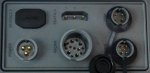
C80 connectors.jpg

Thanking you in advance for any help on this,
Cookie Jar
 
Your bottom right fitting says NMEA. What I would do is :
Find on ebay the cable that will fit in there, then to the other end of the cable you can connect a NMEA GPS Aerial, plenty available on ebay or Digital Yacht sold me the one to replace my original Raymarine GPS Aerial. In fcat the Digital Yacht one worked fine blutacked vertically in a locker down below so no difficult lengths of cable to run, Cant recall whether it also required a power source, but it may well get that through the same NMEA cable.
Why did the person selling you the boat not also leave you with the cables.
If you have an marine electronics company near you that fits new electronics they may well have the exact cables and old GPS aerial that you need.
 
You can either connect a GPS receiver to the Seatalk connector at the top (3 pins, elongated D) or the NMEA port at the bottom right (5 pins, round). There might also be some Seatalk2 options (blanked off, top left) but I've only ever used Seatalk and NMEA.

The easiest would be Seatalk as you can use standard 2.8mm spade terminals on the Seatalk port. Just crimp/solder the spades onto the ends of the three wires (you need to connect some of the wires together if you buy an RS125) coming from the GPS. NMEA is more complicated as you really need the Raymarine plug and cable R08004 as connecting to the pins without it will not be easy. The cable is available on line sometimes but tends to be expensive.

If you don't have the NMEA cable, then you could go for an eBay Raystar RS125 as that will connect easily to the Seatalk port.

Richard
 
Last edited:
I would get a standard NMEA 0183 receiver, such as the aforementioned Evermore unit. This will work with the plotter and can also be connected to a DSC VHF or other possible future upgrades/additions. You will of course need the cable, there are a couple on Ebay.

The receiver will need a 12v power supply, best taken from the same switch as the plotter, suitably fused. There are then just two wires to connect to the Raymarine NMEA input cable. If you have, or fit, a DSC VHF these same two wires can be connected in parallel to the GPS input of the VHF.

As mentioned in post #2 you should be able to stick the receiver to the underside of the deck, rather than running cables throughout the boat.
 
There's no antenna connector, so you cannot connect a GPS antenna directly. You need a GPS receiver which does the decoding and outputs either Seatalk (Raystar 120/125 receiver integrated into antenna puck or RayNav 300 with separate antenna and receiver - all are getting hard to find and therefore often pricey) or NMEA 0183 (cheaply available on Amazbay, or the somewhat pricier Evermore you mention).
 
Whats wrong with the original antena? I had a probelm with a 530 plotter last year loosing position. After a search a on this site I found out that a common problem with the raystar 120 antenna is that there is an internally mounted battery that runs out. The only solution proposed by dealers was to replace the antenna completely. I found a few people on the internet who had opened the units and replaced the battery.
I succeeded in doing this. The battery is a standard disk type available for a few Euro in Maplin. The only difficuly is that Ray star Weld on terminals which allow the unit to be soldered to the PCB. I simply snipped off the old battery at these welded terminals. Its difficult to solder leads to the battery so I created a small spiral of wire on the end of a positive and negative lead. I tightly bound the wire spirals to the +and - sides of the new battery using insulation tape. If you do this tightly it creates a spring effect and maintains contact, binding the spiral to the battery. I then soldered the leads to the PCB close to the old welded terminals. The fix has worked fine and I have had 8 months use without issue.
I met another club menber at the week end who has the same issue with a Rae Marine antenna.

It might be worth checking to see if you have a battery battery in your unit..

Regards , Kinsale 373
 
I've got a Raymarine C80.
A few points:

1) it isn't a GPS antenna, it's a complete GPS system that simply sends position (and other) data to the plotter.
2) The C80 will use standard NMEA data from any suitable standalone GPS system, or Seatalk data from a Raymarine GPS. However, NMEA data are a poor relation in the Raymarine ecosystem, and you won't get all the functionality (e.g. satellite visibility etc.) from a non-Seatalk device.

I know the latter because although I have a Raymarine GPS, it is used in NMEA mode to provide data to the VHF. I'm pretty sure that I could improve on that , but I didn't install it and I'm reluctant to mess with it!
 
Top