Repairing a flow soldered PCB

Ian_Edwards

Well-Known Member
Joined
9 Feb 2002
Messages
2,222
Location
Aberdeen Scotland
Visit site
My favorite head torch partly failed, the red LEDs still work, but the white LEDs no longer switch on.
I've taken it apart, and it looks like a very small surface mount resistor has fallen off the circuit board. I only found it by accident, it's very small, I need tweezers to pick it up.
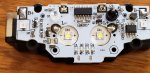
Head Torch PCB.jpg

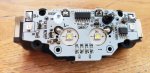
It's the small resistor 1R0, which should be soldered into the pads marked R5.
I'm trying to decide the best way to solder it back in, so far all I can come up with is the glue the resistor back in place with a dab of super glue, then try and put a little solder on the ends of the resistor, without getting everthing too hot to and knackering the PCB.
Any better ideas? Preferably from someone how has done or attempted a repair like this before.
The photo is magnified by about x2
 
With a good soldering iron I would have no concerns about soldering that back into place. Nothing near that point will be temperature sensitive. Better clean off the old solder and apply new.

If you don't like the idea of the smd just buy a conventional replacement and solder that to the pads - plenty of space there
 
I agree that it is possible to repair with a good soldering iron, which is a good thing because it is less likely that you'd have the correct heat gun to hand. Fine tip required. However, I'd stick with the SMD as 1) you already have it and 2) we don't know the whole story when it comes to the packaging constraints.

I would bet that it was assembled with a dot of superglue in the first place, to hold the components in place between the pick-and-place op and the application of solder paste and heat. You'll probably need to clean the area with isoprop or acetone first.
 
Quote "It could of course have got hot and fallen off for a good reason. One ohm resistors are often used as a fail safe device." End quote.
I did think of that, there's no sign of heat damage to the PCB, or my forehead, which is in close proximity to the PCB.
When I look at the board, it's bent into a curve, bowing out in the middle as you look at the photo.
It looks as if the torch has been assembled by inserting the 2 battery tabs, bending then over and the soldering them. This puts the soldered joints on the resistor in tension, and if the soldered was dry, then I could see it failing, first intermitantly, then completly.
I'll have a go tomorrow, to late tonight to start soldering.
 
A manufacturing defect I'd think. Why would both ends desolder themselves simultaneously? If one end had failed, then no current would flow, so no heat generated, which would indicate that at least 1 end was semi dry for a period of time, exactly as Ian said.
With that amount of resistance, if the resistor had been lost, I'd happily try just a link across R5, (in an attempt to keep an ROV on hire), back in the day :) .
 
It looks as though the board was hand soldered. There is far more solder on each joint than there would be with a solder-mask, paste and reflow assembly. Also the 2 pin components don't sit square on their pads. The solder remaining on R5 pads looks like the remains of a dry joint. I agree that it is likely it just fell off.

As others have said, a fine tipped, clean iron and a steady hand should be enough to effect a repair. Bluetak is useful for holding the PCB steady on a worksurface. A wearable magnifying lens will help if you have one. Lead solder is easier to use than lead free but either will be fine so long as the iron temperature is suitable. Have a good look for other dry joints while your at it.
 
Head Torch PCB- repaired.jpg

The resistor is on, not quite square, but it's on and making contact.
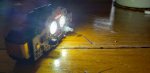
and better still the head torch is now working.

head torch working.jpg

The tube of super glue I had was solid, so I had a go free hand, I found it very difficult to manipulate the resistor, soldering iron and solder, keeping the resistor in the right place, and not getting everthing too hot and damaging the board.
When, after several attempts, I got it connected ..... good enough.
 
The right hand joint in your picture looks as though it hasn't flowed well (dry). But it may have flowed well underneath where the picture doesn't show. The angle is unlikely to be a problem. Well done.
 
Last edited:
View attachment 136775

The resistor is on, not quite square, but it's on and making contact.
and better still the head torch is now working.

View attachment 136776

The tube of super glue I had was solid, so I had a go free hand, I found it very difficult to manipulate the resistor, soldering iron and solder, keeping the resistor in the right place, and not getting everthing too hot and damaging the board.
When, after several attempts, I got it connected ..... good enough.
A tip I learned from my model aeroplane days; keep your cyanoacrolate (superglue) in the fridge.
 
I found it very difficult to manipulate the resistor, soldering iron and solder, keeping the resistor in the right place, and not getting everthing too hot and damaging the board.

Rather than trying to hold tweezers, solder & the iron the usual way is to get a bit of solder on one pad first - melt it on & slather it around. Then hold the component in place with the tweezers & touch the metal end with your soldering iron. It will melt the solder quite easily. Once one end is down you can do the other end at leisure.

Solder paste makes it even easier, but it is expensive & doesn't last long before it goes hard.
 
My favorite head torch partly failed, the red LEDs still work, but the white LEDs no longer switch on.
I've taken it apart, and it looks like a very small surface mount resistor has fallen off the circuit board. I only found it by accident, it's very small, I need tweezers to pick it up.
View attachment 136750

It's the small resistor 1R0, which should be soldered into the pads marked R5.
I'm trying to decide the best way to solder it back in, so far all I can come up with is the glue the resistor back in place with a dab of super glue, then try and put a little solder on the ends of the resistor, without getting everthing too hot to and knackering the PCB.
Any better ideas? Preferably from someone how has done or attempted a repair like this before.
The photo is magnified by about x2
My first job was as a fitter wireman at Plaessy Avionics, way back the 80’s. We all went on a week long course to learn how to solder correctly.
Chip resistors are tricky to solder and if too much heat is applied, the contacts leach. This may have happened to your example. The way to test is to re-wet the resistor terminals, but only back onto the circuit board, or you’ll overheat the resistor. First rewet the PCB contacts and clean excess solder off with flux and solder braid. Clean the PCB with isopropyl alcohol and put a drip of flux on each contact. Hold the chip resistor in place with the tip of some tweezers. Clean and wet a fine tipped iron, apply tip to PCB and add a blob of solder between tip and resistor contact. If the solder flows into the chip, you’re good, if not, you’ll need another resistor. The heating should be just enough to flow the joint and then immediately remove the iron. Do NOT blow on the joint - that will encourage it to go dry. A nicely wetted solder joint will be uniformly shiny. Good luck
 
Top