Renogy Battery Monitor Wiring

aqua_sax

Well-Known Member
Joined
21 Jul 2006
Messages
134
Location
UK South Coast
Visit site
I am in the process of fitting a Renogy Battery Monitor (see here) and am not sure where to place the shunt. Renogy show the wiring for a single battery which is simple (even I can understand it):
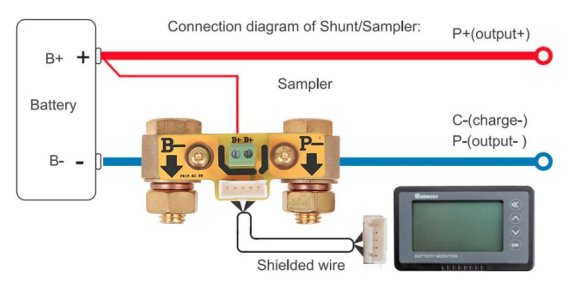
Renogy single battery wiring.JPG

The key point is that the battery negative is the only thing that connects to the B- stud on the shunt. But where does the shunt go when you have two batteries, one engine starter and one house (domestic) battery? I have a BEP VSR (voltage sensitive relay) that controls the charging and the wiring is set up as in this BEP schematic but without the optional extras:
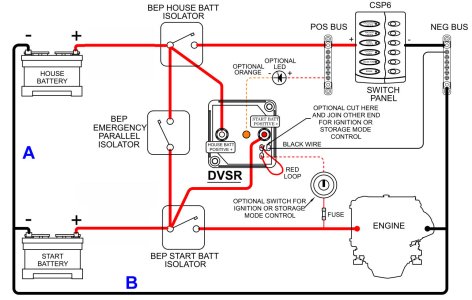
Battery wiring.jpg

I want to monitor the amps in (from engine alternator and solar panel when I get round to fitting one) and out of the house (domestic) battery. Does the shunt go in position A or B? Most of the recommendations I have seen suggest A is the correct position (B- to house battery negative, everything else negative including the engine start battery onto the P- stud), but I can't get my head round how that picks up the charging amps from the engine alternator going into the house battery when the engine is running.

Any advice much appreciated.
 
I can't get my head round how that picks up the charging amps from the engine alternator going into the house battery when the engine is running.
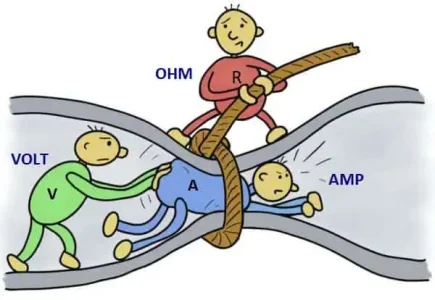
I can’t see why it wouldn’t. If you think of the shunt as a “flow meter” and electrons as though it’s water flowing in a pipe - it is measuring the flow into or out of the battery. The analogy is not perfect but it might help you picture it.
 

Thanks. I wonder is any of you would care to elaborate on how the house battery and only house battery charging amps gets picked up? I've just re-read the BEP VSR manual's description of what it does:

DVSR Operation Explained -

Charging: The DVSR is connected
between two battery banks. When the DVSR senses a charging
voltage (13.4VDC or 26.8VDC) on either of the banks, it automati-
cally activates and joins the two battery banks after a short delay (5
seconds), so they are charged as one battery bank.

Isolation: When the DVSR senses that batteries are not being
charged (voltage drops to 12.8V DC or 25.6V DC) the DVSR
deactivates following a 20 second delay, separating the combined
battery banks into two isolated banks.

I had thought it preferentially charged the engine battery until it was fully charged and then paralleled the two batteries but reviewing the above it seems the VSR operation is more basic, it just parallels the batteries once it senses 13.4V anywhere (which I presume happens pretty soon after starting the engine) meaning the batteries are now seen as one bank, albeit a bank of two batteries. Does placing the shunt at position A mean it only detects the charging current passing to/from the house battery, any charging current to the engine battery gets ignored?
 
Thanks. I wonder is any of you would care to elaborate on how the house battery and only house battery charging amps gets picked up? I've just re-read the BEP VSR manual's description of what it does:
>>>>>>
I had thought it preferentially charged the engine battery until it was fully charged and then paralleled the two batteries but reviewing the above it seems the VSR operation is more basic, it just parallels the batteries once it senses 13.4V anywhere (which I presume happens pretty soon after starting the engine) meaning the batteries are now seen as one bank, albeit a bank of two batteries. Does placing the shunt at position A mean it only detects the charging current passing to/from the house battery, any charging current to the engine battery gets ignored?
At point A it sees only the current flowing into or out of the house battery .
At point B it will see the total current flowing into or out of both batteries.

It is important that you make no other connections to the house battery negative as they would by pass the shunt. All negatives, loads or from charging sources, should be connected to the negative bus bar

You are correct about the VSR operation. It will parallel the batteries once the volts rise to 13.4 which will usually be almost straightaway

I would fit a good quality fuse ( 1 amp) in the wire from the house battery positive to the shunt, as close to the battery as possible. A blade fuse would be suitable.
 
Last edited:
At point A it sees only the current flowing into or out of the house battery .
At point B it will see the total current flowing into or out of both batteries.

It is important that you make no other connections to the house battery negative as they would by pass the shunt. All negatives, loads or from charging sources, should be connected to the negative bus bar

You are correct about the VSR operation. It will parallel the batteries once the volts rise to 13.4 which will usually be almost straightaway

I would fit a good quality fuse ( 1 amp) in the wire from the house battery positive to the shunt, as close to the battery as possible. A blade fuse would be suitable.

Thanks, that is extremely clear and helpful.
 
Others have confirmed that 'A' is the correct position, but not why.

For our purposes, electricity always flows in a circuit. (Break that circuit at any point and it will stop.)

If a battery has, say, 10 amps flowing out of the battery positive cable to power something, then there must be 10 amps flowing back from the load into the battery via the negative cable. (And vice versa if the battery is receiving a charge of 10 amps.)

If you have two batteries they will each have on their negative terminal and the (assumed single) cable immediately connecting to it exactly the the same current (amps) as on their positive terminal (though the reverse polarity (volts)), regardless of what current the other battery is doing or not doing.

If their cables are joined through a common cable to the loads and/or alternator (the common negative at B in your diagram), that common cable will carry the sum of the two currents (bearing in mind that one current will be a minus figure if one is discharging and the other charging).

So the negative cable at A will see only whatever current the house battery is putting out (discharging) to power a load or receiving (charging) from an alternator or mains charger . The negative cable at B will see the current discharging from (or charging into) the house battery and the current discharging from (or charging into) the engine start battery.
 
Others have confirmed that 'A' is the correct position, but not why.

For our purposes, electricity always flows in a circuit. (Break that circuit at any point and it will stop.)

If a battery has, say, 10 amps flowing out of the battery positive cable to power something, then there must be 10 amps flowing back from the load into the battery via the negative cable. (And vice versa if the battery is receiving a charge of 10 amps.)

If you have two batteries they will each have on their negative terminal and the (assumed single) cable immediately connecting to it exactly the the same current (amps) as on their positive terminal (though the reverse polarity (volts)), regardless of what current the other battery is doing or not doing.

If their cables are joined through a common cable to the loads and/or alternator (the common negative at B in your diagram), that common cable will carry the sum of the two currents (bearing in mind that one current will be a minus figure if one is discharging and the other charging).

So the negative cable at A will see only whatever current the house battery is putting out (discharging) to power a load or receiving (charging) from an alternator or mains charger . The negative cable at B will see the current discharging from (or charging into) the house battery and the current discharging from (or charging into) the engine start battery.

Thanks, you have put into clear words what I had sort of muddled in my mind to be the case.

As a sort of cross-check that I have got it right, am I right in assuming that if the house and engine batteries swapped position, then position A would monitor only the engine battery, and position B both batteries? And this has a practical implication: the battery you want to monitor has to be the 'end of the line' battery (with the shunt at position A) when there is a common negative?
 
Thanks, you have put into clear words what I had sort of muddled in my mind to be the case.

As a sort of cross-check that I have got it right, am I right in assuming that if the house and engine batteries swapped position, then position A would monitor only the engine battery, and position B both batteries? And this has a practical implication: the battery you want to monitor has to be the 'end of the line' battery (with the shunt at position A) when there is a common negative?

Yes.

The other ways of achieving the same thing (i.e. monitor the engine battery directly, rather than the house battery) would be by -
1) putting the shunt in the cable (very short link on left in the diagram) between the engine negative terminal and the cable from the house battery and which also goes via B to the engine; or
2) removing the connection (at the bottom of the diagram) between the engine battery (it also connects to the house battery negative cable) and the engine (actually starter solenoid), and putting a new connection (at the top of the diagram) between the house battery negative terminal/cable and the negative bus bar (on top right of the diagram (though in practice you probably wouldn't do this, as you want to keep the engine starting connections, both positive and negative, as short (and thick) as possible and avoid additional cable joints/connections if possible, because of the very high currents these cables carry (because the higher the current the greater the resistance of the cable and joints, potentially significantly reducing the high voltage you need to turn the engine fast and effectively).
 
LittleSister and ylop, thank you both for your clarifications. I think LittleSister can be allowed to simplify a bit in the interests of making things clear! The key point I think is what is flowing where, not which direction it is going in, but at the same time it is useful to be reminded electrons go the other way.

I don't in fact want to monitor the engine battery, I asked the question about swapping the batteries to establish that the battery to be monitored must be the 'end of the line' one. I can imagine a situation where the engine battery just happened to be behind the house battery, and so became the 'end of the line' battery, in which case the cabling would have to be adjusted so that the house battery became the end of the line one, ie the common negative would have to run first to the more distant engine battery, and then a link between the two batteries negatives run back again from the engine battery negative to the house battery negative, if that makes sense.
 
. . .The key point I think is what is flowing where, not which direction it is going in, but at the same time it is useful to be reminded electrons go the other way.

Conventionally, current flows positive to negative. Electrons actually flow the opposite direct. (Though when you get even deeper into it, there are apparently questions as to whether there are actually electrons 'flowing' as you'd imagine it.)
 
(Though when you get even deeper into it, there are apparently questions as to whether there are actually electrons 'flowing' as you'd imagine it.)

I am sure that is right. Modern physics isn't as simple as apples falling on heads, quite the opposite in fact, But there are times when simple analogies eg electricity flows like water with both pressure (voltage) and volume (current) are extremely useful for practical purposes.
 
I am sure that is right. Modern physics isn't as simple as apples falling on heads, quite the opposite in fact, But there are times when simple analogies eg electricity flows like water with both pressure (voltage) and volume (current) are extremely useful for practical purposes.
Quite right ..

Ohms-Law-cartoon.webp
 
Top