Removing toilet scale?

Ian_Edwards

Well-Known Member
Joined
9 Feb 2002
Messages
2,221
Location
Aberdeen Scotland
Visit site
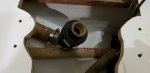
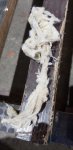
Fabric Bloking Toilet.jpgToilet Lime Scale.jpg

I've just had to replace the pump/macerator on the aft heads, a smelly unpleasant job if ever there was one!
The blockage was caused by some sort of synthetic fabric, perhaps some sort of sanatorium product. The motor is completely seized, I can't turn the shaft at all, I might be able to free when I disassemble it at home.
The picture above shows the lime scale build-up after 12 years of operation, which I don't think is excessive.
I'm aware that I need to use some form of acid to remove the Lime Scale, from vinegar right up to a strong Hydrochloric acid, the question is what strength of acid should I use?
The Tecma data sheet warns against using strong chemicals, and the motor/macerator assembly is expensive and the task of replacing it is, as I found out, is mechanically difficult, messy and smelly, so I don't want knacker the motor again by using to strong an acid..

Cheers Ian
 
Mechanical removal where you can and as gently as you can, the rubber pipes can be removed & if you bash them about most of the scale will just fall out. I don't know whether if you leave such components in a bucket of dilute hydrochloric or something for a day or two they'd be sufficiently descaled to make them operable again or whether that would damage them too much. All of the above is why it's getting more popular to install composting heads or separator heads, especially amongst liveaboards. I for one got fed up dealing with the fancy electric fresh water flushing into a 200L waste tank toilet that my boat came with, now I have a large tool locker where the waste tank was and a separator toilet that's no trouble whatsoever & never will be. So if the people who regularly use the boat can wrap their heads around going down that route that would be my suggestion FWIW...
 
For clarity, I think that the motor/Macerator is probably jammed solid with strands of fabric (1st photo) wrapped around the shaft, nothing to do with lime scale. By disassembling the Macerator part, I can probable remove the fabric from the shaft between the macerator disk and the housing . With luck the motor will spin again, and may even work, but when stalled the motor takes over 40 amps, so there may be damage to the windings.
I guess I could just dilute a proprietor lime scale remover before is pour it into the bowl, but how much should I dilute it?
I'm really looking for some rule of thumb on how strong an acid I should use. Leaving it in the system for a while, or using several application isn't a problem.
 
I've just had to replace the pump/macerator on the aft heads,

I'm aware that I need to use some form of acid to remove the Lime Scale, from vinegar right up to a strong Hydrochloric acid, the question is what strength of acid should I use?
The Tecma data sheet warns against using strong chemicals, and the motor/macerator assembly is expensive and the task of replacing it is, as I found out, is mechanically difficult, messy and smelly, so I don't want knacker the motor again by using to strong an acid..

Cheers Ian

Thetford's Aqua Clean is recommended. As far as I can discover this is citric acid based. Citric acid is a weak organic acid but somewhat stronger than acetic acid (vinegar is a fairly dilute solution of acetic acid)

If anything stronger is needed a lactic acid based descaler might be suitable ( I have just bought some Kilrock Multipurpose descaler ( for small appliances and shower heads ) from Aldi which is Lactic acid based.

The next strongest of the weak organic acids used as a descaler is formic acid which is contained in some other Kilrock products.

If all the weak organic acid based descalers fail then the next choice is a sulfamic acid based central heating boiler descaler such as Fernox DS3
 
Its Sulphatic Acid; I have been using it for years to dissolve calcium based deposits. Its more gentle than hydrochloric acid.

I assume you mean sulfamic acid, which I have mentioned in my previous post and often recommend as a descaler rather than hydrochloric acid.

However according to the link you posted Domestos Toilet cleaner Zero Limescale descaler contains hydrochloric acid.
 
I assume you mean sulfamic acid, which I have mentioned in my previous post and often recommend as a descaler rather than hydrochloric acid.

However according to the link you posted Domestos Toilet cleaner Zero Limescale descaler contains hydrochloric acid.
Yes, Sulphamic acid and Hydrogen Chloride.
 
I hate to lecture on such a grubby subject....
After various Greek/ Spanish holidays we have long adopted an " only -biological" rule for the heads. ONLY human waste or seawater. Nothing else. Nappy bags for any paper involved.
Anybody who reports blocked heads gets to sort out the blockage. Full stop. Assisted by the previous user!
Dilute warm vinegar helps, Mechanical scale removal also?

An avoidable problem not comprehended by landlubbers.....
 
We put white vinegar down both heads every time we leave the boat for more than a couple of days. seems to do the trick.
 
Given the picture, if it has only scaled to that thickness in 12 years, it's got about another 36 years to go before it is so narrow that it will fail.

I removed the pipes from 2 heads in a 1995 Moody 44 in 2006/7 and both had reached the point where a 38mm pipe was down to about 15mm due to scale. No amount of a variety of acids had any significant effect on the scaling.

I had to cut the pipes to get them out, so removing the scale thereafter was pointless. However, bashing a section of pipe on the pontoon did break up the scale and it fell out. So, if you can get them out in one piece, a good bashing should improve things, assuming they need improving, given that they don't look so bad.
 
Only vaguely related but I had my Baby Blakes apart cleaned and reassembled on Saturday. Literally a crappy job but I found chipping the scale was the most effective method. Happy to report it's back where it should be and working like new :)
 
Only vaguely related but I had my Baby Blakes apart cleaned and reassembled on Saturday. Literally a crappy job but I found chipping the scale was the most effective method. Happy to report it's back where it should be and working like new :)
Yes, my experience too. As a long-time exponent of dosing toilets with hydrochloric acid, my experience is that it works well as a preventative on a regular basis. But to clear long-term scaling in hoses and tanks takes a huge amount of acid. It is far quicker and more effective to use mechanical methods if possible. It takes massive time and effort to remove my hose, so chemicals are better there, but a combination of a wooden stick and a water hose sorts my holding tank in half an hour.
 
The motor is the most expensive part of the unit. When the one on my Matromarine toilet packed up I found that it was not much more expensive and a lot more convenient to buy a complete toilet from Force4, including shipping to Spain! A relatively weak acid solution will keep the scale down but won't clear blockages from synthetic material like sanitary products.
 
The motor is the most expensive part of the unit. When the one on my Matromarine toilet packed up I found that it was not much more expensive and a lot more convenient to buy a complete toilet from Force4, including shipping to Spain! A relatively weak acid solution will keep the scale down but won't clear blockages from synthetic material like sanitary products.
Exactly my findings with my Jabsco Lite. A new motor assembly, smallest component that could be bought to fix the macerator drive and bearings, was more expensive than a new Twist-n-lock from my local chandler in Greece.
 
Exactly my findings with my Jabsco Lite. A new motor assembly, smallest component that could be bought to fix the macerator drive and bearings, was more expensive than a new Twist-n-lock from my local chandler in Greece.

In my case, the replacement from Force4 was exactly the same electric unit as the Matromarine. I was quoted £155 + IVA and shipping for the motor, which would mean disassembling everything and rebuilding, or £220 inc. for a complete, ready assembled unit delivered to Spain.
 
I occasionally flush vinegar through the heads but I doubt whether it's in contact with the scale long enough to loosen it,

What is needed is some way of filling the outlet hose with vinegar and letting it stand for a while.
 
Given the picture, if it has only scaled to that thickness in 12 years, it's got about another 36 years to go before it is so narrow that it will fail.

I removed the pipes from 2 heads in a 1995 Moody 44 in 2006/7 and both had reached the point where a 38mm pipe was down to about 15mm due to scale. No amount of a variety of acids had any significant effect on the scaling.

I had to cut the pipes to get them out, so removing the scale thereafter was pointless. However, bashing a section of pipe on the pontoon did break up the scale and it fell out. So, if you can get them out in one piece, a good bashing should improve things, assuming they need improving, given that they don't look so bad.
I remember arriving in Lefkas to a " ah good the plumbers here" many years ago when we regularly sailed on a friend's Moody 425. The heads discharge pipe which went up behind the vanity unit was almost solid so I stripped down to the waist and struggled to get the pipe out, which we eventually managed. After giving it a severe thrashing on the quayside ,thus avoiding having to buy a new lot, we set off and it never blocked again till we rejoined the boat 2 years later in the BVI.
 
I remember arriving in Lefkas to a " ah good the plumbers here" many years ago when we regularly sailed on a friend's Moody 425. The heads discharge pipe which went up behind the vanity unit was almost solid so I stripped down to the waist and struggled to get the pipe out, which we eventually managed. After giving it a severe thrashing on the quayside ,thus avoiding having to buy a new lot, we set off and it never blocked again till we rejoined the boat 2 years later in the BVI.

The biggest problem, after chucking things down the loo like wetwipes, is people using bleach to 'keep it clean'.
Bleach reacts with seawater, preciptating all the scale & salts out. It has no place in a marine, seawater toilet.

If things are clean & the pipes are clear, an occasional flush with cleaning vinager will keep things moving.
 
Top