Removing Paint

Jomac

Member
Joined
12 Apr 2017
Messages
31
Visit site
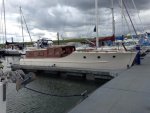
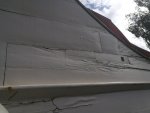
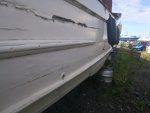
I'm seriously considering purchasing a 1947 Broads Cruiser which needs a lot of TLC and caulking above the waterline. Originally the hull above the waterline was simply varnished and over the years has been painted. I would like to strip off the old paint and restore the varnish finish. Is this a 'doable' exercise or am i asking for much unwanted work? Paint stripper is really out of the question for being too slow and ineffective so it would be a blow torch and scraper unless there is an easier way?

TIA
 

Attachments

  • 4594828.jpg
    4594828.jpg
    43 KB · Views: 43
  • 4594831.jpg
    4594831.jpg
    45.6 KB · Views: 42
  • 5057924.jpg
    5057924.jpg
    167.3 KB · Views: 35
You won't know which is better until you try and paint stripper can be effective with many types of paint. If heating to remove paint then use an electric hot air blower rather than a blow torch. Much safer and more consistent.

Whether you can get it back to a good enough surface to varnish you will only find out when you get some paint off. However if the rest of the boat is perfect and you have nothing else to do on it might as well spend the time on the hull planking! Suggest if it is good enough to be worth finishing bright you use a modern UV resistant 2 part woodstain such as Cetol No7 over HLS as then you will stand a fighting chance of it staying looking good for a few years.
 
Last edited:
Personally I would say 'leave it alone'! I doubt you can remove all the traces of the paint without seriously removing the surface of the planks to get rid of the paint that has sunk into the grain of the timber. Bear in mind that a varnished hull will 'absorb' the heat of the sun. The old timber is 'conditioned' to handle the white paint; new varnish will increase the heat of the topsides and could reduce the moisture in the timber. You would have to address the attack of the UV. White topsides are the best solution for stabilising old timber - and frankly I think she would look better as painted.
 
Personally I would say 'leave it alone'! I doubt you can remove all the traces of the paint without seriously removing the surface of the planks to get rid of the paint that has sunk into the grain of the timber. Bear in mind that a varnished hull will 'absorb' the heat of the sun. The old timber is 'conditioned' to handle the white paint; new varnish will increase the heat of the topsides and could reduce the moisture in the timber. You would have to address the attack of the UV. White topsides are the best solution for stabilising old timber - and frankly I think she would look better as painted.
I'd been hesitating about posting exactly the same thoughts - Tillergirl has more experience than I, so I'm glad he did so! There might also be issues with the underlying wood having become discoloured while previously varnished; it might take the removal of quite a lot of wood to restore a good varnished appearance.
 
I'd been hesitating about posting exactly the same thoughts - Tillergirl has more experience than I, so I'm glad he did so! There might also be issues with the underlying wood having become discoloured while previously varnished; it might take the removal of quite a lot of wood to restore a good varnished appearance.

Besides, it seems from the picture that the topsides have been painted for quite some time. It looks like there is still plenty of wood to varnish with the grab rails and the sides of the coach house.
 
Varnished hulls usually get painted (often white) once the timber has become discoloured in places. You could do a lot of work to find that she'd be better painted after all....
 
A lot of very sensible and logical advice here guys and very much appreciated. I simply took a step back and looked at the pictures and imagined what each suggestion would look like. The planking above the waterline will need caulking and there is a couple of areas which will need re-planking so I will get a chance with a little paint stripping.

Initially I had thought about getting the boat back to its original finish as per the 1947 launch picture. I had expected after removing paint to find area's where the paint had gone deeper into the wood. A long while back I restored a pine kitchen table which had been painted. After stripping i used an electric plane to lightly skim the wooden surface, I simply wondered if that method could have been used here?

What settle dit here was the comment by Poignard "If you want to improve the boat's appearance without a great deal of work I would suggest stripping and varnishing the rubbing strakes " and had to agree that by doing this, it would break up the vast area's of paint.

If only the inside was as easy :o)
 
A lot of very sensible and logical advice here guys and very much appreciated. I simply took a step back and looked at the pictures and imagined what each suggestion would look like. The planking above the waterline will need caulking and there is a couple of areas which will need re-planking so I will get a chance with a little paint stripping.

Initially I had thought about getting the boat back to its original finish as per the 1947 launch picture. I had expected after removing paint to find area's where the paint had gone deeper into the wood. A long while back I restored a pine kitchen table which had been painted. After stripping i used an electric plane to lightly skim the wooden surface, I simply wondered if that method could have been used here?

What settle dit here was the comment by Poignard "If you want to improve the boat's appearance without a great deal of work I would suggest stripping and varnishing the rubbing strakes " and had to agree that by doing this, it would break up the vast area's of paint.

If only the inside was as easy :eek:)
I think that the problem with an electric plane would be that the surface isn't flat, either along or across the planks. So your plane would take too much off the convex surfaces and too little (or none) off concave surfaces.
 
I agree that the rubbing strakes should be varnished. Should never have been painted (I think). But AP is right. Don't use an electric plane. Too much of a brute even when used with someone with practice. Of course it will be a bit of a chore. I hope that whoever painted the rubbing strakes just painted over the existing varnish in which case the paint won't have penetrated beyond the varnish and so you won't have (much of) a problem with the paint sinking into the grain. That argument applies to the planking of course but I would revert to the argument that white paint will be far more 'sympathetic' to old timber.
 
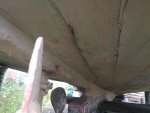
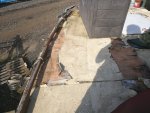
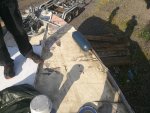
It seems the best olution to this is to strip back the strakes and concentrate on the other varnished parts of the boat. I must admit I do like to see natural wood varnished and this boat has a style very similar to the Gentlemans cruisers of the early 20's. The previous owner for reasons unknown has also clad the deck to the front with non marine ply which has absorbed water and the layers are separating, and from the ply clad to the stern of the boat, it looks like he has also covered the deck with a horrible plastic layer that looks like thick commercial lino. I did ask him if the deck was sound underneath and he said yes. Honestly some people!

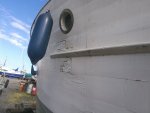
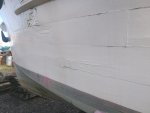
Thes pics are of the obvious bad bits outside, looking at a couple of places, I suspect the rotten wood will extend much further under the paint.
 

Attachments

  • IMG_20210803_162523.jpg
    IMG_20210803_162523.jpg
    366.6 KB · Views: 28
  • IMG_20210803_162620.jpg
    IMG_20210803_162620.jpg
    346.4 KB · Views: 25
  • IMG_20210803_162533.jpg
    IMG_20210803_162533.jpg
    256.1 KB · Views: 25
  • IMG_20210803_162702.jpg
    IMG_20210803_162702.jpg
    552.6 KB · Views: 25
  • IMG_20210803_162707.jpg
    IMG_20210803_162707.jpg
    351.2 KB · Views: 24
  • IMG_20210803_162740.jpg
    IMG_20210803_162740.jpg
    343.3 KB · Views: 24
  • IMG_20210803_162752.jpg
    IMG_20210803_162752.jpg
    378.5 KB · Views: 25
  • IMG_20210803_162742.jpg
    IMG_20210803_162742.jpg
    330 KB · Views: 24
  • IMG_20210803_162754.jpg
    IMG_20210803_162754.jpg
    319.7 KB · Views: 23
  • IMG_20210803_162804.jpg
    IMG_20210803_162804.jpg
    369 KB · Views: 23
Currently I'm looking at a few YouTube video'sto see what skills i need to swot up on before I start.
 

Attachments

  • IMG_20210803_162807.jpg
    IMG_20210803_162807.jpg
    411.4 KB · Views: 18
  • IMG_20210803_163103.jpg
    IMG_20210803_163103.jpg
    289.1 KB · Views: 19
  • IMG_20210803_172928.jpg
    IMG_20210803_172928.jpg
    663.8 KB · Views: 19
  • IMG_20210803_172933.jpg
    IMG_20210803_172933.jpg
    573.2 KB · Views: 19
  • IMG_20210803_172940.jpg
    IMG_20210803_172940.jpg
    394.7 KB · Views: 20
  • IMG_20210803_173112.jpg
    IMG_20210803_173112.jpg
    672.4 KB · Views: 20
  • IMG_20210803_173650.jpg
    IMG_20210803_173650.jpg
    361.9 KB · Views: 21
Frankly – my advice – don't buy the boat. There looks to be a massive amount of work and the repairs that are visible have been badly carried out and are going rotten again.

If you must buy the boat get a good survey first by a surveyor used to wooden boats, so that you know what you are letting yourself in for.

George
 
There look to be a significant number of planks that will need to be replaced. I would worry about the state of the ribs. If you don’t have any boat building experience that will be very challenging and time consuming. You absolutely need a good survey.
 
Frankly – my advice – don't buy the boat. There looks to be a massive amount of work and the repairs that are visible have been badly carried out and are going rotten again.

If you must buy the boat get a good survey first by a surveyor used to wooden boats, so that you know what you are letting yourself in for.

George
The pictures i posted are the worst of what i saw but i understand your concerns and share them. Let me explain what i have done and what i have gathered so far. The boat came out of the water something like 3+ years ago. During the 11 years the owner used a professional shipwright before he retired, I've seen past receipts. I took a friend who is a professional skipper and knows my engineering skills, there were no adverse comments. I was at the boatyard a good hour before the owner arrived and the marina manager knows the boat and the owner very well, I asked him if he knew off any issues i should look at, his reply was, other than what i can see, he wasnt aware of anything severe. The boat is advertised for £2,000, the marina manager said that should I offer around half of this, £1,000 there is a good chance it will be accepted. Most issues i saw were well above the waterline mainly deck level and above. But i am no expert here
 
There is no way that you can strip that back and get a good varnish finish on it. The planks are all poor patch work. Timber types are likely to be different. Any original planking is likely to wet/soft/black around fastenings.

The leaking deck suggests a lot of rot below, and the areas of rotten planks are bound to be back up by rotten frames, carlings and beam shelves. Unless you have you years to work on it, or are a professional/semi-pro boat builder it is going to cost a lot of money. Personally, I wouldn't consider taking it on.

I have restored two classic boats, one of 33 feet and one of 50. They were both in commission (mostly) when I bought them, and there were still some rotten planks/frames/carlings and deck shelves, but they were generally sound. They each took about 5 years to get decently sound, and another 5 to get close to proper yacht finish. The 33 footer spent a year and half in a barn, and the 50 footer spends 6 out of every 24 months in a barn. Old classic boats need time and money, and a very patient family!
 
I think it's worth pointing out that a Broads cruiser would have been maintained on a purely commercial basis - if a repair would keep it going for a season, it was good enough. That accounts for the patchwork you can see. Many of these boats were built to a high standard, but maintenance - especially towards the end of their commercial life - would be simply to wring another season out of them. Older boats would be last on the priority list for winter work.

I tend to agree with the posts above - she looks seriously end of life. Short of almost rebuilding her, I doubt she can be brought back; there would always be pockets of rot that would surface in the future. The deck, for example, might have been fine when the plywood went on, but it almost certainly isn't now - the plywood would have trapped fresh water, the state of the plywood tells you that - and that's death to wood.
 
I agree I'm afraid - unless you are someone who enjoys a major restoration. I am afraid most of the problems have arisen from a leaky deck. Fresh water is the killer of wooden boats. Re-caulking the topsides are not the most frequent issue to need to do - unless fresh water has run down the insides of the planking and getting to the planks seams from the inside - leading to pouting - which you can see. Pouting seldom occurs from the outside. Expect the beam shelf, beams and half beams needing attention but probably replacement. Frankly I think you need to remove the old decking to see just how bad she is: which I appreciate you cannot do.
 
Run! Roll on November 5th. Is the owner going to pay you £2k to take it of his hands - even then it would not be worth it.

While some boats justify that sort of rebuild, I am afraid this is not one of them. As AP says they were built for commercial use and kept going each year with minimal work. 3 years out of the water with freshwater pouring through that deck is death. Every lump and bubble in the planking is hiding rot in the structural timbers. Dread to think what the interior furniture, mechanics and gear are like.
 
Top