removing old sealant off the deck?

Ian_Edwards

Well-Known Member
Joined
9 Feb 2002
Messages
2,221
Location
Aberdeen Scotland
Visit site
I've just removed four semiflexible 50W solar panels off the deck, more or less dead after about 10 years.
They were fixed down with sealant, I suspect Sikaflex, the professional who did the work, put a thin layer all over the underside of the panels.
They were very difficult to get off, I used a rubber mallet and three very thin scrapers to cut the sealant and peel them off.
I'm now left with a deck covered with a thin layer of sealant 1mm thick or less. Some of it peels off with a scrapper, other bits are well and truly stuck.
I'm looking for the most expedient way to remove the sealant.

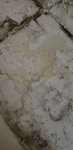
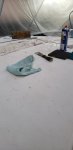
after removing 4 solar panels.jpgremaining sealant.jpg

The deck has a random none skid pattern, and in the right hand photo, you can see the yellow 'ish deck where I've managed to scrape the sealant off.
Would a rotary Face-Off Disk, as sold by Hawke House, on a drill be effective? bearing in mind I don't want to damage the deck.
The boat is 160miles away, so next time I go down I want to be armed with all the stuff I need to clean the deck.
 
One trick I learned from Eric Birch (owned Jaguar Yachts and probably made more grp boats than almost anyone in the UK) is to use a sharp hardwood edge, something around 15-20 degrees, sharper if you like. It will slice the stuff off the grp and do no damage. You've got a problem in the dips in the non-slip pattern though, and I'd suggest that you talk to someone like these people - Chela. I've always meant to try their stuff, but never got round to it.
 
Try rag soaked in white spirits and leave on the sealer for at least an hour ,use as suggested earlier a sharpened wooded scraper pref hardwood and when the sealer has softened scrape off what you can then put white spirit soaked rag on again for another hour and get one of those green Pan scourer that sometimes have sponge on the back , this is usually enough to shift it , I’ve been repairing my aluminium boat windows that have been filled with silicone , I got some 110mm drain pipe filled it with white sprit and soak individual pieces it doesn’t dissolve it but it kind pickles it up a bit like when been in the bath to long then I scraped it and used green pan scouring pad
 
Thanks for all the input, I've order some CT1 Mulitsolve and I have some MEK from RIBSTORE, I have a little bit of Stick2 contact adhesive thinner and cleaner left over from a previous project, although it seems that this product might have been withdrawn. I'll try a combination of these with plenty of old rags, wooden scrapers and a good quality face mask.
From previous experience with CT1 Multisovle, which wasn't that good, you need to keep the solvent on the sealant for awhile, for it to work. This proved to be very difficult on a vertical surface, it just ran off. This time it's a horizontal surface, so I'm hoping it'll be more effective.
 
Update 2/2/22
I gave up thinking of excuses, and started trying to remove the old sealant of a textured deck.
I'm using multi solve, and I've tried various scrapers, green scotch pad and black, course Scotch pads.
Mulit solve doesn't really work, it soften a little but, even after multiple soakings and plenty of time, nothing comes off with a cloth or the Scotch pads.
It's probably not silicone or sikaflex, looks like CT1.
When I Google remove cured CT1, I just get ways to remove silicon. I guess that means no one has come up with a viable method.
The scraper at a very low angle, almost parallel with deck, removes a lot of it, but leaves a smooth surface, with the sealant filling the voids in the non slip pattern.

20220202_150138.jpg
20220202_150215.jpg

Any ideas on how to remove CT1 from the remaining thin film?
And I do mean sepifically CT1, Not silcone, Not sikaflex.
 
Rag soaked in MEK, laid flat then plastic bag sealed over it to prevent evaporation , let the mek soften the sealant to a rubbery less bonded state and then JUDICIOUSLY use pressure and a stiff nylon bristle brush -maybe a brass wire brush , carefully -.

Before that(!) if you are risk averse and have the debris to hand , it might be worth collecting the bits you’ve scraped off , and doing an exact test laying them in a container , MEK or acetone should do something without rotting off the gelcoat though ! But with these things it is often a case of trialling an area and taking a view .
The gelcoat , after all this chemical and abrasive attack, may remain slightly sticky in which case you have removed one problem and created another of course ?
Your call
 
One, er, solution would be to install four solar panels to cover the mess!
If only it was that easy! I spent a lot of time looking for exact replacements. I've bought 2 replacements which will cover most of the area, they are the same width, but not as long, and have a higher output. Solar panels have moved on, since I bought the original 4.
However, in some ways that's just kicking the can down the road. At some point I'm sure I'll want to replace them again, perhaps in a different location.
 
I've bought 2 replacements which will cover most of the area, they are the same width, but not as long, and have a higher output. . .
However, in some ways that's just kicking the can down the road. At some point I'm sure I'll want to replace them again, perhaps in a different location.

How about the two new panels, with a cosmetic panel (wood, GRP, or w.h.y.) in between (or either end).

However, in some ways that's just kicking the can down the road.

Don't knock it: it's how most governments and companies manage things!
 
I have found that if you make an acrylic scraper, take a piece of scrap acrylic, cut an edge at 45 degrees then sharpen - it makes an excellent chisel or scraper to remove Sika or Silicone. But you need a lot of them as the gel coat will blunt them (but the acrylic does not damage the gel coat). If you use an acrylic scraper make the handle of the device comfortable to use. Once you have cleaned of as much as possible then a tough 'nylon' type brillopad offers some help in cleaning the valleys. Speak to your local tool shop they will know what you want (we buy ours from Bunnings) - but you want something coarse and tough.

We have some stuff - I think contains phosphoric acid - its gel like - that removes silicone. Its a bit nasty - you need decent gloves.

Now that I've scripted this I find the thread dates from Jan '22 - I hope the OP has solved his problem and can offer all the answers!

Jonathan
 
Top