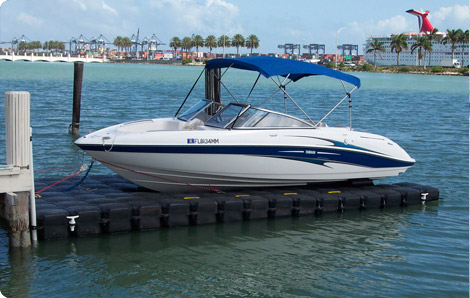
Remember that antifouling idea? A big 'bag' round the yacht.

Is that right? Really? Can the seawater organisms which attack hulls, not tolerate fresh water? I never knew that. :)

This is definately the case as we only lift the boat out once every three years. Each time it comes out, it is as clean as it went in with the exception of a very small amount of green slime around the waterline. I use Cruser Uno which is marketed for salt although the boat spends the majority of it's time in the Crinan Canal.
 
When I visited the Vasa, which is Stockholm's "must see", it was explained that one of the reasons for its very good state of preservation is that the water in the archipelago is brackish and suits neither fresh nor salt water species so there are very few organisms.

So...in the case of a yacht that is used regularly, the 'boat-bag' device would work, even without chemicals?

Or maybe one wouldn't even need to use the boat regularly - a pump, on a timer, could evacuate the brine and pour in a few gallons of fresh - for a week perhaps, then reverse the process? It'd need a bigger tank aboard - but cheaper than present antifouling options.

Is there some very good reason, why these 'boat-bags' aren't visible in every marina, everywhere? :confused:
 
The "antifouling" concentrate was the problem. the "greens" got mighty upset at the thought of the volumes of concentrate being released into rivers and estuaries through this method of antifouling.
Having been involved in antifouling trials slime is no 1 enemy then shell and "grass" .
For a piece of useless info, goose barnacles can attach themselves to a hull at speeds of up to 18knots!!
 
The "antifouling" concentrate was the problem. the "greens" got mighty upset at the thought of the volumes of concentrate being released into rivers and estuaries through this method of antifouling.
Having been involved in antifouling trials slime is no 1 enemy then shell and "grass" .
For a piece of useless info, goose barnacles can attach themselves to a hull at speeds of up to 18knots!!

That's...something I'm sure I'll remember!

I can't say I think the greens were unreasonable, in objecting to quantities of biocidal liquids being deliberately released by members of the public. Who knows how catastrophically it might go wrong? I'm surprised there's no ongoing outcry over existing modes of antifouling.

But...if fresh/salt water do as good a job in the 'boat-bags', that mightn't matter. It would still seem to me to be most obvious choice of boat-owners with sheltered moorings. Surely easier than the annual/biannual cost and nuisance of reapplying antifouling.

So...'slime' is the number one enemy? Interesting. But, presumably slime isn't difficult to jetwash off, if it's done regularly?

If I'm mistaken, don't get mad...I concede I know little or nothing about this. Just seems there's room for alternatives.
 
So...in the case of a yacht that is used regularly, the 'boat-bag' device would work, even without chemicals?

Or maybe one wouldn't even need to use the boat regularly - a pump, on a timer, could evacuate the brine and pour in a few gallons of fresh - for a week perhaps, then reverse the process? It'd need a bigger tank aboard - but cheaper than present antifouling options.

Is there some very good reason, why these 'boat-bags' aren't visible in every marina, everywhere? :confused:

I think you have the bones of a workable idea there. To take it a little further how about:

1. Pump sea water out of bag and into sea. Bag collapses and sticks round hull almost empty.

2. Fill bag with fresh water from hose.

3. Leave it like that when you go home.

4. When you next want to use the boat open / lower the bag and go.

5. On return repeat steps 1 - 3.

For people who use their boats regularly a manual system like that would probably be quite sufficient. Those who seldom use them might need some fancier automatic system of switching back to salt at intervals.
 
I think you have the bones of a workable idea there. To take it a little further how about:

1. Pump sea water out of bag and into sea. Bag collapses and sticks round hull almost empty.

2. Fill bag with fresh water from hose.

3. Leave it like that when you go home.

4. When you next want to use the boat open / lower the bag and go.

5. On return repeat steps 1 - 3.

For people who use their boats regularly a manual system like that would probably be quite sufficient. Those who seldom use them might need some fancier automatic system of switching back to salt at intervals.

Why not simply stop after step 1? Just leave the bag dry and wrapped around the hull.
 
I think you have the bones of a workable idea there. To take it a little further how about:

1. Pump sea water out of bag and into sea. Bag collapses and sticks round hull almost empty.

2. Fill bag with fresh water from hose.

3. Leave it like that when you go home.

4. When you next want to use the boat open / lower the bag and go.

5. On return repeat steps 1 - 3.

For people who use their boats regularly a manual system like that would probably be quite sufficient. Those who seldom use them might need some fancier automatic system of switching back to salt at intervals.

That's exactly what I was thinking.

Amazing to me, that a system which is far from new, has neither been tried and dismissed as useless, nor recognised and adopted for its apparently simple, green, cost-saving advantages. Why wouldn't a boat-bag be better than the pricey annual haul-out & respray?

(I know it wouldn't suit long-distance cruisers, unless they make regular stops. But I'm sure the many marinas, full of thousands of boats around the UK, could save owners lots of labour & costs, and prevent hundreds of tonnes of toxin-release, if they "bagged-up".)
 
Why not simply stop after step 1? Just leave the bag dry and wrapped around the hull.

Because the bag wouldn't be dry inside, it would be wet with pockets of residual sea water in it. It might suffocate the nasties eventually - I've no idea how long - whereas fresh water would kill them quickly.
 
I s'pose I'm asking every boat-owner who reads this, and who leaves their vessel in the same place for most of each year, WHY they prefer the expenditure and effort of reapplying their antifouling periodically, when they might as easily have parked in a No-Grow zone?
 
The use of 'bags' is quite common in Brazil. They use a polystyrene collar around the waterline to stop them dropping off.
As the sea water temperature was high enough to make coffee, I can't imagine how else you would keep growth at bay.
 
Because the bag wouldn't be dry inside, it would be wet with pockets of residual sea water in it. It might suffocate the nasties eventually - I've no idea how long - whereas fresh water would kill them quickly.

If the bag were made of opaque fabric then it'd be dark. As most of the growth on my hull is near the waterline, on the sunny side of the hull, I assume that the darkness would inhibit the growth too. Sounds like an interesting idea to me. You'd need to find a way of quickly fitting/removing the bag.
 
Wouldn't this sort of thing be better, but with a slot for the keel?

boat-main.jpg

Saw lots of a similar sort of arrangement (but rather more elaborate) in Bangor marina a few years ago.
 
I have seen another system for ribs where instead of a actual floating pontoon they drive the rib into a frame that is on sponsons that are then filled full of water to raise boat ..

Something like this.

I wonder if you could do similar for your sailing boat, obviously the keel and rudder would still be in the water. They could be antifoulded and would not take to much to scrub off each time...

Even with fairly deep keel it would me max 2m to scrub and for most only a meter...

Just an idea :o
 
August 17th 2018

After six years and hundreds of threads about antifouling, I'm surprised never yet to have seen the boat-bag solution, in marinas.

I didn't get the feeling back then, that anyone had a serious reason why this option wouldn't be an improvement on the cost and hassle of antifouling as we know it.

The real boon seemed to be the fact that it didn't need many - if any - toxins to aquatic life, in the bag - just ordinary fresh water.

Are yachtsmen - even new ones, who haven't yet grown accustomed to (and perversely proud of) the burdens of boat-ownership - really unwilling to give it a try?
 
I expect that would depend on the fuel-efficiency you expected whilst underway in the bag. :)

Isn't the potential avoidance of antifouling, worth serious consideration? I don't know - my boat lives ashore under a cover.
 
After six years and hundreds of threads about antifouling, I'm surprised never yet to have seen the boat-bag solution, in marinas.

A complicated, expensive system that doesn't protect you when you are away sailing or cruising and prevents other boats from using your berth while away, all to save couple of hundred quid per year for antifouling or a scrub down of coppercoat? What could possibly be unattractive about that?
 
Isn't that an exaggerated response, JD? Antifouling seems to be a significant, predictable headache for most folk - judging by forum input. And the boat-bag doesn't seem complicated - quite the reverse.

Is it really "a couple of hundred quid", to have a 30ft sloop hauled out, and the old a/f removed by means in keeping with environmental laws, and the new paint applied?

Do most owners go far enough, for long enough in the average season, to need antifouling that poisons the hull's vicinity continuously?

Cost could account for slow uptake, I agree - I haven't seen any indication of the cost - did you? If I had a boat afloat, I'd have attempted a DIY version by now. How hard can it be?
 
Not sure whether I dreamed this, now. I've certainly never seen it in marinas, so possibly it was a 'clever' idea of my own, or somebody equally impractical...:rolleyes:

In effect, it consisted of a big plastic sack: long, wide and deep enough to park your boat in. The 'sack' was prevented from sinking by an inflatable rim.

Somehow, the sack could be zipped and unzipped to allow the yacht's entry/exit, but once sealed, a few drips of antifouling added inside the 'chamber' could eliminate organisms therein, preventing any growth on the hull.

Seemed like a pretty efficient way to concentrate antifouling on the body of water around the hull, rather than blitzing everything that the hull encounters on a mooring...

...then again, I haven't seen/heard of its use for fifteen years. Was it a daydream? :rolleyes:

University of Bangor did a project at Holyhead with something similar, it was to address seasquirts or whatever the invasive species was called. Im sure they bagged the boat then dumped bleach or something in it. It wasnt very successful, the last I saw of it 5 years ago, it looked like one of those trailer trash park swimmimg pools lying half deflated, gently decomposing in the berth!
 
Top