Remember PBOStar?

neil_s

Well-Known Member
Joined
28 Oct 2002
Messages
1,731
Location
Chichester
Visit site
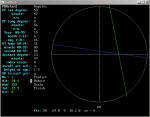
I have been messing about with an old Ebbco sextant. I still make lots of mistakes with sun-sights but I seem to be getting the idea of meridian altitude and sun-run-sun. Thinking about star sights, I remembered PBOStar - a star sight reduction program published in PBO back in February 1996. The program was written by Philip Corridan for Quick basic, which used to come free with Windows. PBO published the listing for those with the patience to type it in themselves - which I did, being on night shift at the time! The floppy disc has been lost since - but, retired now, I have typed it in again. Qbasic is no longer provided with Windows, but I found QB64 for modern machines, so PBOStar lives again (It needed a bit of updating). PBOStar, notwithstanding its barely VGA graphics, is well featured. It predicts the stars you can see from your EP, giving you azimuth and altitude, allows you to observe and reduce 7 stars, gives you a graphical representation of the position lines, a fix, and a measure of its accuracy. The problem is with the graphics. The program should construct a circle around your EP, show you the intercepts and the LOP's and their intersection at the fix. Indeed, it did so when I compiled it on the Win 3.1 machine some time ago. Annoyingly, the QB64/modern computer set-up plots this circle as an elipse and distorts the picture. Although I can turn my hand to a bit of simple programming, I can't fix this! Can you help?
fix.png
 
I guess that's due to the aspect ratio of the display. they used to be 4:3 but your screenshot looks wider than that. 16:9 is a common ratio now.
Sorry I don't know how to fix it but I'm sure it is a widely encountered problem so a solution must exist out there somewhere.
 
Nice bit of retro computing :)

As cpedw pointed out, the problem is the aspect ratio expectations of the ancient software don't match. Maybe QB64 has a feature to correct for this?

Alternatively, you can use DOSBox to run the original QBasic version and then configure DOSBox with a virtual display of the right aspect ratio. It's a DOS PC emulator specifically designed to run ancient software in and has lots of features to deal with issues such as yours. You'll have to edit some config files for that.

Or you can just use OpenCPN's celestial navigation plugin instead: https://opencpn.org/OpenCPN/plugins/celestialnav.html
 
I have been messing about with an old Ebbco sextant. I still make lots of mistakes with sun-sights but I seem to be getting the idea of meridian altitude and sun-run-sun. Thinking about star sights, I remembered PBOStar - a star sight reduction program published in PBO back in February 1996. The program was written by Philip Corridan for Quick basic, which used to come free with Windows. PBO published the listing for those with the patience to type it in themselves - which I did, being on night shift at the time! The floppy disc has been lost since - but, retired now, I have typed it in again. Qbasic is no longer provided with Windows, but I found QB64 for modern machines, so PBOStar lives again (It needed a bit of updating). PBOStar, notwithstanding its barely VGA graphics, is well featured. It predicts the stars you can see from your EP, giving you azimuth and altitude, allows you to observe and reduce 7 stars, gives you a graphical representation of the position lines, a fix, and a measure of its accuracy. The problem is with the graphics. The program should construct a circle around your EP, show you the intercepts and the LOP's and their intersection at the fix. Indeed, it did so when I compiled it on the Win 3.1 machine some time ago. Annoyingly, the QB64/modern computer set-up plots this circle as an elipse and distorts the picture. Although I can turn my hand to a bit of simple programming, I can't fix this! Can you help?
View attachment 79078

Nice work - but I can see a Y2K problem. It only allows two digit years between 0 and 99. Which century does it assume??
 
I've got an Ebbco sextant too and I most certainly want to try my hand at navigating by using celestial sights. (I note you can still download a QBasic compiler)

You might like to check these sites out if you haven't done so already

https://www.youtube.com/watch?v=AYnhesJKzaU
https://www.youtube.com/watch?v=NyFuVl8zk2k
http://www2.arnes.si/~gljsentvid10/sightred.htm
https://www.celnav.de/sightred.htm
http://www.ybw.com/forums/archive/index.php/t-426552.html

Thankyou - I will check out those sites this evening. I got started with Andrew Evans' Sextant user guide. He does sun sights in the simplest way possible! You can find his book on backbearing.com with the nautical almanac and sight reduction tables included.
 
Thankyou for the DOSBox tip! I think QB64 is a C++ translator or converter so it might still be too 'modern'. I am using VMH and Seaclear on my laptop for charting at the moment, but OpenCPN is lurking in the background, only with tidal atlases so far.
 
Nice work - but I can see a Y2K problem. It only allows two digit years between 0 and 99. Which century does it assume??

PBOStar calculated GHA Aries using stored annual constants that ran out in 2010. I have incorporated an algorithm published by Keith Burnett in 2002 that doesn't need the stored constants and is claimed to retain reasonable accuracy until 2099, although I have only checked it up to 2025 - the limit of the published Nautical almanacs. So I have assumed validity for 21st century with the proviso that occasional checks against paper an pencil are made. Checking the accuracy of the stored SHA star data would also be a good idea.
 
Thank you Yngmar - I have QBasic1.1 already. It starts under Win 7, but will not run the program - I get a 'cannot run in full screen mode' message. Before downloading DOSBox, I have been trying to fix PBOStar so it will not infringe Win 7's sensibilities!
 
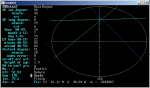
Fixed it! On forcing myself to look at the graphics statements in the program I discovered that the display output was 640 x 350 pixels. Investigating the graphics options in QB64 I found a SCREEN command for 640 x 480. Substituting this into the program and presto! my ellipse became a circle! I had to edit the graphics statements to move the origin and factor the y axis calculations. This has got to be terrible programming - what will happen when I get a wide screen monitor? It works for now, though - thank you all for your helpful suggestions!
fix2.png
 
The program was written by Philip Corridan for Quick basic, which used to come free with Windows. PBO published the listing for those with the patience to type it in themselves - which I did, being on night shift at the time!
Does the magazine state any license under which the code is published?

I would be interested to take a look at it, and perhaps a helpful thing would be to put it on GitHub, with and without your patches, to save anyone else having to retype it.
 
Last edited:
I cut the articles from my copies of the magazine - so I don't know. It seems to me, though, that PBO published these articles and so they have copyright on them. You could get the articles from PBO's copy shop - that way, you'd get the original listing and the very informative text that goes with it. The articles were published in PBO, 1996, February edition pages 46 to 50, and March edition pages 51 and 52, under the title 'Star sights by computer'. If you PM'ed me your e-mail, I could send you my edits.
 
Top