Reefing

Re. use of engine, some people feel more confident in holding the boat head to wind under engine while reefing, some boats are happy to lie to just the headsail.

We roll away some headsail (generally to working jib size or a bit less) then sail the boat hard on the wind on the reduced headsail and ease the main to depower it while reefing. Better motion, takes seconds to set up. (Not sure if this is what you meant by lying to the headsail Snowy)

- W
 
We roll away some headsail (generally to working jib size or a bit less) then sail the boat hard on the wind on the reduced headsail and ease the main to depower it while reefing. Better motion, takes seconds to set up. (Not sure if this is what you meant by lying to the headsail Snowy)

- W

Our enormous genoa won't sail anything like close to the wind when furled at all, so, upwind in a blow, we find it better to do away with it completely. We carry a smaller jib that hanks onto a baby-stay but we've never used it.

When we have to go to windward in anything more than 15 kt of wind (which seems like any time we go out with the intention of getting anywhere specific), we tend to reef the main, sheet it in tight and motor-sail.

I've never managed to reef or move the main up or down the track at all without being head to wind, which means either motoring or anchoring.
 
I've never managed to reef or move the main up or down the track at all without being head to wind, which means either motoring or anchoring.

That's not right - you should be able to depower the main enough to reef in any boat. Just ease the boom out until the sail is depowered. If you can't sail close to the wind on the genoa then get as close as you can and let the boom out further. Another option might be to heave to.

You need to be able to reef without an engine as sods law dictates that the engine will only stop in a flat calm or a big blow :eek:

- W
 
Do you find you need to take it round the mast as well as the boom to take the outhaul tension of the reefing pennant? A horn holds it forward as well as down.

If you are replacing the ramshorn with a line, it will indeed need to pull forwards as well as down.
You can achieve this by running it through some sort of fairlead (an eye nut on an existing bolt perhaps) or running it through the sail and back to the gooseneck.

Another hint for getting reefs in quickly is to be able to drop the halyard the right amount repeatably. Marking the halyards helps.
 
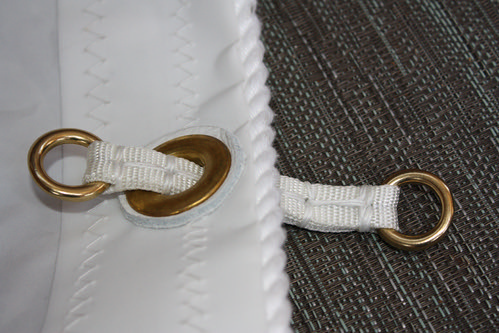
They're known as spectacles.

You have a ring either side of the luff cringle which are each too big to slip through the cringle. They're then stitched together with strong tape.

You put the most convenient on the ramshorn and the other is held tight against the cringle.

It's a minor job for a sailmaker to add them to your sail.

A picture is worth a thousand words:
4576150282_223cdbdeb5.jpg


....however in this example I think the tape is too long as it will not pull the tack low enough. This would mean that pulling in the reef will tension the foot from a point above the horns and pull the tack cringle away from the mast.
 
A picture is worth a thousand words:
4576150282_223cdbdeb5.jpg


....however in this example I think the tape is too long as it will not pull the tack low enough. This would mean that pulling in the reef will tension the foot from a point above the horns and pull the tack cringle away from the mast.

Thanks.

I think you're right about the length. Ideally they shouldn't slide too far from side to side through the cringle.
 
I currently use a lanyard to tie down the tack as I don't have a goosenenck and consequently no horns. I find it less hassle than horns as I used to have to hold the cringle onto the horn while taking up the luff tension with the other hand.

That's what I do, except I do have a gooseneck. I took the horns off it. The pivot of the gooseneck is simply an eyebolt to which the tack is shackled. When passing the reefing line it goes through the eye of the eyebolt and that prevents the sail pulling aft.

Also it's easy to put a reef or two in before hoisting the sail if still on a mooring with the wind aft.
 
As people have said, it's a matter of repeated practice. Reefing is a normal part of sailing and should be executed without apprehension, even in the dark. I can reef mine by myself in a couple of minutes without leaving the cockpit but those with older rigs or larger boats won't be as lucky and need to be absolutely sure what they are doing.

It is years since I have felt the need to take in a reef before leaving harbour "just in case it blows up", though the old days of roller-reefing weren't much fun. This is a recipe for slow passages.
 
Couple of minutes? My first reef comes down in 20 seconds :D

(Second one takes a little longer as I have to ease the peak halyard as well as the throat.)

Pete

Golly, that's quick.

Reefing takes me ages:

1. Find length of line to lash down the reef cringle

2. Find the handle for the halyard winch (last used for killing mackerel or cracking nuts).

3. Find safety harness and safety line

4. Make my way up to the mast

5. Come back again to collect the length of line and the winch handle

6. Return to mast

7. Let halyard go.

8. Return to cockpit to administer first aid to swmbo who is bleeding after having boom dropped on her head because I forget to set up topping lift

9. Exchange a few pointed words with aforementioned angry lady

10. Return to mast

Yes reefing is a slow business. :(
 
I reef (3/4 length battens) whilst actively sailing under headsail (all lines back to cockpit), I find shaking out the reef harder work though!!

I also drop the main whilst sailing down wind under headsail with the main sheeted iin cos I find it easier to fold the main like that .. but don't tell anyone ;-)
 
A picture is worth a thousand words:
4576150282_223cdbdeb5.jpg


....however in this example I think the tape is too long as it will not pull the tack low enough. This would mean that pulling in the reef will tension the foot from a point above the horns and pull the tack cringle away from the mast.

That's it. To make reelfng even easier, add another tape to each ring to give you something to grab onto.

To make it even easier still, remove the horns and replace them with a couple of snap hooks attached to the gooseneck with a short piece of Dyneema. Then there is no chance of the Spectacle slipping off the horn before you tighten the halyard.

My sequence for reefing was tack, head, clew.
 
Many yachting articles seem to start by saying they put the engine on when the wind got too strong then continue with a long list of mishaps that followed.

There's little that builds confidence more than reefing down to the right level in a gale and feeling the boat snugged down, sailing powerfully and with a much kinder motion.

I can never understand people who want the engine on to reef. Practicing is the key to being under control if you ever find yourself with an engine that isn't doing the job.

One recent tip that made my reefing far far easier is a bit of bungee cord tied to the front of the mast at gooseneck level. My routine used to get to the stage of hooking the cringle on, getting back to the winch to take up the slack, notice the cringle had fallen off the hook, cry, hook it back on again, go back to the cockpit to take up the slack, notice the cringle had fallen off again.....

Now when I hook the cringle I slip the tensioned bungee cord hook on after it, rehoist the main at my leisure
 
RupertW - precisely why it is a good reason to remove the hooks and replace them with snap hooks as in my previous post.

Another advantage of removing the hooks is that you won't accidentally trap the luff of the main in the hook, then grind the halyard up (when shaking out a reef) without noticing you are ripping the luff tape out of the sail. Ask me how I know.
 
Golly, that's quick.

Reefing takes me ages:

1. Find length of line to lash down the reef cringle

2. Find the handle for the halyard winch (last used for killing mackerel or cracking nuts).

3. Find safety harness and safety line

4. Make my way up to the mast

5. Come back again to collect the length of line and the winch handle

6. Return to mast

7. Let halyard go.

8. Return to cockpit to administer first aid to swmbo who is bleeding after having boom dropped on her head because I forget to set up topping lift

9. Exchange a few pointed words with aforementioned angry lady

10. Return to mast

Yes reefing is a slow business. :(

Oh yes! That's the way it often goes with us too!
 
I dunno! I just make it up as I go along...

Actually I don't. First I let the mainsheet out to depower the sail, heading sufficiently to windward under headsail if I need to and to keep the boat sailing. Then I ease the halyard from the cockpit a bit, then go forward to pull the reef-cringle over the rams-horn, then back to the cockpit to re-tension the halyard. Once this is done, I go forward again with the winch-handle to tension the reefing line using the winch under the gooseneck. Finally I re-trim the mainsheet. That's it! Sheet-halyard-tack-halyard-reefing-line-sheet. Repeat if you need to pull in a second reef, and reverse when you wish to shake out a reef.

The engine certainly doesn't need to go on. And, on my boat, the topping-lift doesn't need to be tensioned first, which is useful because it would involve an additional trip to the mast before easing the mainsheet from the cockpit.

Isn't it a great feeling when the power comes back on from the reefed mains'l and you're no longer heeling excessively?
 
If you are replacing the ramshorn with a line, it will indeed need to pull forwards as well as down.
You can achieve this by running it through some sort of fairlead (an eye nut on an existing bolt perhaps) or running it through the sail and back to the gooseneck.

My reef lanyards are permanently attached to the same shackle on the mast that the tack is fixed to.
 
Golly, that's quick.

Reefing takes me ages:

1. Find length of line to lash down the reef cringle

2. Find the handle for the halyard winch (last used for killing mackerel or cracking nuts).

3. Find safety harness and safety line

4. Make my way up to the mast

5. Come back again to collect the length of line and the winch handle

6. Return to mast

7. Let halyard go.

8. Return to cockpit to administer first aid to swmbo who is bleeding after having boom dropped on her head because I forget to set up topping lift

9. Exchange a few pointed words with aforementioned angry lady

10. Return to mast

Yes reefing is a slow business. :(

  1. Topping lift on
  2. Sheet out
  3. Throat halyard down
  4. Tack pendant in
  5. Halyard back up
  6. Clew pendant in
  7. Topping lift off
  8. Sheet in

No winches needed for any of this, the halyards have tackles instead.

And while I usually put the tillerpilot on, I can if necessary steer with my bum while doing it :D

Pete
 
Whilst sailing close reaching to put a reef in, you can depower the main considerably by releasing the kicker (or vang as it is also known). Allows the boom to lift, flappy boom = easy to reef main.

Hope this helps.
 
Whilst sailing close reaching to put a reef in, you can depower the main considerably by releasing the kicker (or vang as it is also known). Allows the boom to lift, flappy boom = easy to reef main.

Hope this helps.

You need to ease it anyway if it was doing anything much to start with.
 
Top